The editorial team at FBRK continues to investigate schemes for exporting cattle (bovine animals) through the territory of Kazakhstan. The final part will focus on the geography of a potential scheme that spans several countries.
In the first two parts of the investigation, we showed how Russian internal veterinary certificates can be used for export to countries outside the Eurasian Economic Union (EAEU), how single documents for multiple vehicles impede traceability, how electronic documents are cancelled after the shipment has been dispatched, and how 42-day gaps in dates can indicate backdating. All these elements point to a potential systematic practice. But where exactly are the key points of this possible scheme located? And who is servicing it?
Previously, our editorial team also published a series of investigations into potential schemes in the export of meat products and live animals, as well as about fictitious inspections at markets, the concealment of anthrax outbreaks, and the illegal trade of saiga meat. Furthermore, we reported on how the country's veterinary safety system, controlled by the Ministry of Agriculture, allows the import of potentially unsafe products.
THE TURKESTAN HUB
An attentive reader has likely already noticed that the systematic passage of goods through veterinary control posts in the Turkestan Region involving the same officials can be traced across many of the documents previously presented.
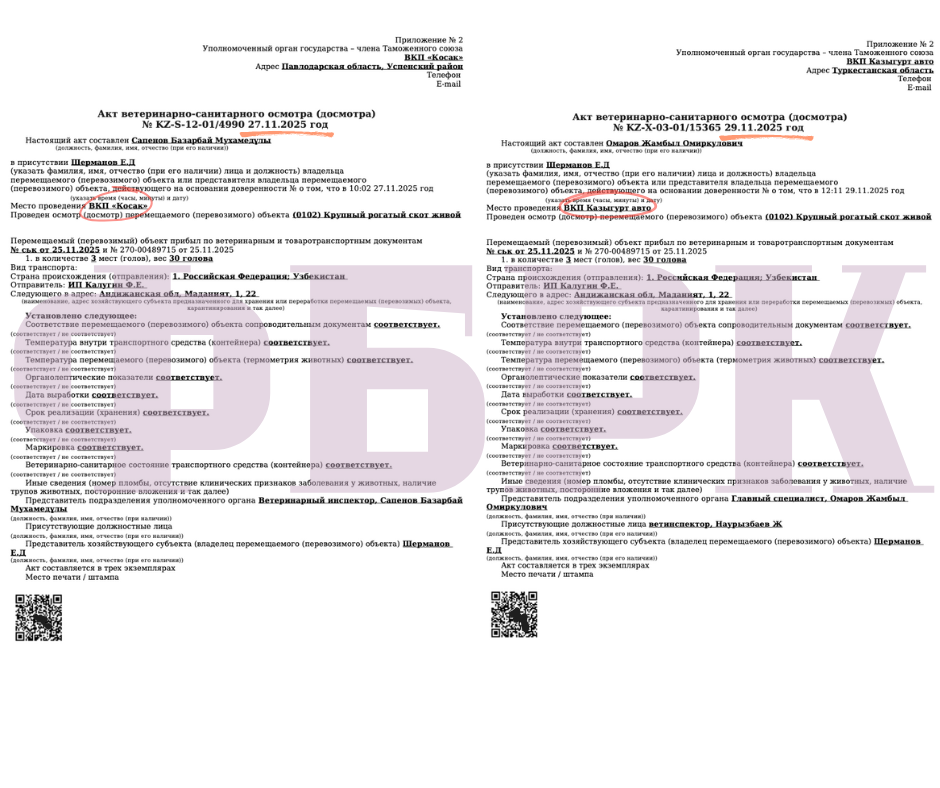
The Kazygurt-Auto Veterinary Control Post (VCP) in the Turkestan Region, for example, appears in the inspection reports accompanying the certificates dated 25 November. The first is accompanied by reports from the Kosak VCP dated 26 November, signed by veterinary inspector Bazarbai Sapenov, and from Kazygurt-Auto dated 29 November, signed by chief specialist Zham byl Omarov.
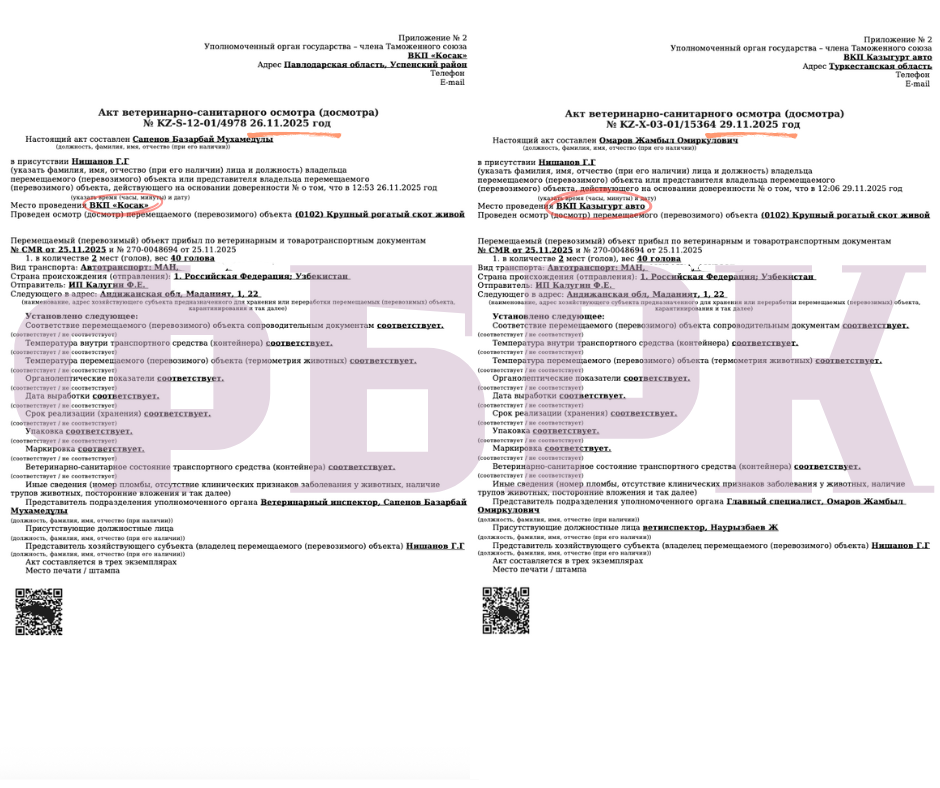
The second is accompanied by reports from the Kosak VCP dated 27 November and Kazygurt-Auto dated 29 November, signed by the same officials.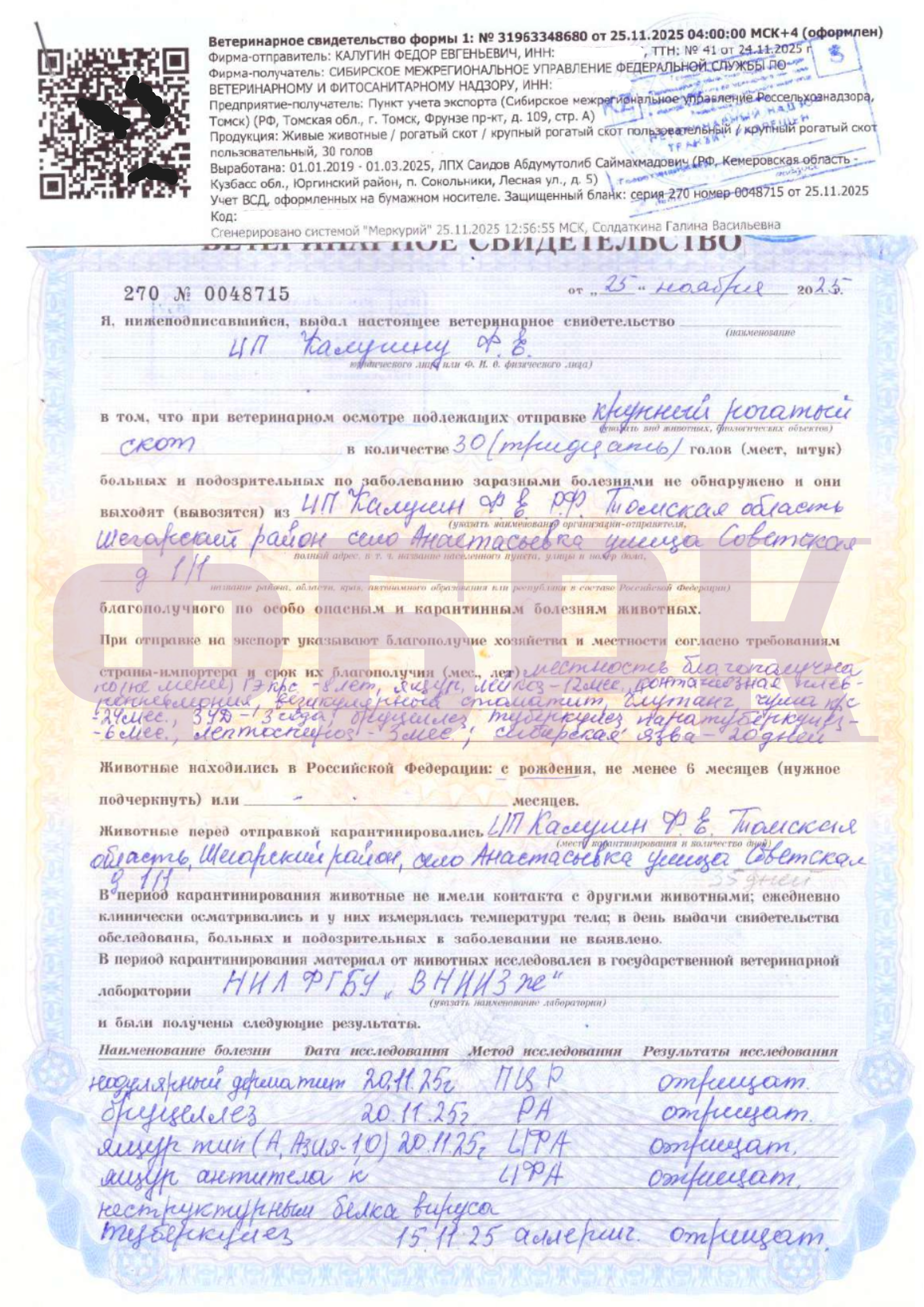
The B.Konysbaev VCP in the Turkestan Region appears even more frequently. For example, an inspection report dated 28 November for a certificate covering 375 head was drawn up by chief specialist Batyr Moldabekov in the presence of veterinary sanitary inspector Mr Sambetov. Meanwhile, a report dated 30 November was signed by chief specialist Erzhan Dospulov.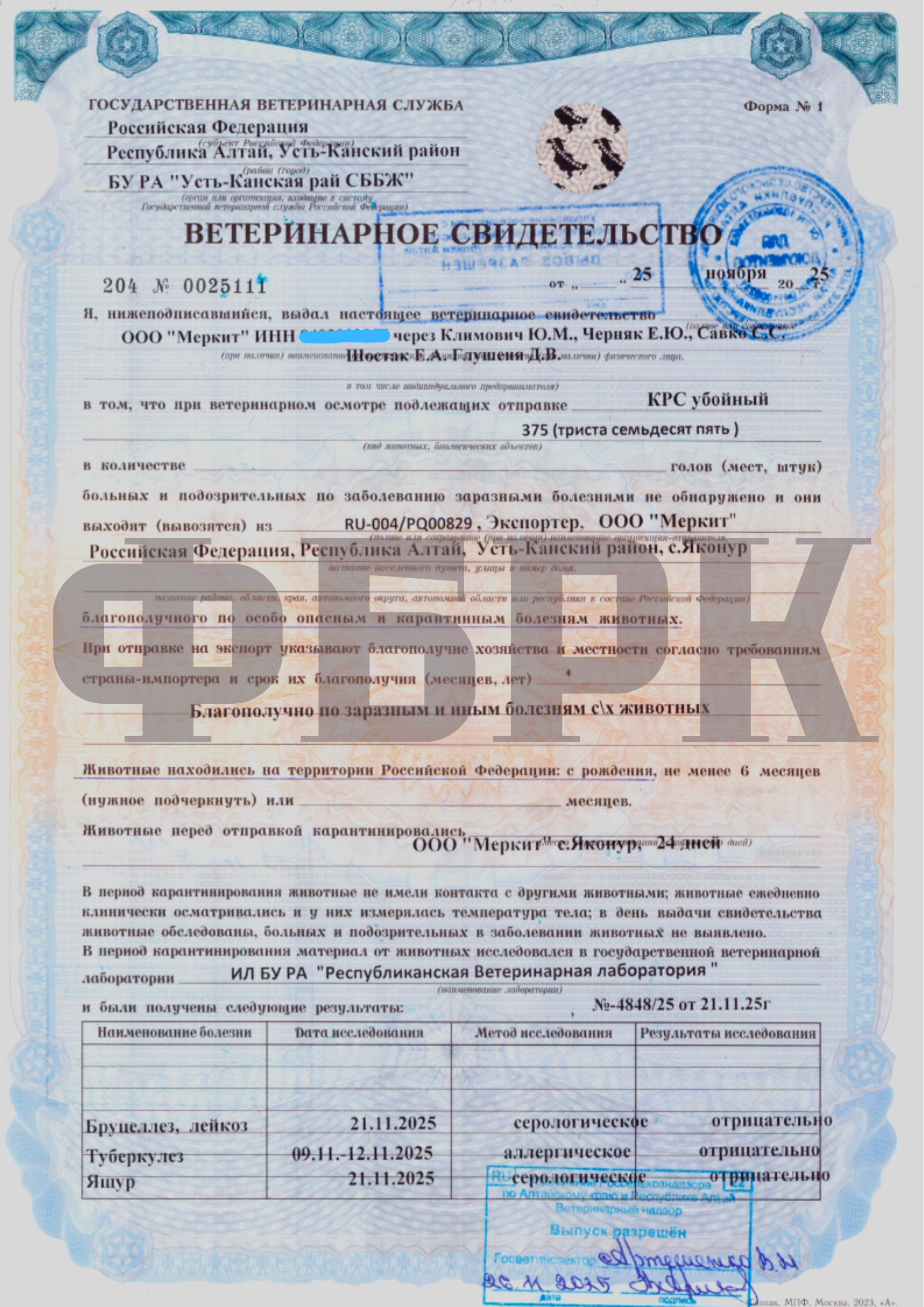
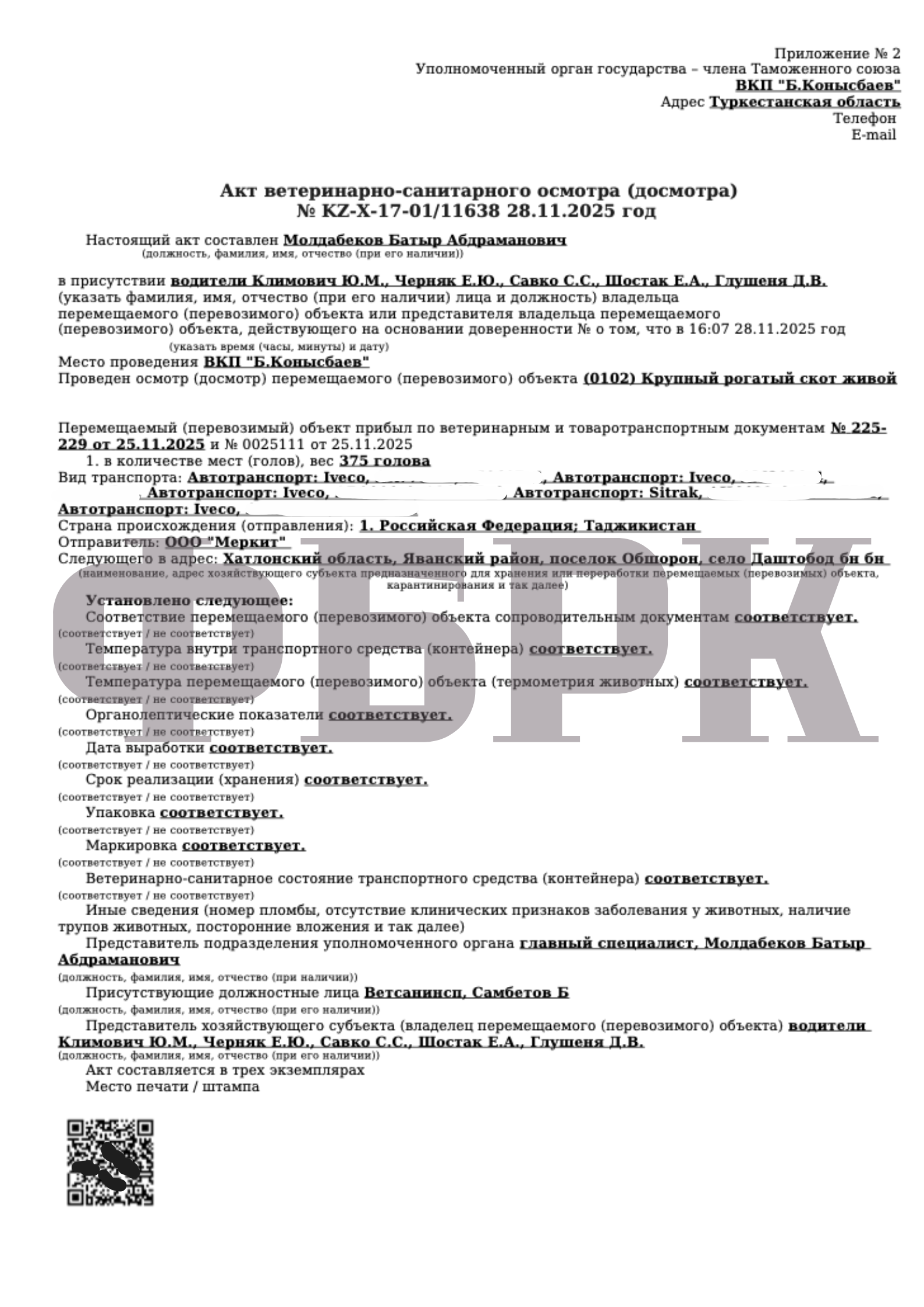
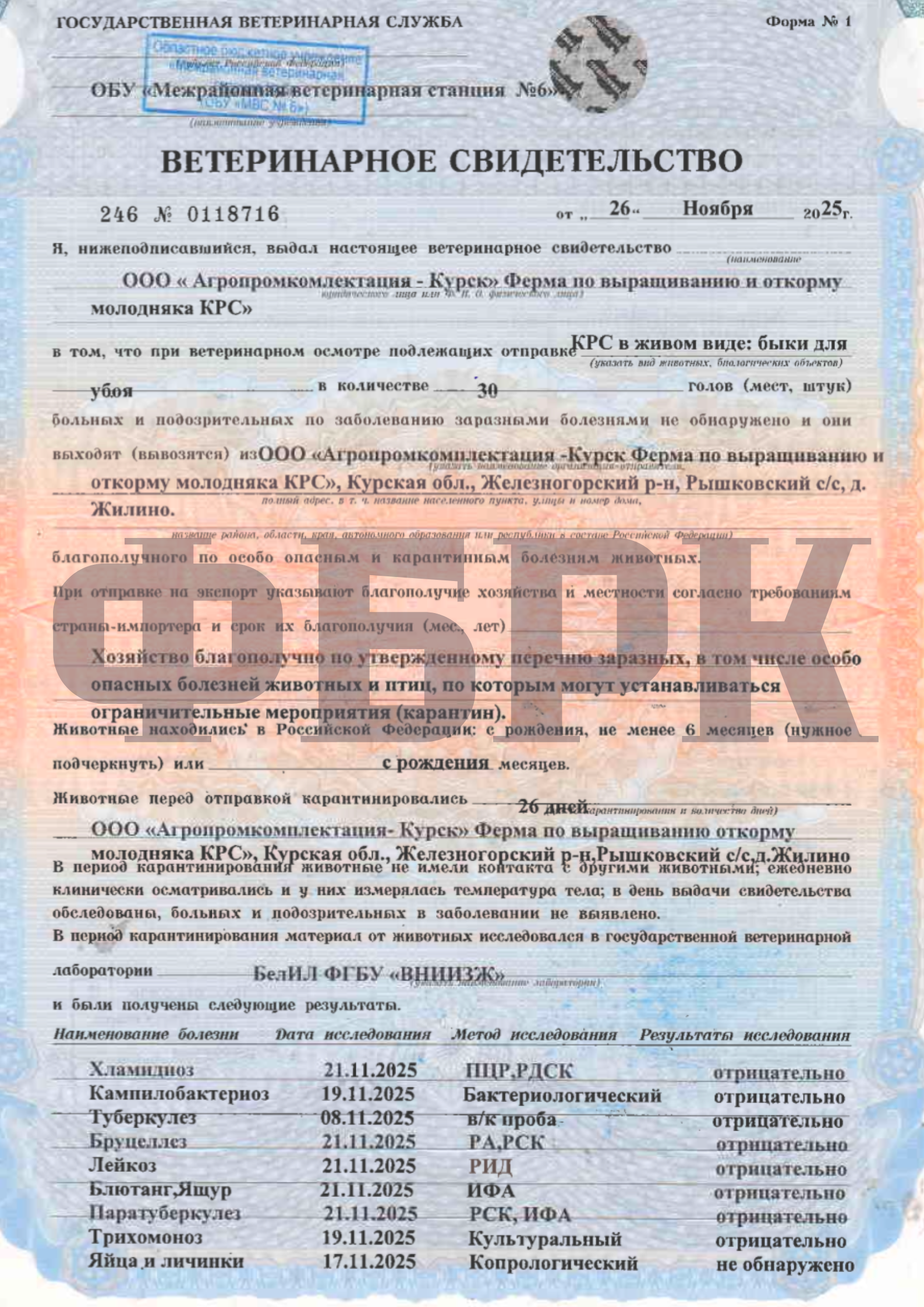
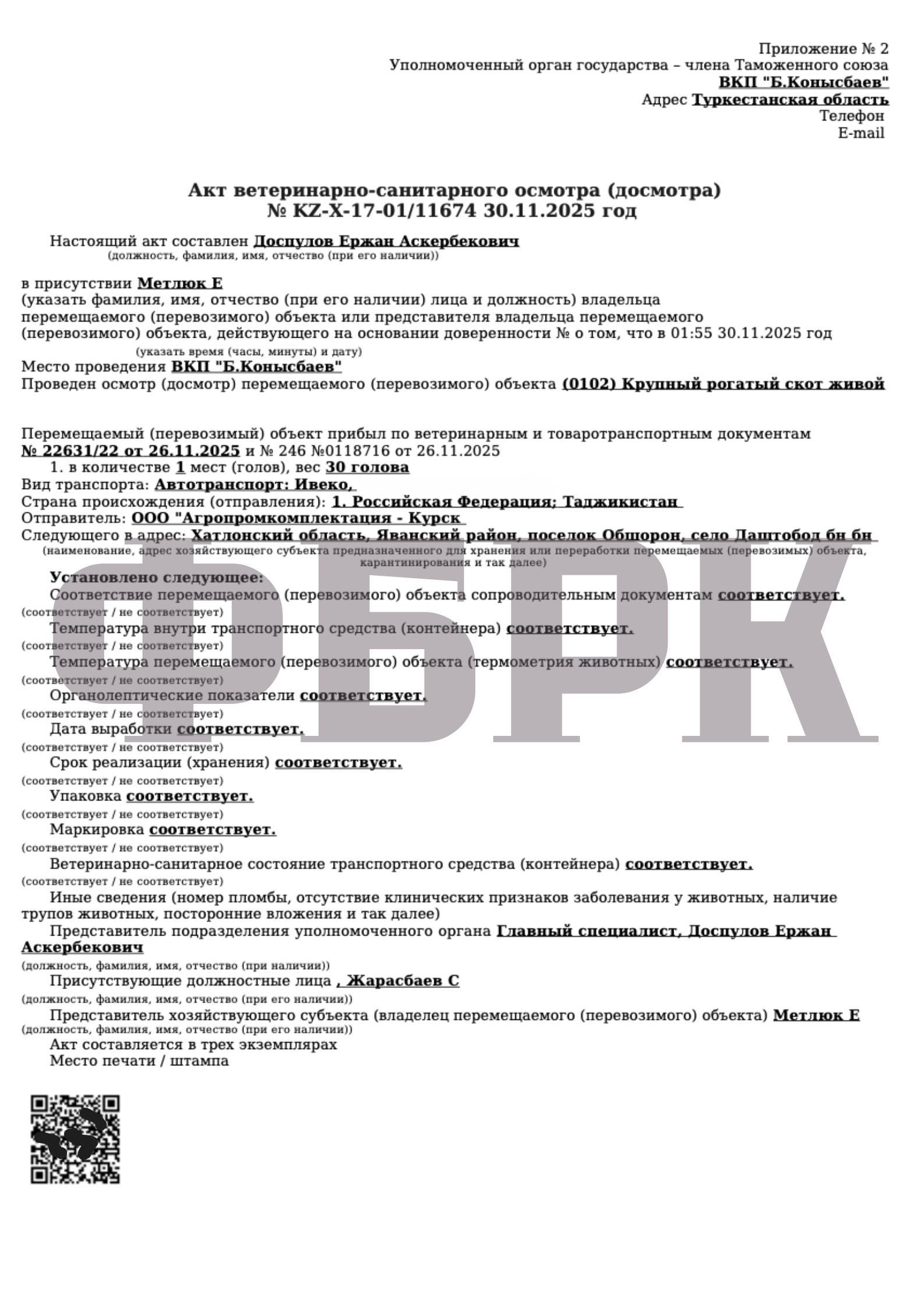 All veterinary-sanitary inspection reports noted the full compliance of the moved object with the accompanying documents, as well as the compliance of temperature, organoleptic indicators, packaging, labelling, and the veterinary-sanitary condition of the vehicles with established requirements. They also indicated the absence of clinical signs of disease in the animals.
It should be noted that the operation of these posts falls under the responsibility of the territorial department of the Veterinary Control and Supervision Committee of the Ministry of Agriculture for the Turkestan Region, which coordinates their activities in accordance with the regulations of the central committee. Such systematic passage of goods through controlled posts inevitably raises doubts about the thoroughness of the regional control being exercised.
THE TRAIL THROUGH BELARUS
Of particular interest are markings related to the Republic of Belarus on documents whose route, according to the primary certificates, should pass through Kazakhstan.
For example, in a veterinary certificate series dated 23 November for 225 head, the consignor is Merkit LLC in the Altai Republic, and the consignee is Marmari LLC in the Khatlon Region of Tajikistan. The route: the village of Yakonur through Kazakhstan to Uzbekistan. Attached to the single veterinary certificate are three separate international CMR consignment notes, each for the transport of 75 head. On all three consignment notes, in section 16, there are stamps with the text "Private Unitary Transport Enterprise", "REPUBLIC OF BELARUS", "BELARUS". On CMR note 220, the name of the organisation "MEGASILA" can be read.

The appearance of Belarusian markings on documents whose route should pass through Kazakhstan to Tajikistan/Uzbekistan may indicate the involvement of vehicles from Belarus in the scheme, which is not reflected in the main veterinary certificate.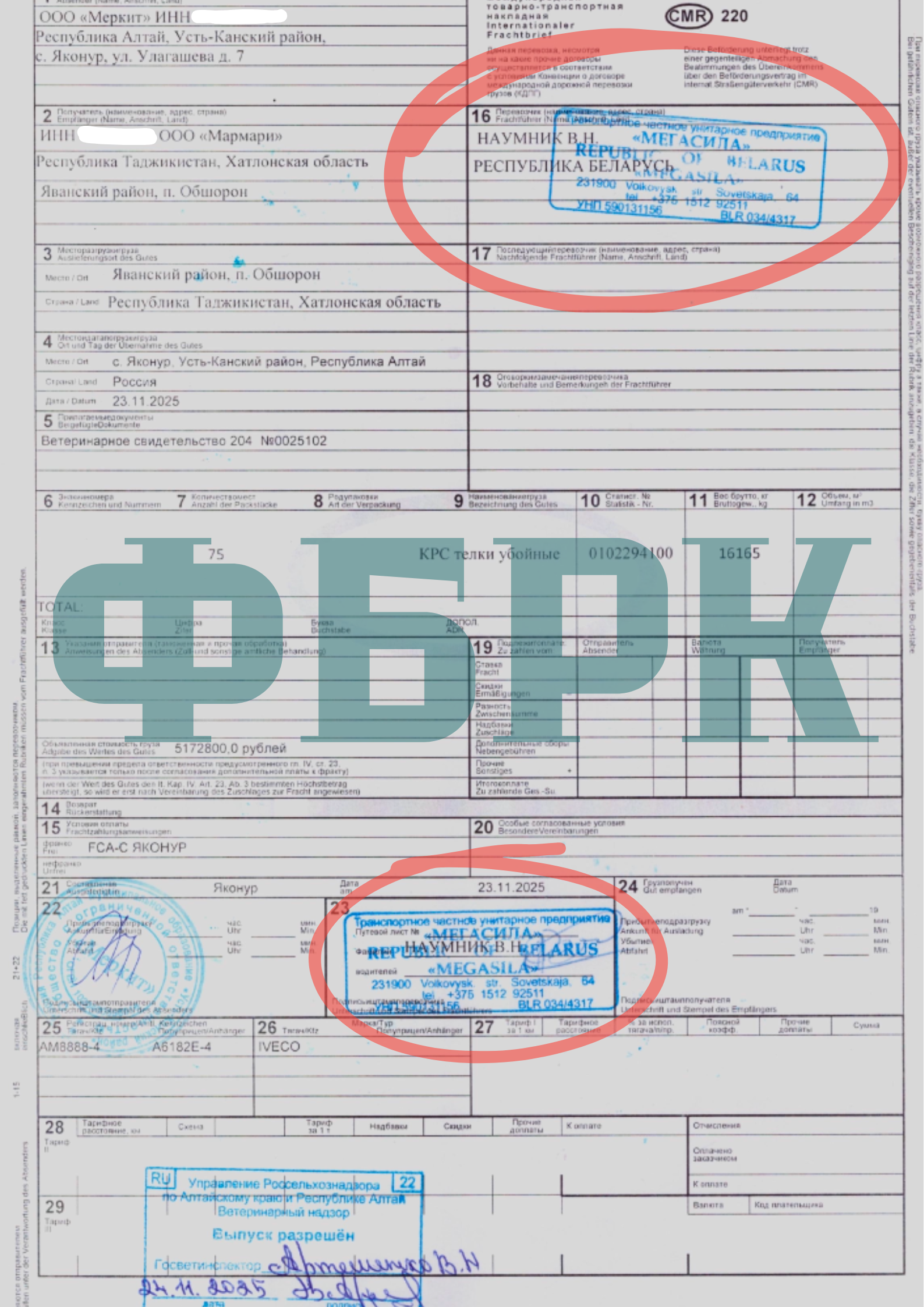
SYSTEMATIC NATURE AND GEOGRAPHY
The recurrence of specific names, organisations, and geographical points may indicate the systematic nature of the described practice.
For instance, veterinary doctors from the Ust-Kan District Animal Disease Control Station regularly issue certificates for large consignments involving multiple vehicles. And Merkit LLC appears as the consignor in most of the cases we are aware of: in certificates for 200, 120, 225, 375, and 400 head. In all these cases, according to the documents, the route passes through Kazakhstan to Uzbekistan or Tajikistan, with the point of departure being the village of Yakonur in the Ust-Kan District of the Altai Republic.
As is known from previous parts of the investigation, veterinary doctor Ms Kryukova processed three certificates dated 26 November for consignments of 30 head each. All three have cancelled eVSDs, all have the same official consignee, and all have a real route, according to the waybills, through Kazakhstan to Tajikistan. The consignor in all cases is Agropromkomplektatsiya-Kursk LLC, branch "Farm for rearing and fattening young cattle" in the village of Zhilino, Zheleznogorsk District.
And state veterinary inspector Mr Shumashinov, on behalf of the Rosselkhoznadzor administration for the Altai Territory and the Altai Republic, repeatedly affixed the "Release Permitted" seals and stamps on documents with the described processing peculiarities. Uzbek consignees are also repeatedly recurring in the certificates for hundreds of transported head.
All animals are identified with electronic tags bearing the prefix RU1, which corresponds to the Russian identification system. However, according to a source, this does not preclude the possibility of legalising livestock of unclear origin through the processing of Russian certificates followed by transit through the territory of the Russian Federation.
CONCLUSION: HOW THE SCHEME COULD WORK
What do we have? The mechanisms of the scheme include the use of single documents for multiple vehicles, the cancellation of electronic accompanying documents after dispatch, chronological inconsistencies, and the systematic passage through the same veterinary posts.
Based on the nature of the documents, there may be intermediaries between the consignors and the veterinary services—individuals who coordinate the processing of the necessary paperwork, ensure goods pass through specific posts, and organise transshipments along the route. The recurrence of the same consignors, consignees, veterinary doctors, and border posts may indicate the existence of stable connections between the participants in the potential scheme.
A key element of this practice is the veterinary posts at the border, where the main inspection should take place. The task of border control is to compare documents with data in the 'Mercury' system, check for the presence of international veterinary certificates for export, verify the legality of transit, check the vehicles and drivers, and confirm the validity of the documents. However, the systematic passage of goods with the described peculiarities may indicate that these checks are either not being carried out properly, or their results do not affect the decision to allow passage.
Allowing vehicles through on cancelled electronic documents, failing to react to the absence of international certificates, ignoring discrepancies in dates—all this can only happen systematically under certain conditions. A single case could be a mistake. Regular practice requires, at a minimum, a lack of proper oversight.
Territorial departments of veterinary services in the regions are obliged to control the work of subordinate posts, conduct inspections, monitor anomalies in document flow, track cancelled electronic documents, check transit routes, identify unusual transshipments, and analyse export statistics. The systematic passage of large consignments with the described peculiarities through the same posts in the Turkestan Region may raise questions about the quality of such supervision.
At the republican level, responsibility for the functioning of the veterinary control system lies with the Veterinary Control and Supervision Committee of the Ministry of Agriculture. The Minister of Agriculture, Aidarbek Saparov, as the head of the department, is responsible for the work of the entire subordinate structure, including the veterinary control system at the borders. In turn, the scale of the potential practice, the breadth of its geography, and the regularity with which such goods pass through inevitably raise questions about the adequacy of systemic control measures, and also about whether this situation was promptly noticed and properly assessed at the ministerial level.
An important role in the overall picture is also played by the Ministry of Trade and Integration, headed by Arman Shakkaliyev, as the department oversees matters of cross-border trade and goods transit. Coordination between veterinary and customs control is critically important for preventing illegal schemes. The systematic passage of goods with questionable documentation may indicate gaps in interagency cooperation.
Incidentally, according to our sources, it was Mr Shakkaliyev who initiated the temporary restrictions on the export of bull calves and cattle in May, while the Ministry of Agriculture supposedly sided with farmers on this issue, and the Ministry of Trade insisted on the ban. We are not asserting anything, but such schemes themselves allow certain conclusions to be drawn.
The geography of the potential scheme covers the Altai Republic, Kursk Oblast, the Kabardino-Balkar Republic, the Altai Territory, and Orenburg Oblast in Russia; the Abai Region and the Turkestan Region in Kazakhstan; the Andijan and Bukhara regions in Uzbekistan; and the Khatlon Region in Tajikistan. The recurrence of officials, consignors, routes, and processing methods points not to isolated incidents, but to a potential well-established practice in which veterinary control may be transforming from a barrier into a mechanism that facilitates the movement of livestock of unclear origin.
In the end, a picture emerges in which the oversight mechanisms designed to ensure the transparency and legality of goods movement may not simply be ineffective, but potentially embedded within the scheme for their unimpeded transit. When such routes become the norm, rather than the exception, the question is no longer one of oversight failure, but rather who and at what level ensured the sustainability of this practice. And something tells us that the answer to that extends far beyond individual veterinary posts.