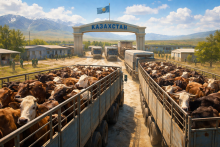
The anonymous bot of the FBRK has once again received a report about potential violations in the area of meat product exports and live livestock. This time, the documents obtained demonstrate repeated discrepancies between the declared and actually transferred number of animals exported from Kazakhstan, meaning a possible scheme is taking on new forms.
Not so long ago, the FBRK editorial team raised the issue of violations in the meat product export sector. At that time, we obtained documents concerning the export of livestock that was formally in transit from Russia through Kazakhstan to Uzbekistan.
An analysis of that documentation suggested that, under the guise of Russian transit cargo, Kazakhstani animals were actually being exported without the necessary permits. A characteristic detail was the absence of records regarding the departure of vehicles from Russia — the trucks would appear already on the Kazakh side of the border, which could indicate the formation of the load inside Kazakhstan with subsequent legalisation through 'transit' documents.
After the publication of the article, new messages were received in the editorial bot — this time with a different set of documents concerning the direct export of Kazakhstani livestock to Uzbekistan and Tajikistan.
What the documents show
All the documents provided to us, the veterinary certificates, contain the required stamps and are dated 2025. Each certificate states the total number of exported animals, often between 60 and 250 head. However, when compared with the attached lists of transported animals with individual identification numbers, significant discrepancies are found.
For example, in a veterinary certificate issued to the farm (FH) 'Kenesbek', the number of animals is stated as 170 head. The attached table, however, lists only 4 animals with individual numbers. In another certificate for the same company, 150 head is stated, while the list again contains just 4 animals with individual numbers (without a complete list of the transported animals). 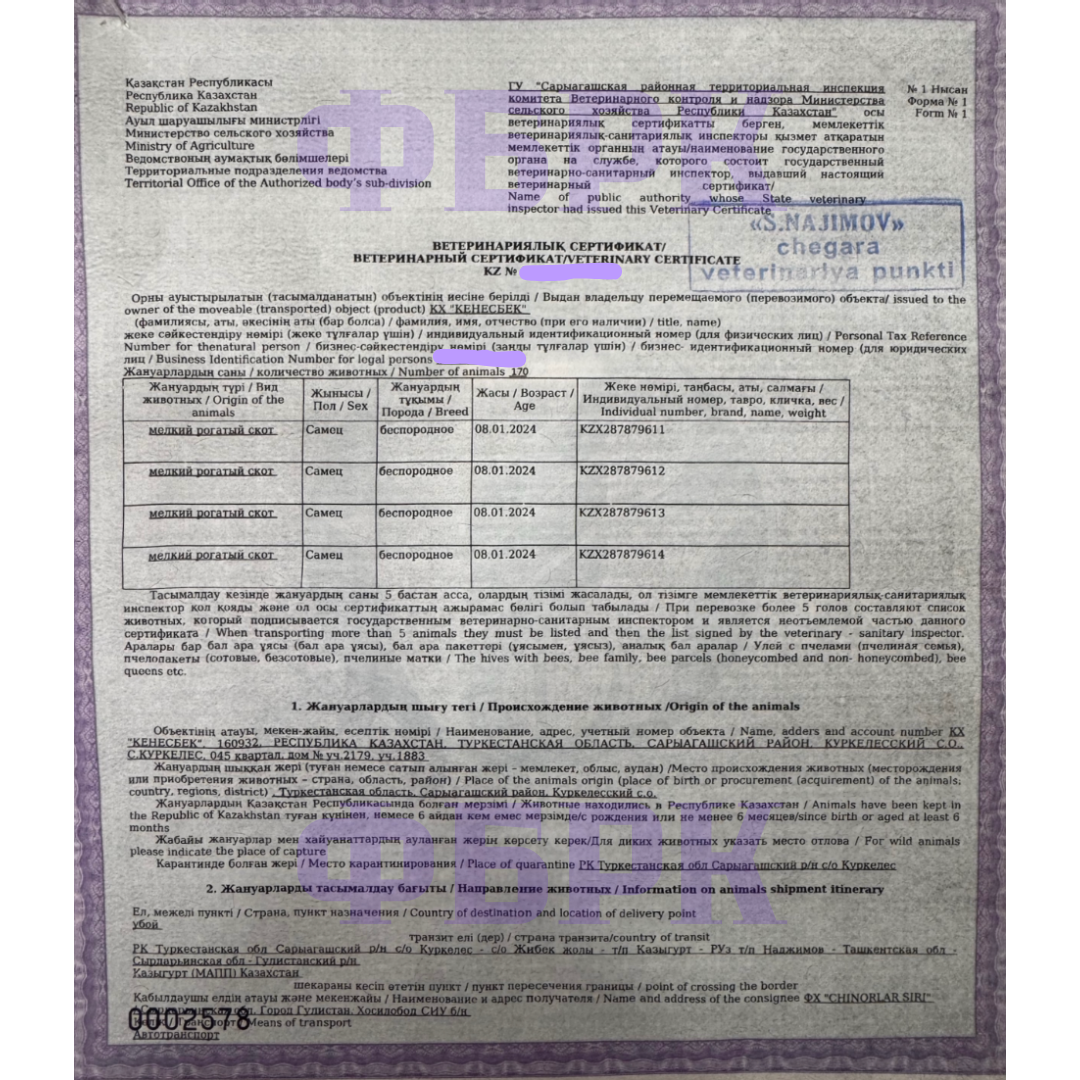
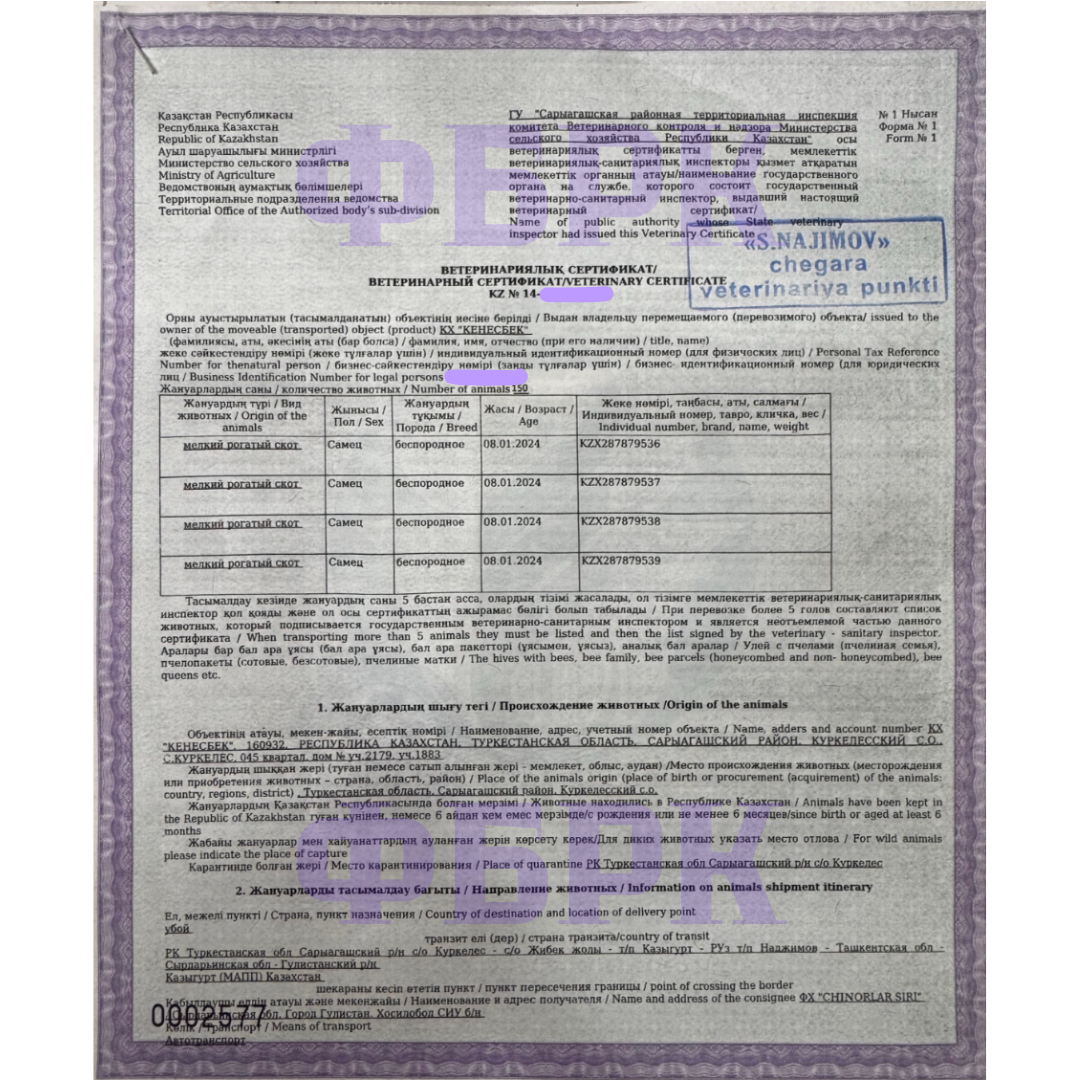
Two certificates issued to FH 'Murynbai' contain an identical declared quantity — 250 head. In both cases, the separate lists with individual numbers indicate 172 animals each. A similar pattern is observed in the documents of the other companies.
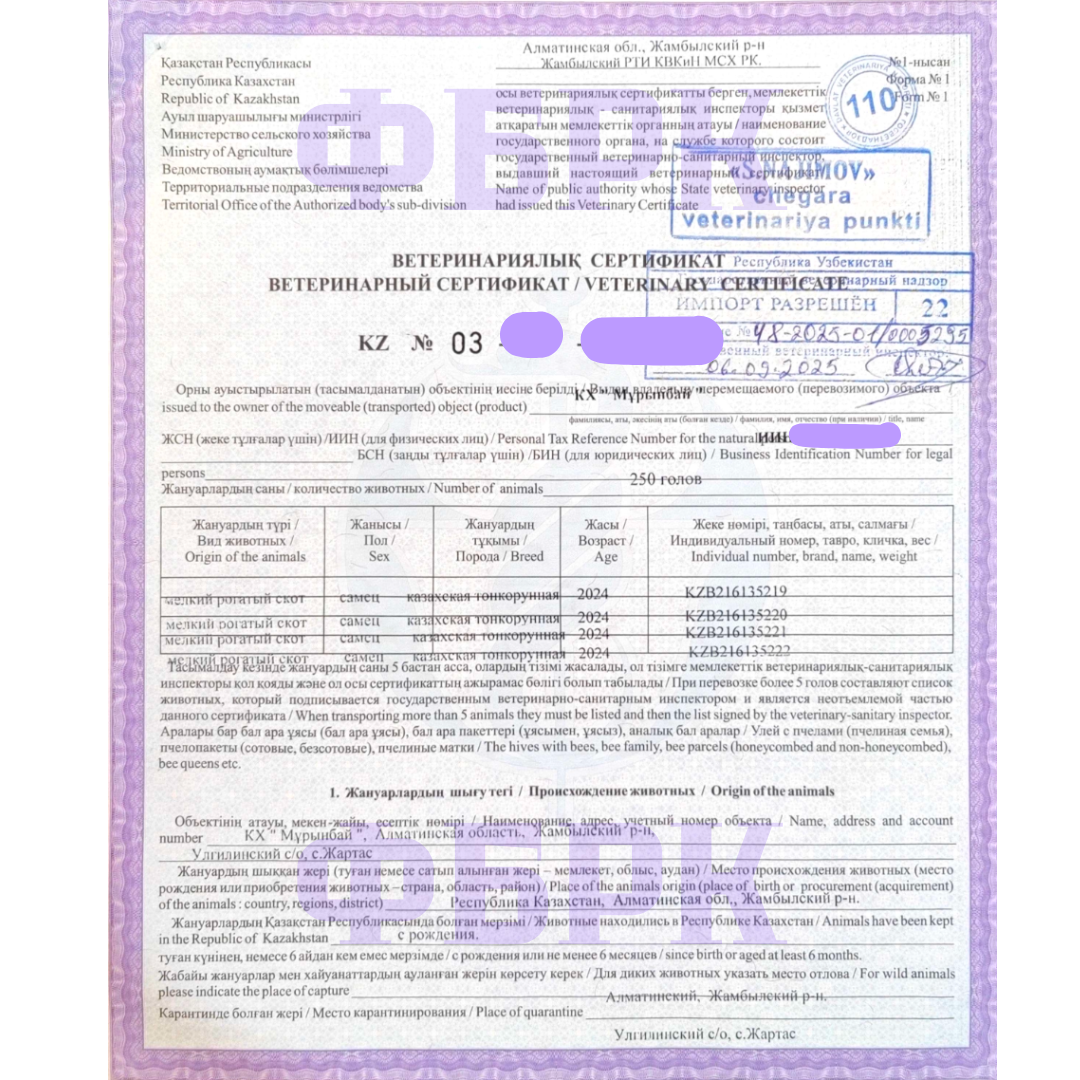
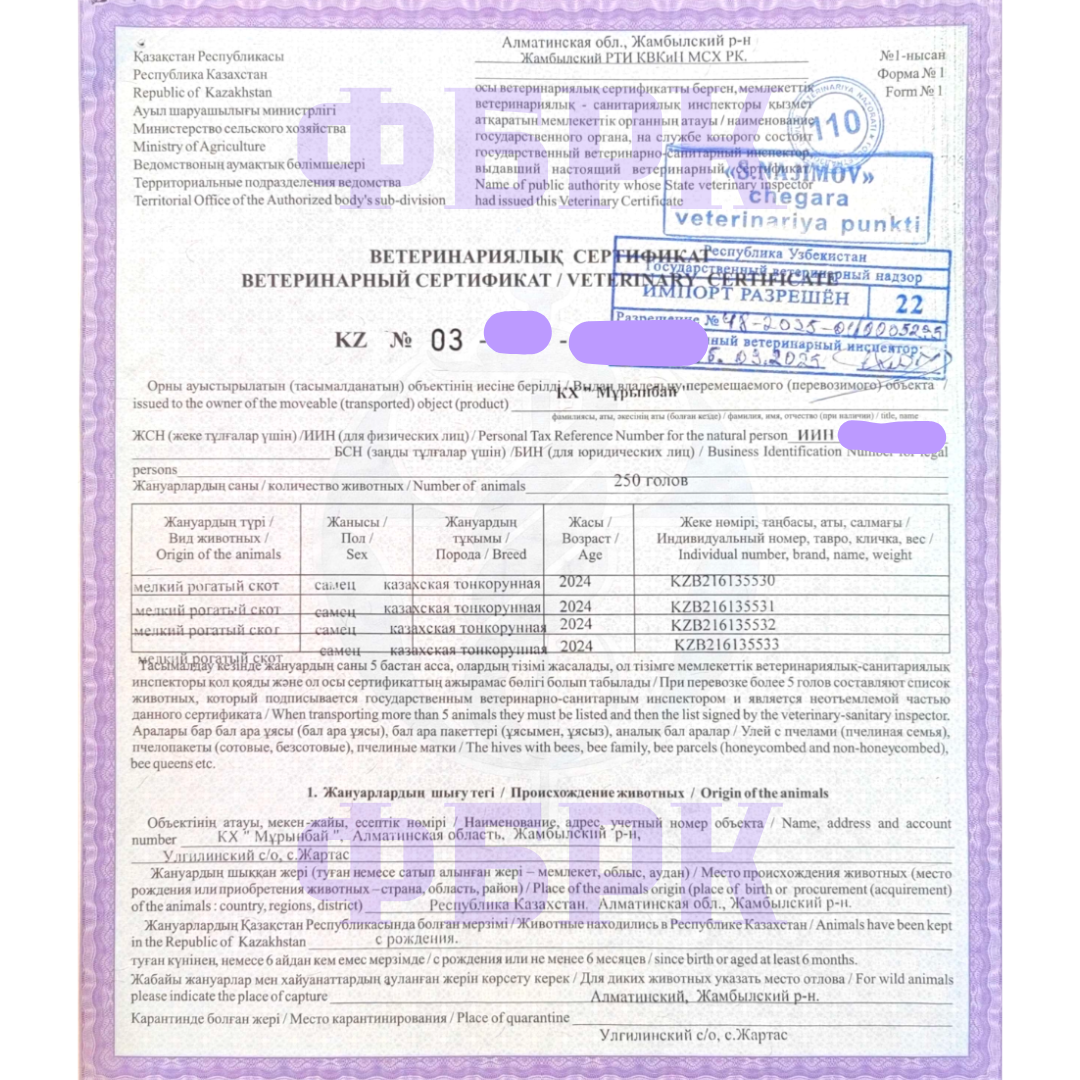
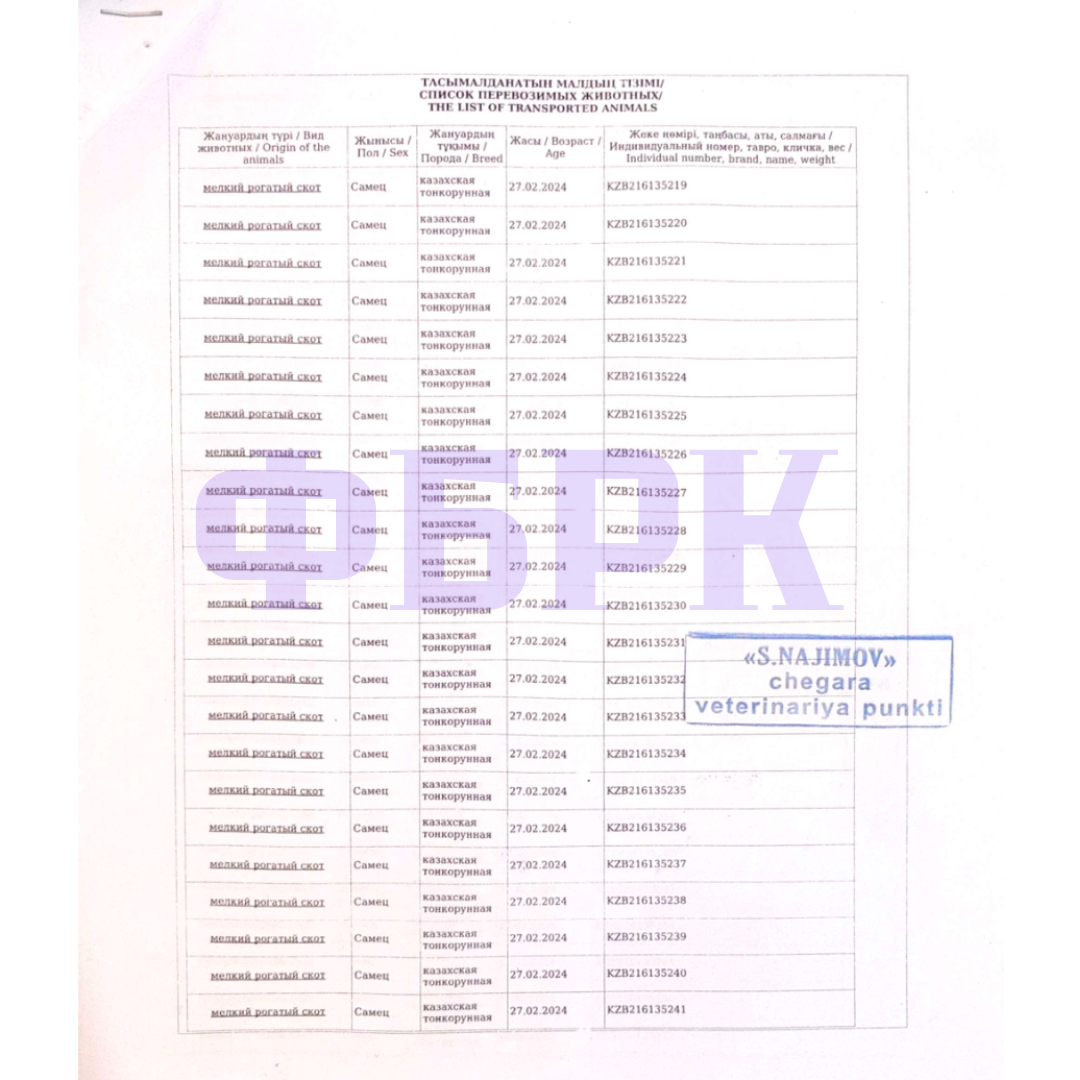
All the documents studied share several common characteristics. Each certificate bears the stamp of the border veterinary post of the S. Nazhimov customs checkpoint, indicating that all shipments passed through the same checkpoint on the Kazakhstan-Uzbekistan border. In all cases, the declared number of animals does not match the number of individuals with individual numbers in the accompanying lists. Furthermore, the documents are drawn up according to a single standard and contain all the necessary stamps and signatures of state veterinary inspectors.
In other words, different companies, whose documents are dated from different periods, demonstrate an identical model of discrepancies. This may indicate not individual violations, but a systemic practice.
Possible scheme and consequences
The documentary discrepancies suggest the following mechanism. Exporters declare a smaller number of animals than are actually brought across the border. Possibly, official documents with individual numbers are only prepared for part of the consignment, creating a semblance of legality for the entire shipment.
The actual volume of imported livestock may significantly exceed that declared. The documented portion of the animals is presented for inspection and obtaining the necessary stamps, while the remaining livestock crosses the border without proper identification and veterinary control.
The key element here is passing through border veterinary control. The inspection is carried out only on the declared part of the consignment, which receives all the necessary stamps and signatures.
The remaining volume effectively remains outside of control, which means not only a lack of veterinary supervision but also the avoidance of taxation, customs payments, and compliance with veterinary and sanitary requirements.
The key element here is the passage of documents through border veterinary control. The presence of supposedly official stamps and signatures on documents with such significant discrepancies raises questions about the quality of inspections at the border crossing stage.
If the assumptions about the nature of the scheme are correct, the consequences could be multifaceted. From a veterinary safety perspective, the export of animals without proper individual accounting and control creates epizootic risks. The lack of complete documentation makes it difficult to trace the origin of the animals and their veterinary status. In economic terms, such a practice could affect the accuracy of foreign trade statistics and create a basis for financial abuse.
The source of the documents, who remains anonymous, claims that this practice has existed since 2022 and covers significant export volumes. According to him, participants in foreign economic activity have learned to prepare documents in such a way that they formally comply with the requirements but allow operations to be carried out circumventing established restrictions.
The appearance of documents with identical violations from different companies over a long period points to a deeper problem than isolated cases of fraud. If such discrepancies systematically pass through official controls, this indicates either insufficient verification mechanisms or their deliberate disregard.