The FBRK editorial team continues to investigate schemes for exporting cattle through the territory of Kazakhstan. After the publication of previous materials, a new source contacted our anonymous bot, providing a package of veterinary certificates and accompanying documents.
We analysed dozens of pages of veterinary paperwork, consignment notes, inspection reports and electronic documents. And we discovered several problematic points indicating a potential scheme - not the first and, likely, far from the only one.
Based on the documents obtained, we can assume that livestock of unclear origin may be legalised using Russian documents by issuing internal veterinary certificates for transport, whose final destinations, according to the routes, are countries outside the Eurasian Economic Union (EAEU).
Single documents covering multiple vehicles can complicate the traceability of consignments. At the same time, according to the documents, key to allowing such batches through are the veterinary control posts of the Turkestan region of Kazakhstan.
For context, the FBRK editorial team recently published a series of investigations about potential schemes in the export of meat products and live livestock, as well as about fictitious expert examinations in markets, the concealment of anthrax outbreaks and the illegal trade in saiga meat. Furthermore, we wrote about how the country’s veterinary safety system, controlled by the Ministry of Agriculture, allows the import of potentially unsafe products.
In the following articles, we will break down the new scheme step by step. But first, let's discuss the main feature common to all documents - the use of ordinary Russian veterinary certificates for export to countries outside the EAEU.
RUSSIAN CERTIFICATES TO THE TAJIK BORDER
The central feature evident in all the documents provided to us is the use of ordinary Russian veterinary certificates form №1 for shipments whose final destinations, according to the routes in the accompanying documents, are Uzbekistan and Tajikistan - countries not part of the EAEU. In practice, this means that when exporting Russian products to states outside the EAEU, it is necessary to issue veterinary documents recognised by the receiving party, and a single Russian certificate is clearly insufficient. However, in practice, this looks even more confusing.
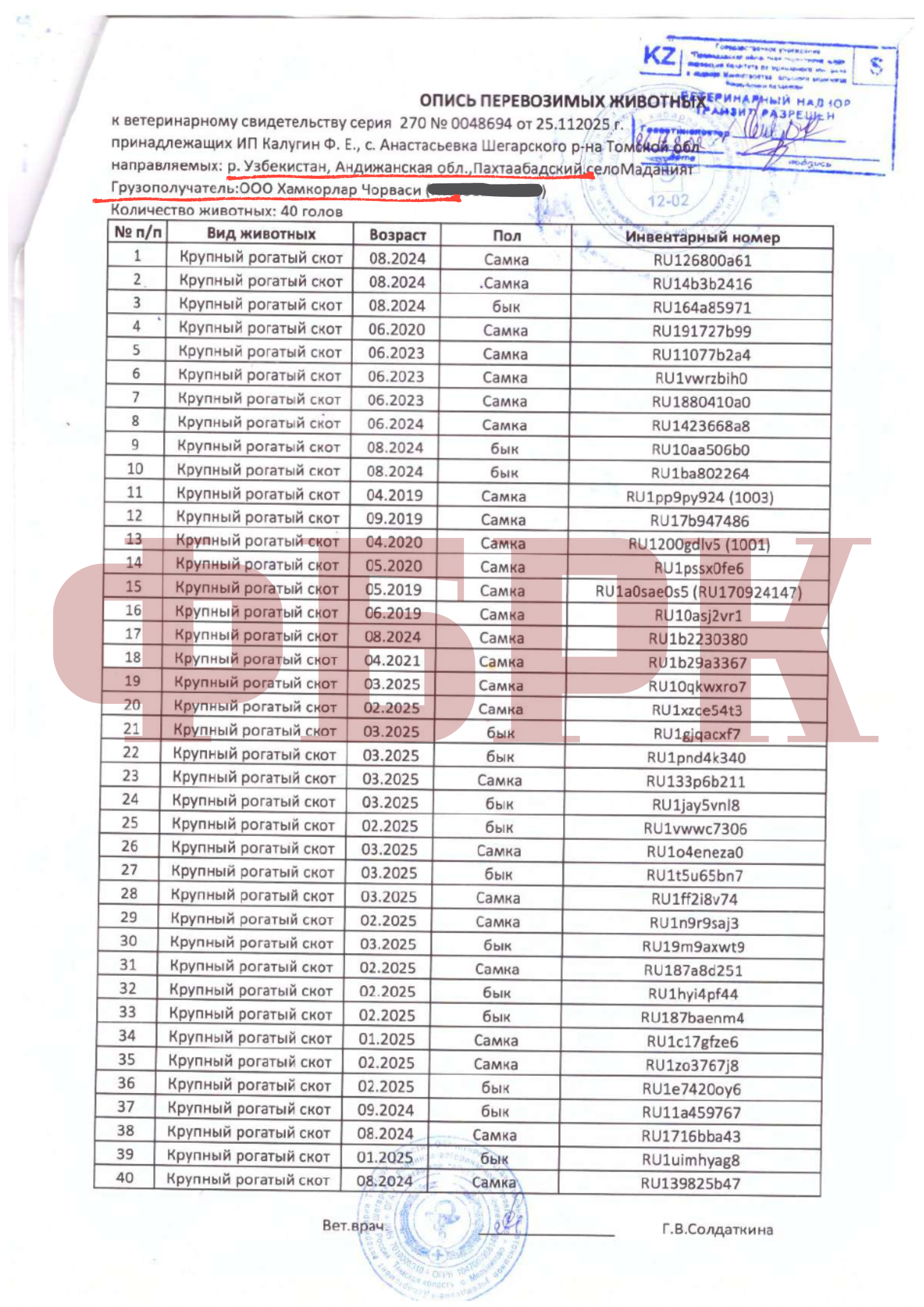
For example, in one of the veterinary certificates we received, dated 25 November 2025, for 40 head of cattle, the official recipient is listed as the Export Accounting Point of the Siberian Interregional Directorate of Rosselkhoznadzor in Tomsk - a Russian institution. However, the inventory of transported animals indicates that the livestock is being sent to Uzbekistan, Andijan region, Pakhtaabad district, village of Madaniyat, to the consignee LLC "Khamkorlar Chorvasi".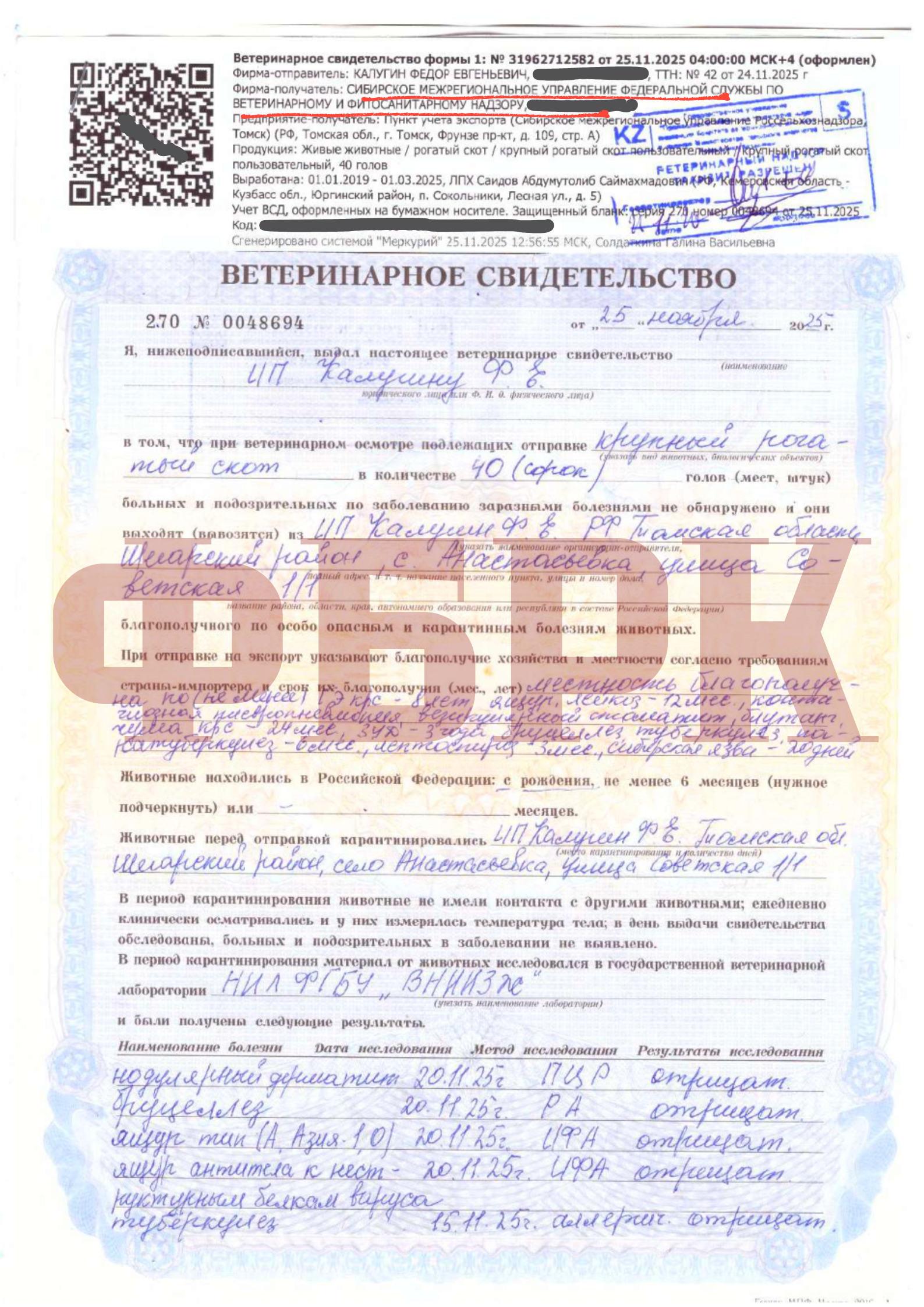
A similar picture is seen in another certificate for 30 head: the recipient is the same Tomsk accounting point, but in the special notes, the same Uzbek address is handwritten.

Another document contains a certificate dated 26 November - again for 30 head, issued by veterinary surgeon Ms. Kryukova (she appears quite often in the documents) from Interdistrict Veterinary Station No. 6 in the Kursk region. The recipient is listed as the Slaughter Reception Point (PPU) "Sagarchin" in the Orenburg region, Akbulak settlement. But the route recorded in the accompanying documents looks somewhat different: Sagarchin (RF), Republic of Kazakhstan — Zhaisan (KZ) — B.Konysbaev (KZ) — Republic of Uzbekistan — Yallama (UZ), Sariasia (UZ) — Dusti (TJK), with the final destination being the village of Dashtobod, Yavan district, Khatlon region, Tajikistan.


Two other certificates from the same set of documents, also issued by Ms. Kryukova on 26 November, show an identical feature. The official recipient is PPU "Sagarchin" of the Rosselkhoznadzor Directorate for the Orenburg Region, but the consignment notes specify a route with the same final address in Tajikistan.
Such documentation could well create the appearance of domestic Russian or internal EAEU movement while actually enabling export to third countries, where veterinary control requirements may differ.
WHAT NEXT?
The use of Russian domestic documents for international export is just the first layer of a far more complex and multi-layered scheme. But how do its potential organisers manage to muddle the supply chain so thoroughly that tracing the origin of a specific batch of livestock becomes practically impossible?
In the next part, we will examine the equally interesting tools used by participants in grey schemes. We will look at the practice where a single veterinary certificate is 'stretched' to cover several trucks at once. We will see how electronic certificates can suddenly disappear or be cancelled after the goods have left the country, creating a hole in the accounting system. And finally, we will focus on chronological inconsistencies: strange discrepancies in time that suggest some documents are backdated to align reality with a desired picture. All these techniques, woven together into a single pattern, turn the control system not into a barrier, but rather into an instrument for legalising dubious transactions.
To be continued...