The FBRK editorial team continues to investigate export schemes for cattle (bovine animals) through the territory of Kazakhstan. Today we will focus on mechanisms that effectively render control meaningless: single documents for multiple vehicles, cancellation of electronic certificates en route, and chronological inconsistencies in dates.
Recall that in the first part of the investigation the FBRK wrote about how ordinary Russian veterinary certificates could be used to export livestock to countries outside the Eurasian Economic Union (EAEU), creating the illusion of domestic Russian transport. The official recipient was a Russian institution, but the actual destination was a village in Tajikistan or Uzbekistan.
Earlier, our editorial team also published a series of investigations into potential schemes in the export of meat products and live animals, as well as about fictitious expert examinations in markets, the concealment of anthrax outbreaks and illegal trade in saiga meat. In addition, we wrote about how the country's veterinary safety system, controlled by the Ministry of Agriculture, allows the import of potentially unsafe products.
WHY TRACEABILITY IS IMPORTANT
The second feature of the documents that came into the possession of the FBRK is the issuance of a single veterinary certificate for several vehicles. According to a source, when distributing a batch of animals across different vehicles or during reloading, separate documents or amendments should be issued specifying the specific vehicles and the distribution of animals among them. This should be done for the traceability of the cargo, but in practice this is simply not done.
For example, one of the documents obtained reveals a veterinary certificate dated 25 November for a batch of 200 head of slaughter cattle, transported simultaneously by two vehicles. The certificate was issued by a veterinary doctor from the Ust-Kan District Animal Disease Control Station. The sender is LLC "Merkit", and the final destination, according to the route, is Bukhara Region of Uzbekistan.
Similarly, in another document - there is a certificate dated 20 November for 120 head, also transported by two vehicles, issued by the same institution, the same sender, route via Kazakhstan to Andijan Region of Uzbekistan.
And, for example, in a veterinary certificate dated 23 November for a batch of 225 head of slaughter cattle, there are three separate CMR consignment notes attached. Each consignment note is issued separately for the transport of 75 head. Three vehicles, three separate consignment notes, but one single veterinary certificate.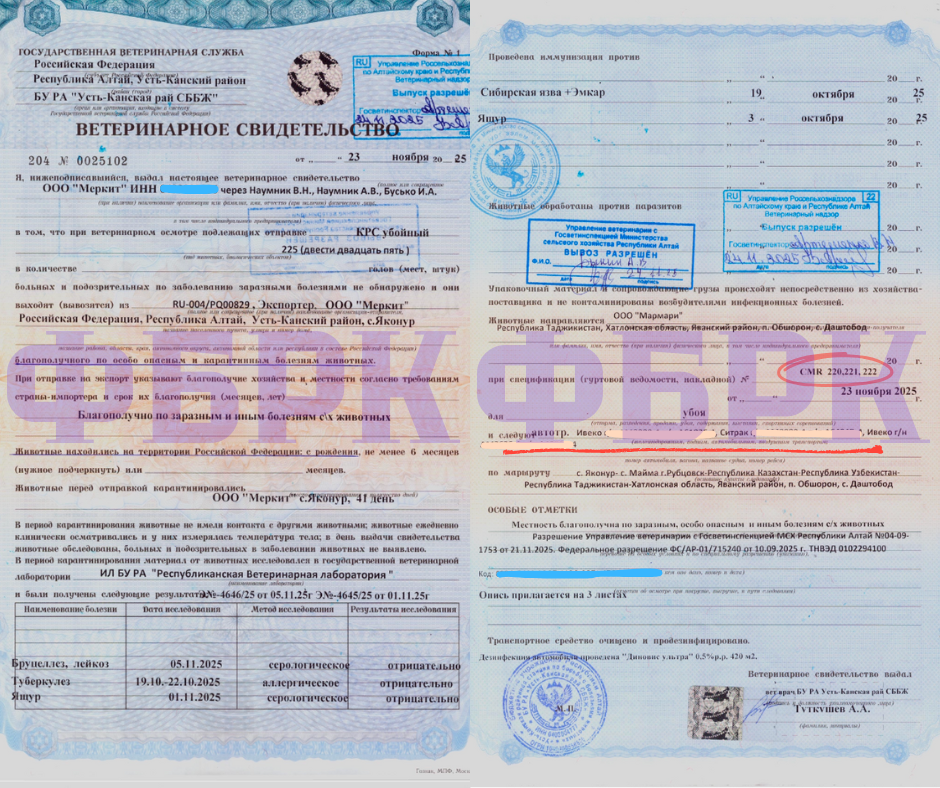
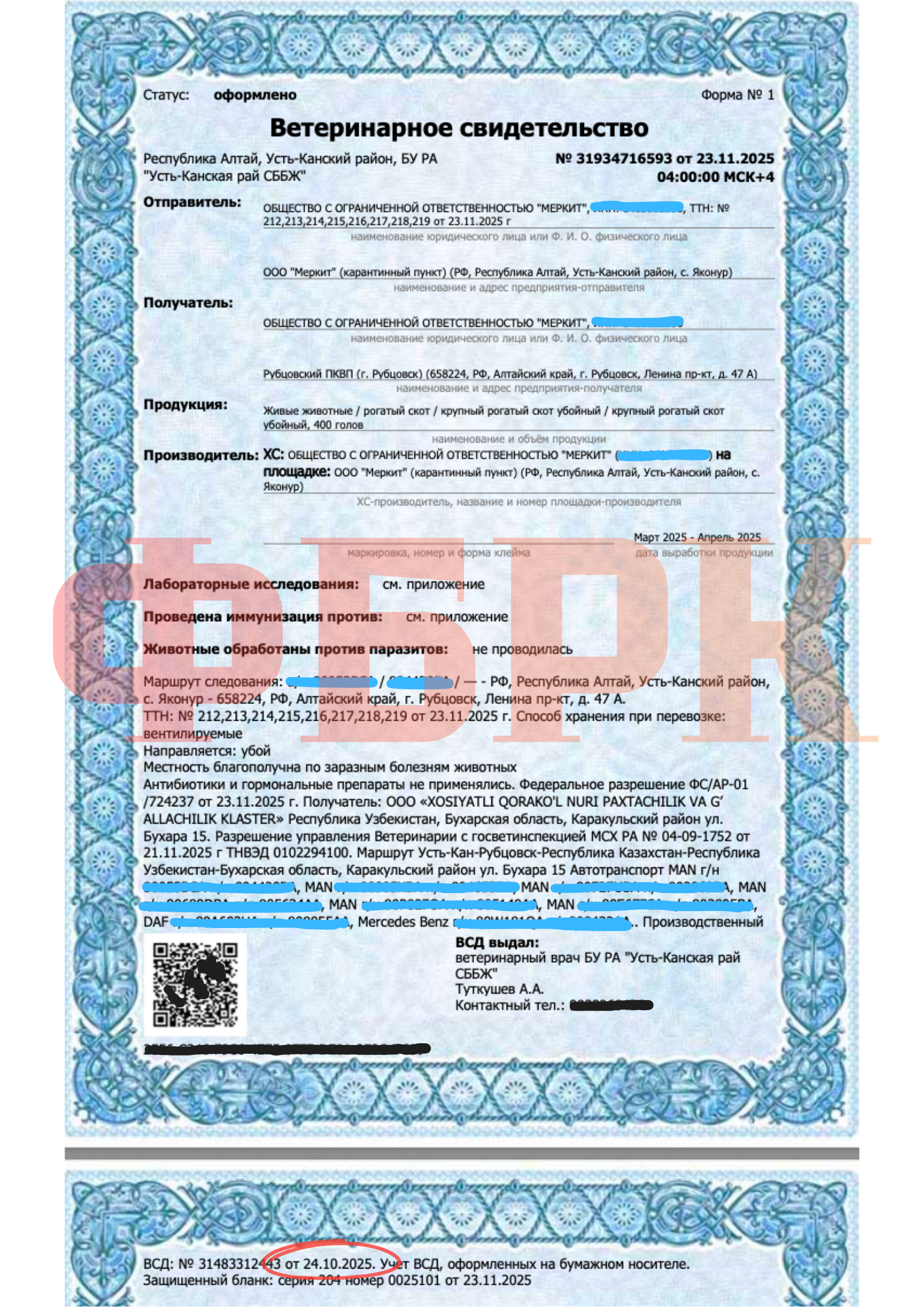
The most telling case is the certificate dated 23 November, issued by veterinary doctor Mr. Tutkushev (familiar to us from the first part of the investigation). The document is issued for a batch of 400 head of slaughter cattle, transported by eight lorries with trailers. Interestingly, the sender and recipient are the same entity, LLC "Merkit", the departure point is the quarantine point in the village of Yakonur, Altai Republic, and the official destination is the Rubtsovsk Border Quarantine Veterinary Point (BQVP) in Rubtsovsk, Altai Krai.
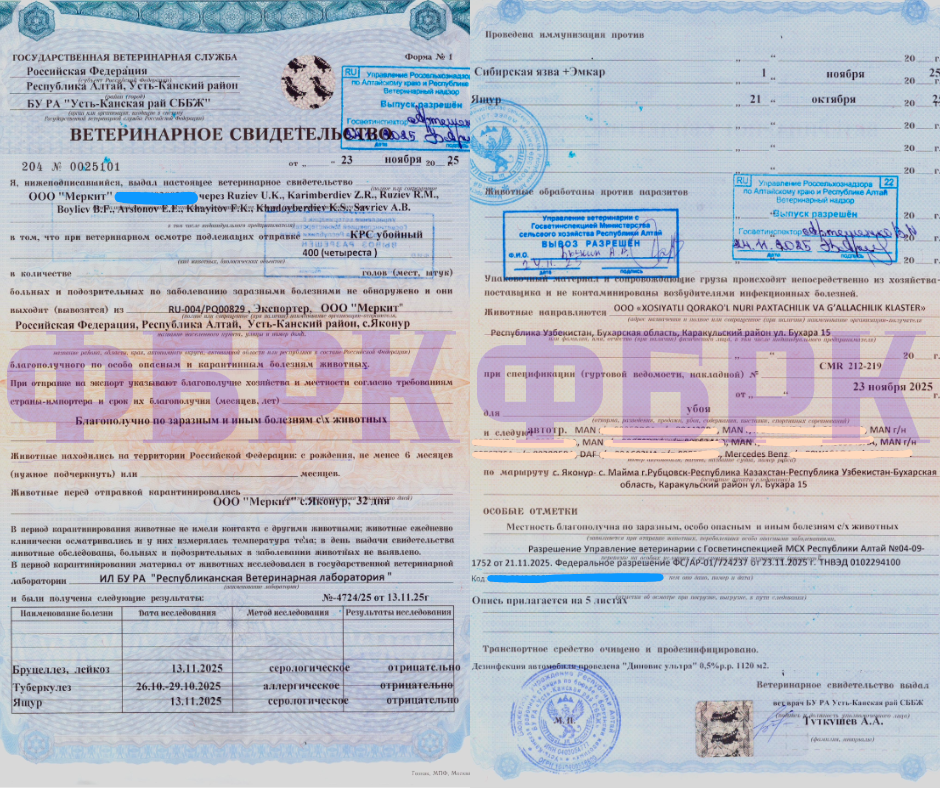
However, the final recipient is listed further on - LLC "XOSIYATLI QORAKO'L NURI PAXTACHILIK VA G'ALLACHILIK KLASTER" in Bukhara Region of Uzbekistan, route: Yakonur — Maima — Rubtsovsk — Republic of Kazakhstan — Republic of Uzbekistan — Bukhara Region. Eight separate consignment notes were issued for the eight vehicles, but a single veterinary certificate.
Such documentation can make it difficult to determine which exactly animals are in which vehicle. In the inventories of live animals, each animal is identified by an electronic ear tag with an alphanumeric code starting with the prefix RU1, which corresponds to the Russian identification system. However, when a single certificate is issued for several vehicles, the list of animals is not divided by vehicle.
Why is this important? If a disease or death is detected en route, it can complicate determining which vehicle the sick animal came from. Additionally, it can create a technical opportunity for substituting part of the cargo without it being reflected in the documents.
CANCELLATION AFTER DISPATCH
The third feature of the scheme described by the anonymous source involves possible manipulations with electronic veterinary accompanying documents (eVADs) in the "Merkuriy" system. According to system requirements, a paper veterinary certificate must be linked to a valid electronic document. However, in reality, based on inspection reports, the paper documents continued to be used even after the eVAD had been cancelled.
For example, an eVAD was issued for the veterinary certificate dated 26 November. According to a screenshot from the "Merkuriy" system, the document status is "cancelled", with a cancellation date of 28 November. At the same time, the document is accompanied by veterinary and sanitary inspection reports from the Kazakh veterinary control points (VCP) "Zhaisan" in Aktobe Region dated 28 November and VCP "B.Konysbaev" in Turkistan Region dated 30 November. The cargo passed through the Kazakh border on 28 and 30 November, while the electronic document had already been cancelled on 28 November - that is, after actual dispatch, but while the cargo was still en route.
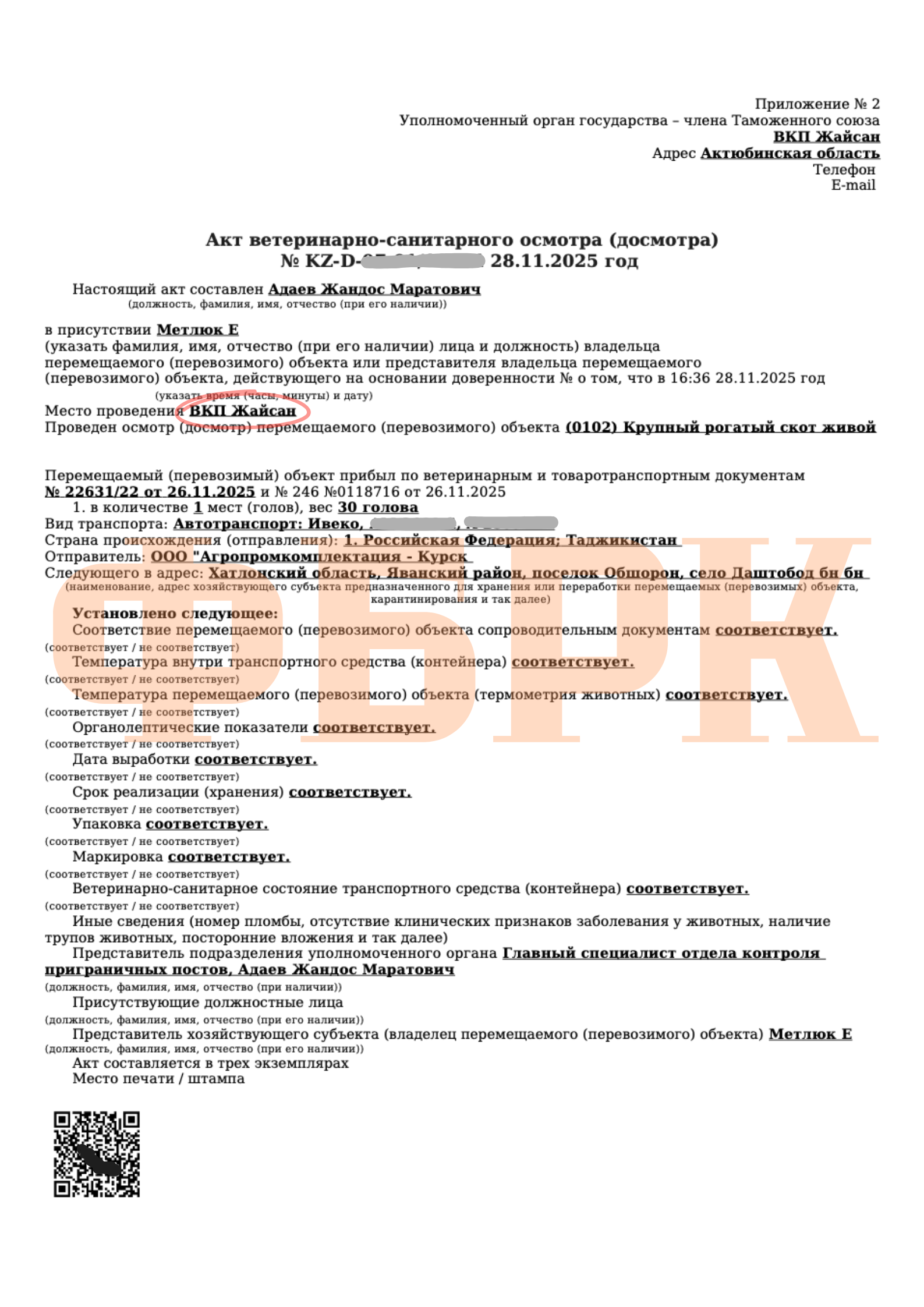
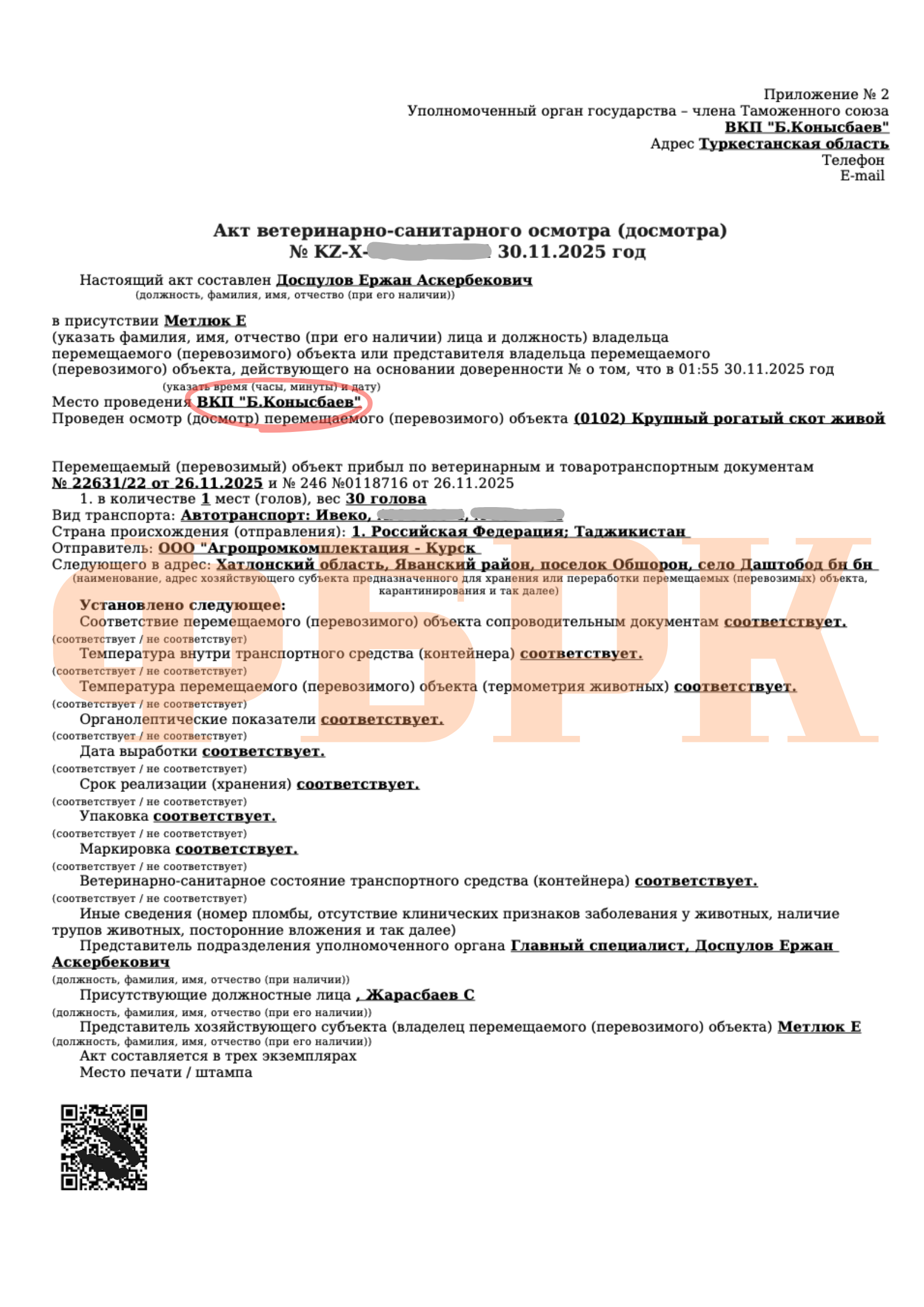
A similar situation occurred with two other certificates from Kursk Region. One eVAD has the status "cancelled", with a cancellation date of 28 November. The eVAD for another certificate from the same series, issued 18 minutes after the first, is also "cancelled" on 28 November. Both cargoes of 30 head each, certified by the veterinary doctor (now familiar to us) Mrs. Kryukova, were allowed through VCP "Zhaisan" on 28 November and VCP "B.Konysbaev" on 30 November, as recorded in the inspection reports, despite the cancelled status of the electronic documents.

What does this indicate? Such a practice can allow one to avoid electronic traceability. A cancelled document is not displayed as active, while the paper certificate can formally continue to be used and accepted at the border.
Another feature was found in the electronic document dated 23 November for 400 head. The inventory attached to the veterinary certificate lists an eVAD as "completed" on 23 November. But the same bundle of documents contains information about another VAD dated 24 October. We can assume that either one eVAD was cancelled retroactively, or an attempt was made to link the paper document to a pre-existing electronic one.
CHRONOLOGICAL INCONSISTENCIES AND RELOADING REPORTS
Temporal discrepancies between document issuance dates, reloading reports, and border control reports may also indicate backdated documentation.
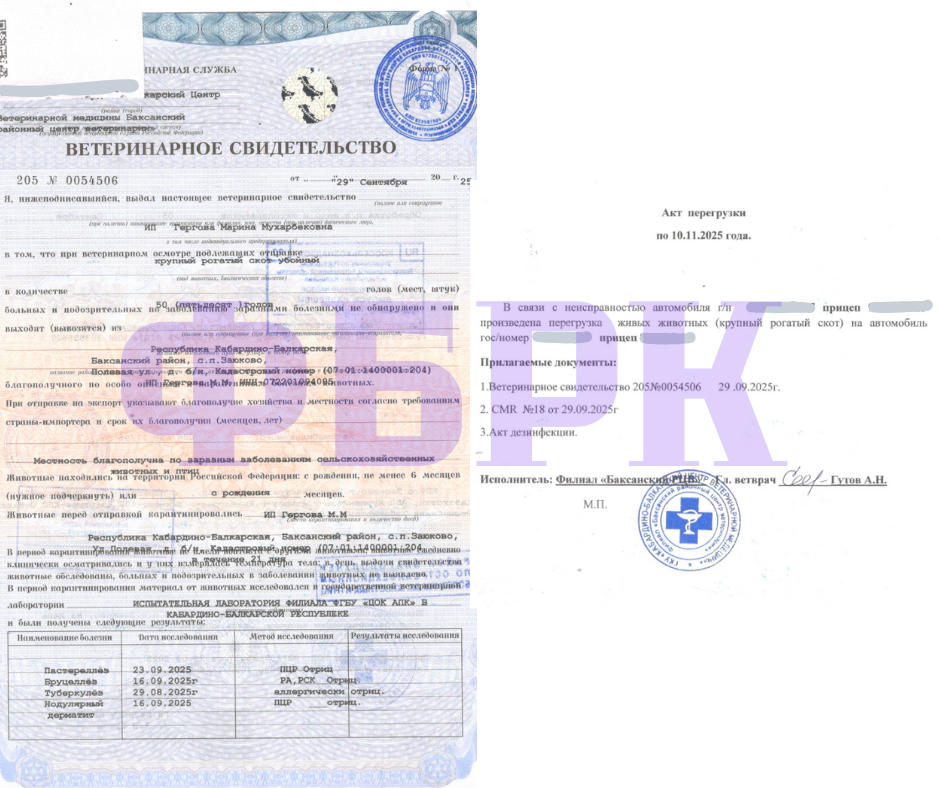
For example, one of the documents provided contains two veterinary certificates dated 29 September 2025. Both are issued for 50 head of cattle, transported by three vehicles. Both are signed by the chief veterinary doctor of the "Baksanskiy RTSB" veterinary station of the Kabardino-Balkar Republic - Mr. Gutov. Attached to the documents is a reloading report dated 10 November, according to which, due to vehicle malfunction, a transshipment of live animals to other vehicles was carried out. The report is signed by the same Gutov. The time gap between the issuance of the certificates on 29 September and the reloading report on 10 November is 42 days, which, at the very least, raises questions about where the animals were kept during this period.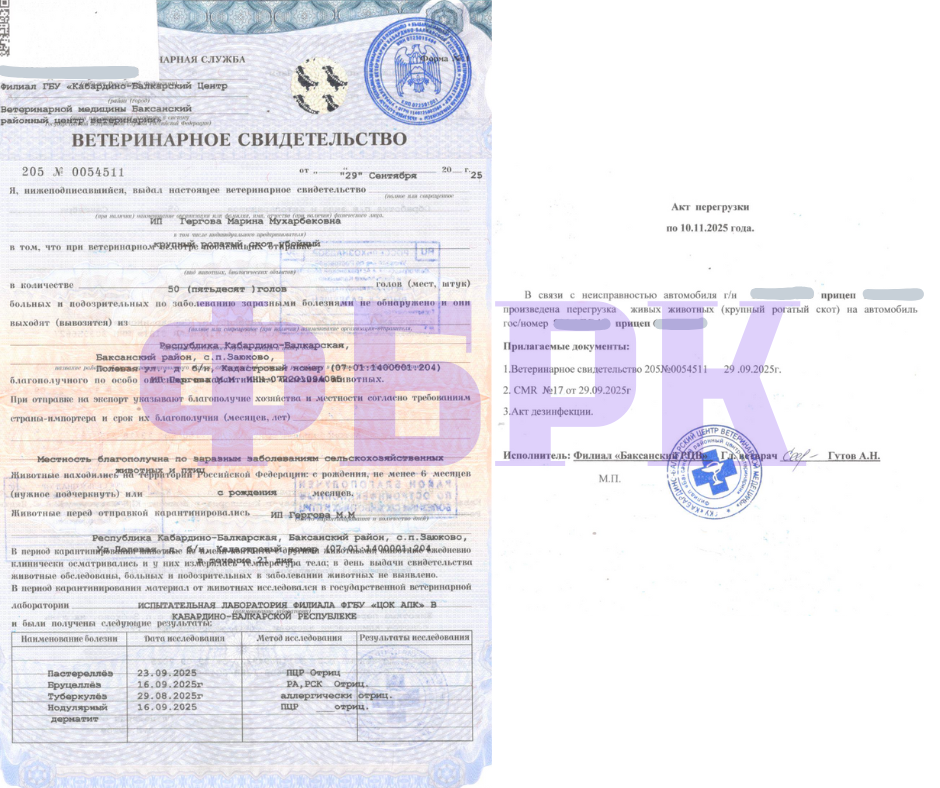
Delays are also observed between the issuance of veterinary certificates and passing through Kazakh veterinary posts. For instance, the certificate dated 25 November for 200 head is accompanied by an inspection report from the VCP "Auyl" in the Abay Region dated 27 November - two days later. Then follows a report from VCP "B.Konysbaev" in Turkistan Region dated 29 November. The certificate dated 23 November for 400 head is accompanied by a report from VCP "Auyl" dated 25 November, followed by a report from VCP "B.Konysbaev" dated 28 November - five days after the main document was issued.
WHAT NEXT?
Discrepancies in dates, electronic documents cancelled en route, single certificates for convoys of vehicles - all these details come together to form a coherent picture: the current livestock control system has ceased to fulfil its safety function and is step by step turning into a convenient service for covering up transit flows (if it is not already). Formally, everything seems to be documented, but in reality, traceability breaks down at every stage.
We risk suggesting that veterinary control, created to protect consumers and prevent dangerous diseases, has now become embedded in the logistics of grey export schemes. And while the regulator limits itself to formal checks, the infrastructure itself is becoming a tool for circumventing the rules.
But who exactly stands behind these schemes? Which veterinary posts systematically allow such cargoes through? And why do the same names keep appearing in the documents time and again? In the final part, we will reveal the "Turkistan node" of the scheme, an unexpected Belarusian trace, and the full geographic picture of a potential practice that spans five countries.
To be continued...