(8 January 2026 | Source: FBRK)
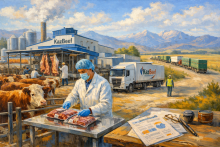
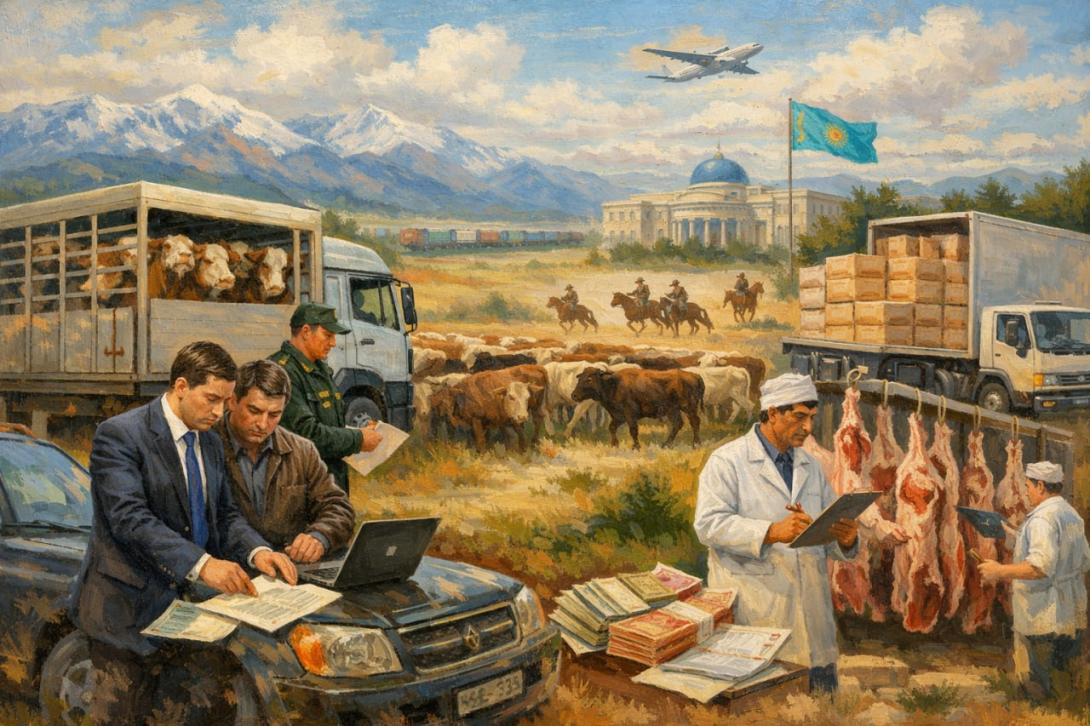
The FBRK editorial team continues to examine documents that reveal a complex system of control over the export of beef and live cattle from Kazakhstan. The materials obtained show how formal government decisions could create advantages for certain companies, and how subsequent transit and export of meat allowed quotas to be bypassed and accounting with state bodies to be minimised.
FACTUAL BASIS
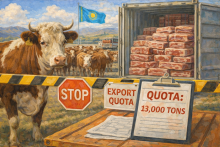
Previously, the FBRK editorial team reported that on 29 August 2025, a meeting of the Interdepartmental Commission on Foreign Trade Policy and Participation in International Economic Organisations (ICFTPIO) was held. According to our information, the meeting was chaired by the Deputy Prime Minister - Minister of National Economy, Serik Zhumangarin. Protocol No. 121 provided for the introduction of a quota for beef exports of 13,000 tonnes until the end of the year.
The key point, however, was a discrepancy between the Russian and Kazakh versions of the protocol: in the Russian version, clause 2.4 granted four companies (KazBeef Processing LLP, Terra-Akzhaik LLP, Terra LLP, Kaiyp-Ata LLP) the right to export beef without restrictions until the entry into force of Ministry of Agriculture (MoA) Order No. 441, registered on 1 December 2025. The Kazakh version does not contain this clause; it stated that the quota applied only to third countries, excluding the EAEU. Thus, a three-month period of privilege for specific companies was created.
Documents obtained by FBRK from an anonymous source show that the companies' advantages were not limited to this period. On the contrary: a system was being created that allegedly included the 'sham transit' of live cattle and the export of meat in small consignments.
If the information received is to be believed, the management of beef exports in Kazakhstan involves several levels of authority. At the government level, Serik Zhumangarin appears; at the ministerial level, Amangaliy Berdalin, Vice-Minister of Agriculture and a fellow countryman of Mr Zhumangarin; at the regional level, the Akims of the Turkestan region, Darkhan Satybaldy (until January 2025) and Nuralkhan Kusherov (from January 2025); at the level of the Committee for Veterinary Control and Supervision (CVCS), the head of the territorial inspectorate, Sundetali Kaldibekov. The source points to their involvement in processes related to the regulation and control of the transit and export of livestock and meat.
Let us try to understand.
ANALYSIS AND INTERPRETATION
According to the source, the scheme involved arranging the transit of cattle from Russia through Kazakhstan to Uzbekistan. Our editorial team has previously reported in detail on this process here. In this instance, the documents allegedly indicated smaller volumes (e.g., 30 head), although the source claims the lorry actually carried 80–100 head. It is presumed that this difference 'remained' in Kazakhstan, was then slaughtered at local abattoirs, and turned into 'Kazakhstani' beef for export.
It is also not new to us that the documents demonstrate the repeated presence of the same inspectors when processing consignments, as well as delays between the dates of veterinary documents, waybills, and inspection reports (in this case, of 9 to 11 days), which indicates possible backdating of documents. 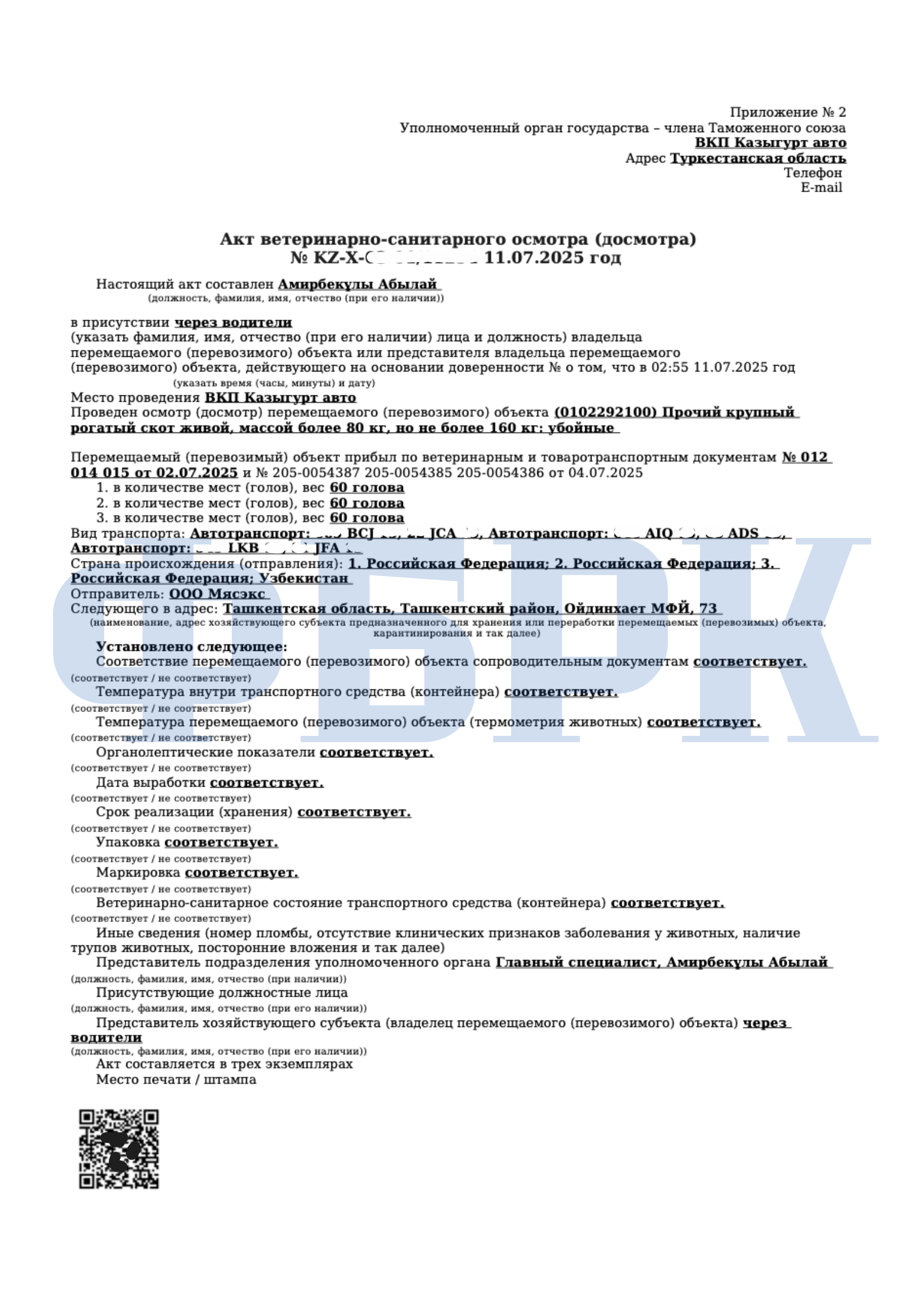
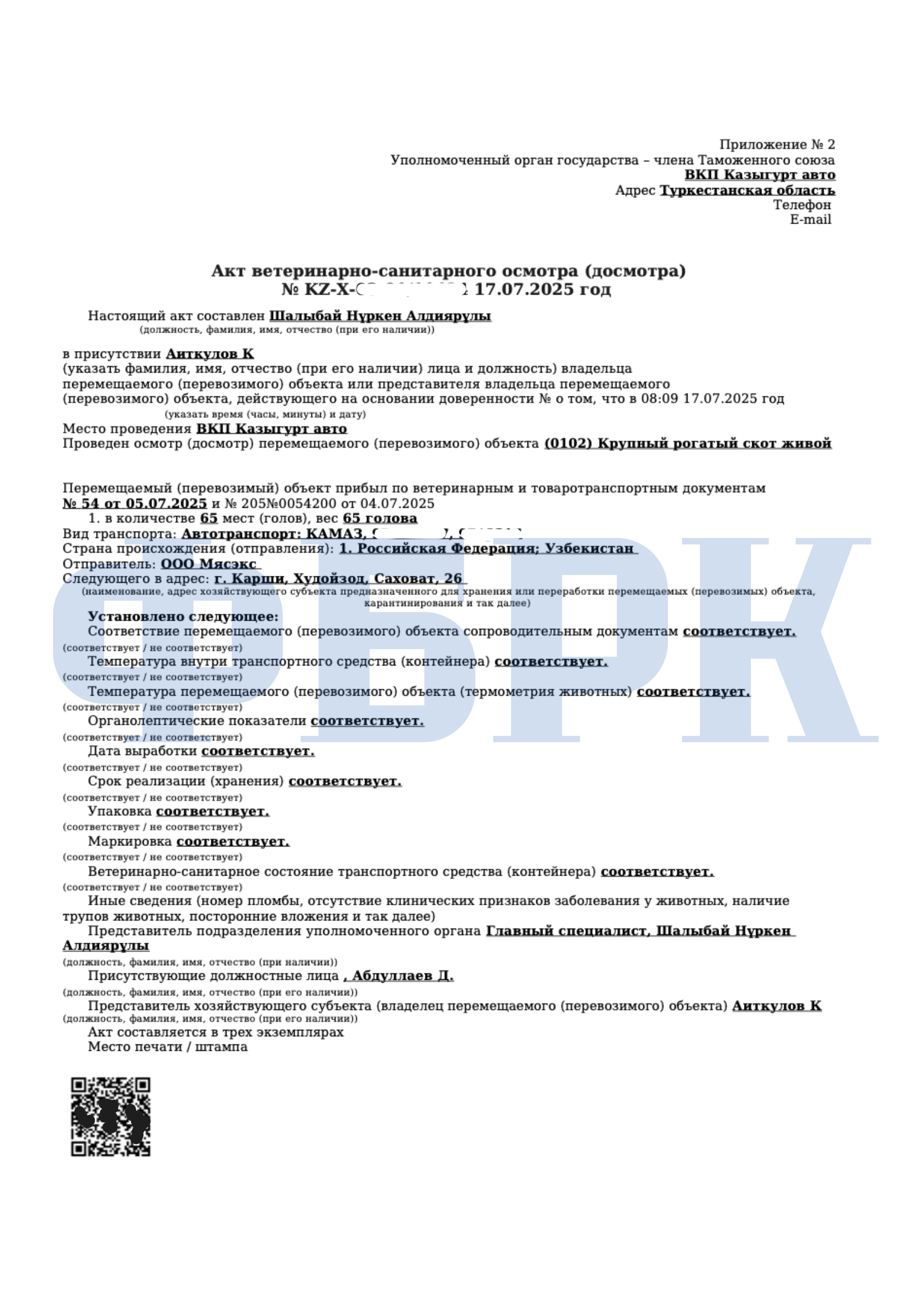


The documents show that meat transport was often carried out in small consignments, using vehicles registered in the Turkestan region. At the same time, the source claims that the declarations for these trips were not entered into the State Revenue Committee (SRC) database, which allegedly allowed quotas to be bypassed and tax accounting to be minimised.
The constant involvement of one person in accompanying each consignment may indicate centralised management of these supplies. The economic effect based solely on the documents presented above for three months amounts to approximately 25–30 tonnes of meat.
The average slaughter weight of cattle is 120-150 kg, with a meat yield of 50-60%. Based on just four documents (see above) over three months, 385 head were recorded (≈50 tonnes live weight, ≈25-30 tonnes of meat). Actual volumes, judging by the number of small trips, are likely tens of times greater than these figures.
POSSIBLE CONSEQUENCES
The scheme in question carries a number of systemic consequences that manifest themselves on both an economic and social level. Firstly, financial flows organised through a chain of structures and intermediaries create risks of opaque resource distribution. This leads to a distortion of market mechanisms: the real needs of an industry or community may be ignored, while funds are concentrated among a narrow circle of participants in the scheme. For example, FBRK has previously reported in detail here on how grey schemes in meat exports contribute to rising prices.
Secondly, this type of operational organisation provokes an accumulation of administrative and legal pressure. Numerous points of control, inspections, and approvals emerge, which hinders effective management and slows down decision-making. In the long term, this stifles the development of industries and undermines trust in institutions.
A third consequence is the socio-psychological effect. Participants in the scheme who gain advantages form stable networks of influence, which can affect appointments, the distribution of contracts, and access to key resources. Meanwhile, an external observer sees only formal structures, while the real chain of decision-making remains hidden.
Incidentally, by a coincidence, the chain of participants includes fellow countrymen and individuals linked by personal or professional contacts. For instance, Serik Zhumangarin and Amangaliy Berdalin turn out to be from the same region. Both are natives of the Aktobe region. This is, of course, not grounds for hasty conclusions.
The FBRK editorial team has been investigating the issue of meat and livestock exports for a long time, and the endless stream of complaints only confirms once again the existence of problems that the authorities, it seems, would prefer to keep quiet about.
(The information and documents provided are based on reports from sources who wish to remain anonymous and have not been officially confirmed — ed. note FBRK)