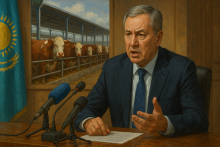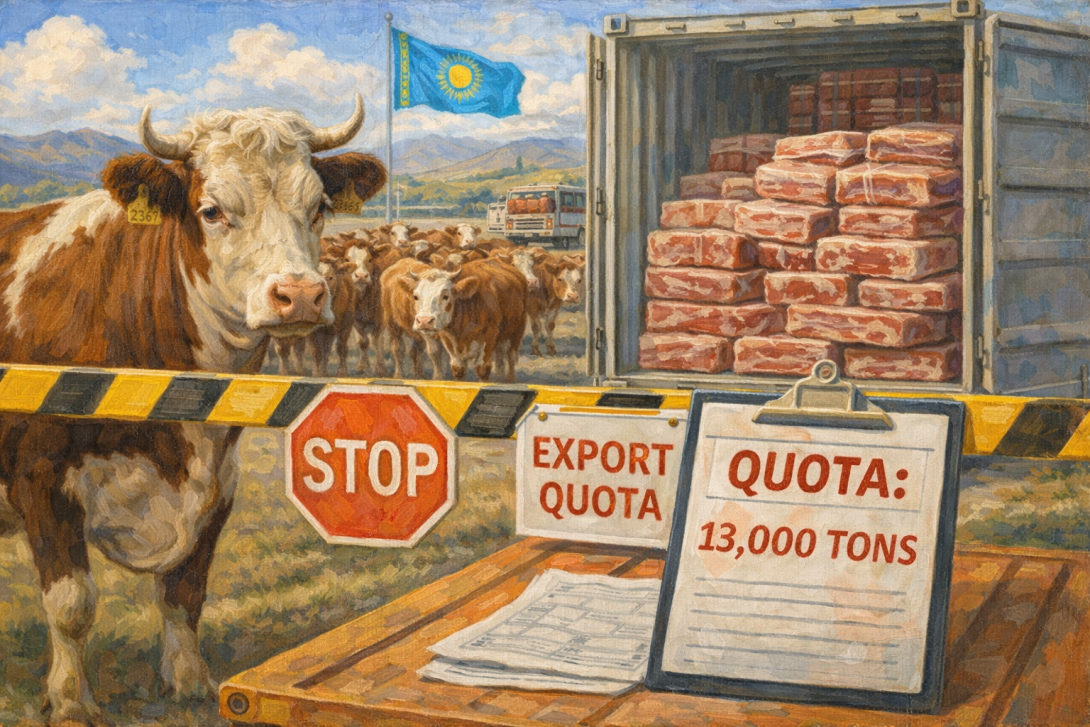
Kazakhstan's authorities have introduced a quota on beef exports of 13 thousand tonnes until 31 December. The restrictions apply to the export of fresh, chilled and frozen beef, and are in effect for both countries of the Eurasian Economic Union (EAEU) and other states. This was stated by the Minister of Agriculture, Aidarbek Saparov.
According to Tengrinews.kz, the head of the department said that the introduction of quotas and tighter control over meat exports is a necessary measure aimed at preventing a shortage of beef on the domestic market and stabilising prices.
According to the ministry, the new restrictions should not negatively affect the competitiveness of the industry.
"The approach introduced is not aimed at creating an oligopoly or restricting competition. On the contrary, its goal is to create a civilised, transparent and responsible model of beef production based on a full industry cycle," the response states.
The department also stated that these measures will help limit the activities of small slaughterhouses and intermediaries who previously purchased livestock and resold it abroad without fattening.
According to representatives of the Ministry of Agriculture, this includes the export of livestock to neighbouring states, including Uzbekistan. It is noted that such practice distorted the market and led to rising beef prices within Kazakhstan.
"Thus, the introduction of quotas is aimed at eliminating export intermediaries who do not engage in breeding and fattening livestock, but merely resell animals. Their activities lead to an unjustified increase in beef prices and do not contribute to the development of the industry," the statement reads.
Alongside the export restrictions, the ministry announced the continuation of state support measures for agricultural producers. It was reported that farmers continue to receive subsidies for the purchase of breeding livestock.
For instance, the state compensates 260 thousand tenge for one head of domestically produced breeding livestock, 390 thousand tenge for animals imported from CIS countries and Ukraine, and 525 thousand tenge for livestock imported from Europe, the Americas and Australia.
Recall that recently the FBRK editorial team published a series of articles showing how Russian internal veterinary certificates can be used for export to non-EAEU countries, how single documents for multiple vehicles hinder traceability, how electronic documents are cancelled after shipment, and how 42-day gaps in dates may indicate backdating.
All these elements point to a possible systemic practice.
Earlier, FBRK released a series of investigations into potential schemes in the export of meat products and live livestock, as well as fictitious inspections at markets, the concealment of anthrax outbreaks, and the illegal trade of saiga meat.
Furthermore, we have written about how the country's veterinary safety system, controlled by the Ministry of Agriculture, allows the import of potentially unsafe products.