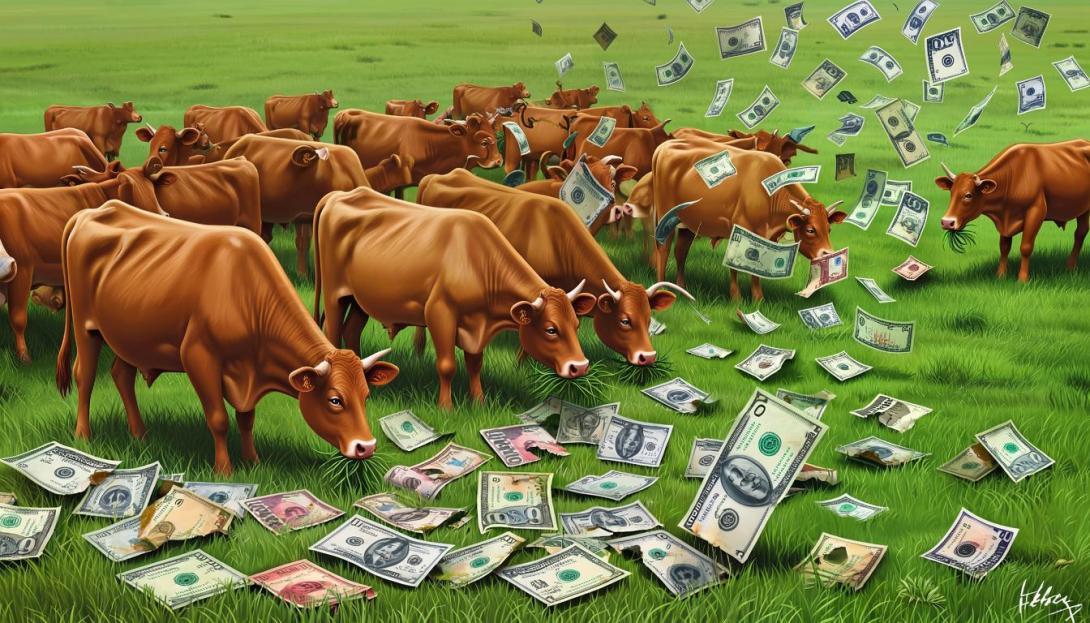
The anonymous bot of the FBRK received an appeal with documents regarding potential violations in the field of meat product exports and live cattle. The information obtained may help to understand the issue of rising meat prices in Kazakhstan, a country with favourable conditions for livestock farming.
Price dynamics for meat products
Retail prices for meat and meat products in Kazakhstan for September 2025 increased by 2.7% month-on-month and by 19.1% year-on-year. Beef rose by 28.4% over the year, and lamb by 25.9%.
The price increase has reached a level where the issue is being raised at the state level. In October, the Ministry of Agriculture (MoA) proposed introducing quotas on the export of beef cattle meat — the corresponding draft order was posted on the "Open Legal Acts" portal. The goal, according to the document, is to ensure the country's food security, develop the processing of livestock products, and stabilise beef prices.
Similar measures were previously discussed in Russia. In April, the State Duma proposed temporarily banning the export of meat products and introducing import quotas to stabilise prices. The authorities' resort to administrative restrictions may indicate that existing control mechanisms are working insufficiently effectively or that market participants are circumventing them.
Appeal by the Akim of the Turkestan Region
According to the available documents, the Akim of the Turkestan Region, Nuralkhan Kusherov, sent an appeal to the Deputy Prime Minister — Minister of National Economy, Serik Zhumangarin, in which he outlined the problem of exporting live farm animals.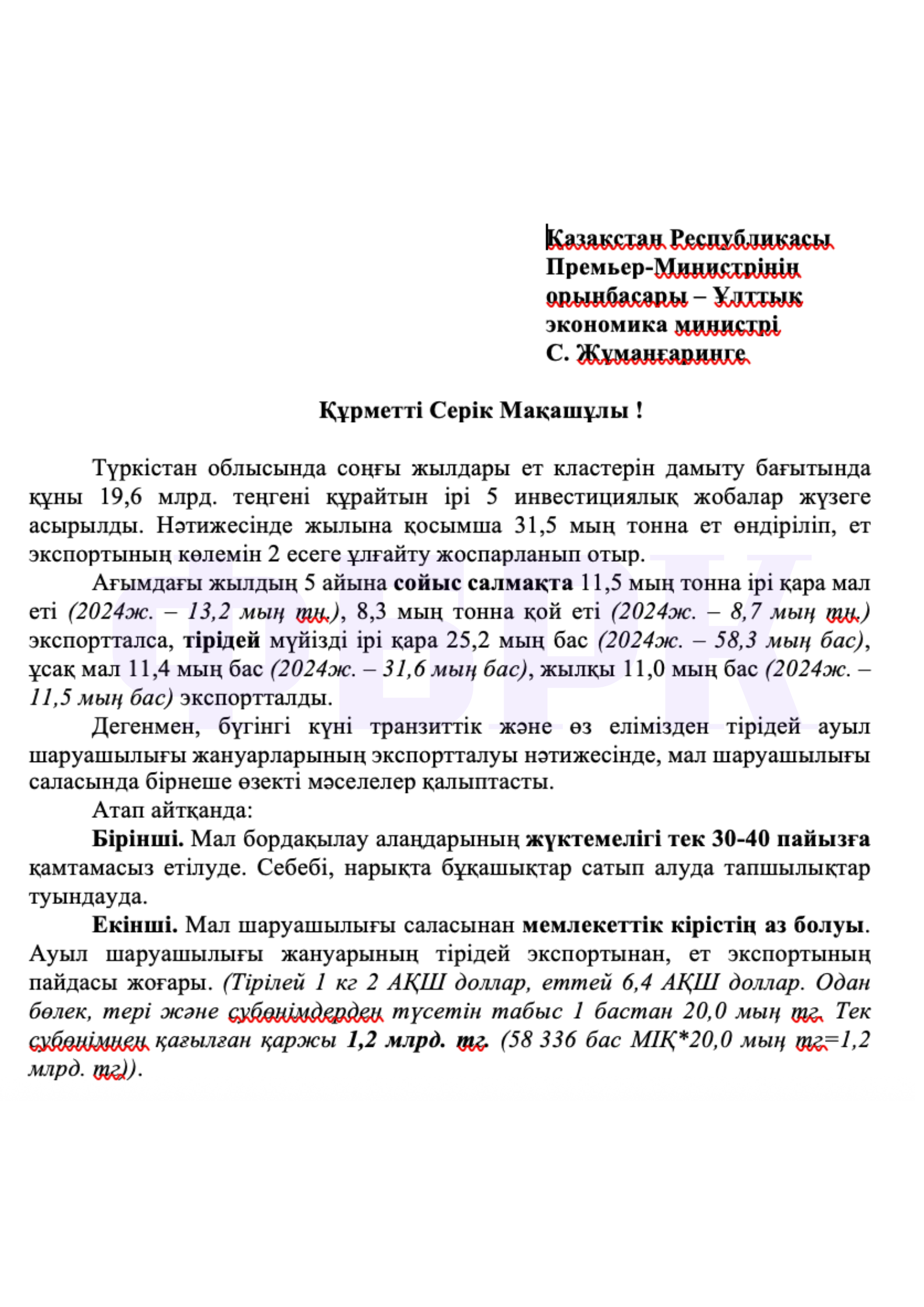
According to the appeal, during the five months of 2025, the region exported 25.2 thousand head of cattle, 11.4 thousand head of small livestock, and 11 thousand horses. For the same period in 2024, these figures were 58.3, 31.6, and 11.5 thousand head respectively. Despite the decline in live animal export figures, problems in the sector have intensified.
The document notes that feedlots in the region are only 30-40% full due to a shortage of bullocks for purchase. Meanwhile, the economy earns significantly less from live animal exports than it could: 1 kg of live weight costs about $2, while meat is exported at $6.4. Furthermore, hides and offal from a single animal can yield up to 20,000 tenge in income, but when exported live, the region does not receive this money. According to the Akimat's calculations, lost income from offal alone could amount to 1.2 billion tenge.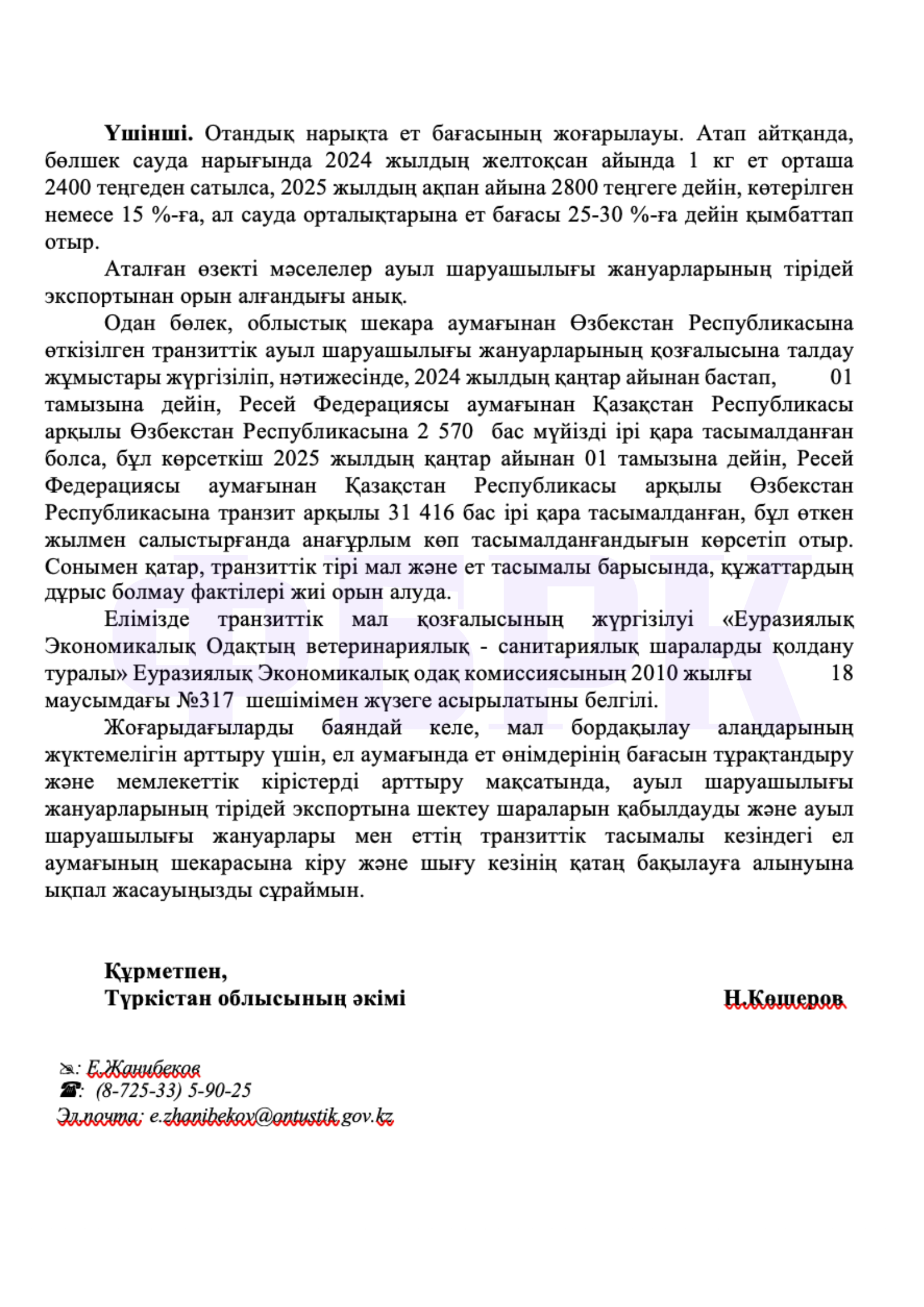
The issue of livestock transit
Special attention in the appeal is given to the transit of livestock through Kazakh territory. While from January to August 2024, 2,570 head of cattle were transported from Russia to Uzbekistan, for the same period in 2025 this figure rose to 31,416 head — an increase of more than 12 times. The Akim is asking for measures to be taken to limit the export of live animals and to establish strict controls upon the entry and exit of livestock across the state border.
To understand the situation, it is necessary to examine the documents that came into the possession of the editorial office.
Analysis of documents
The editorial office of the FBRK obtained a series of veterinary and transport documents related to the export of cattle from Russia to Uzbekistan via Kazakh territory. The documents include veterinary certificates, international consignment notes, Rosselkhoznadzor permits, and export declarations.
Upon studying the documents, several peculiarities were discovered. The sender is often listed as LLC "MYASEX" from Samara, and the recipient as IE TURGUNOV HALOL CHORVA from the city of Namangan in Uzbekistan. The route for these companies is almost always indicated as Dagestan — Saratov — Chelyabinsk — Novosibirsk — Kazakhstan — Uzbekistan, which appears logistically irrational and may raise questions about the purpose of such a route.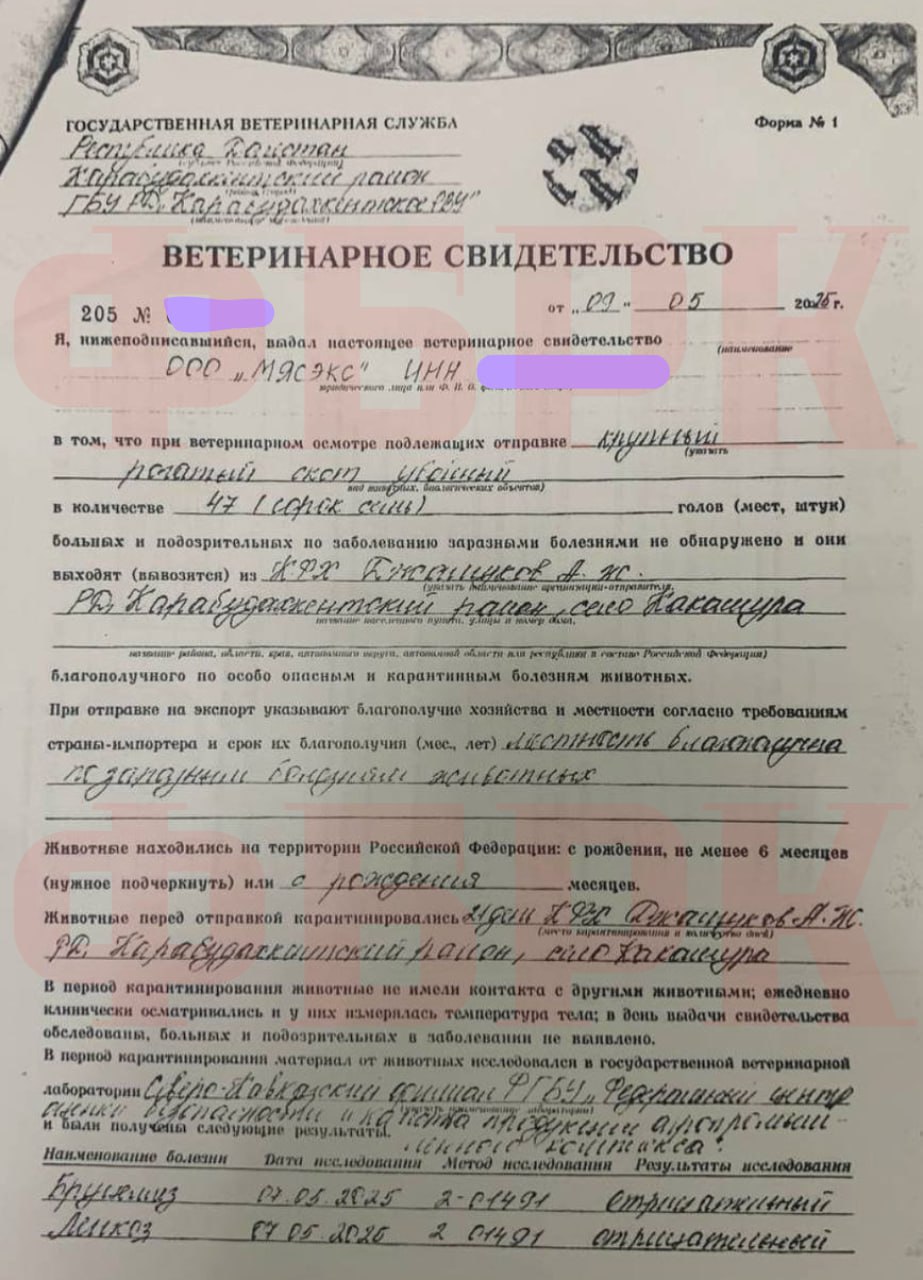
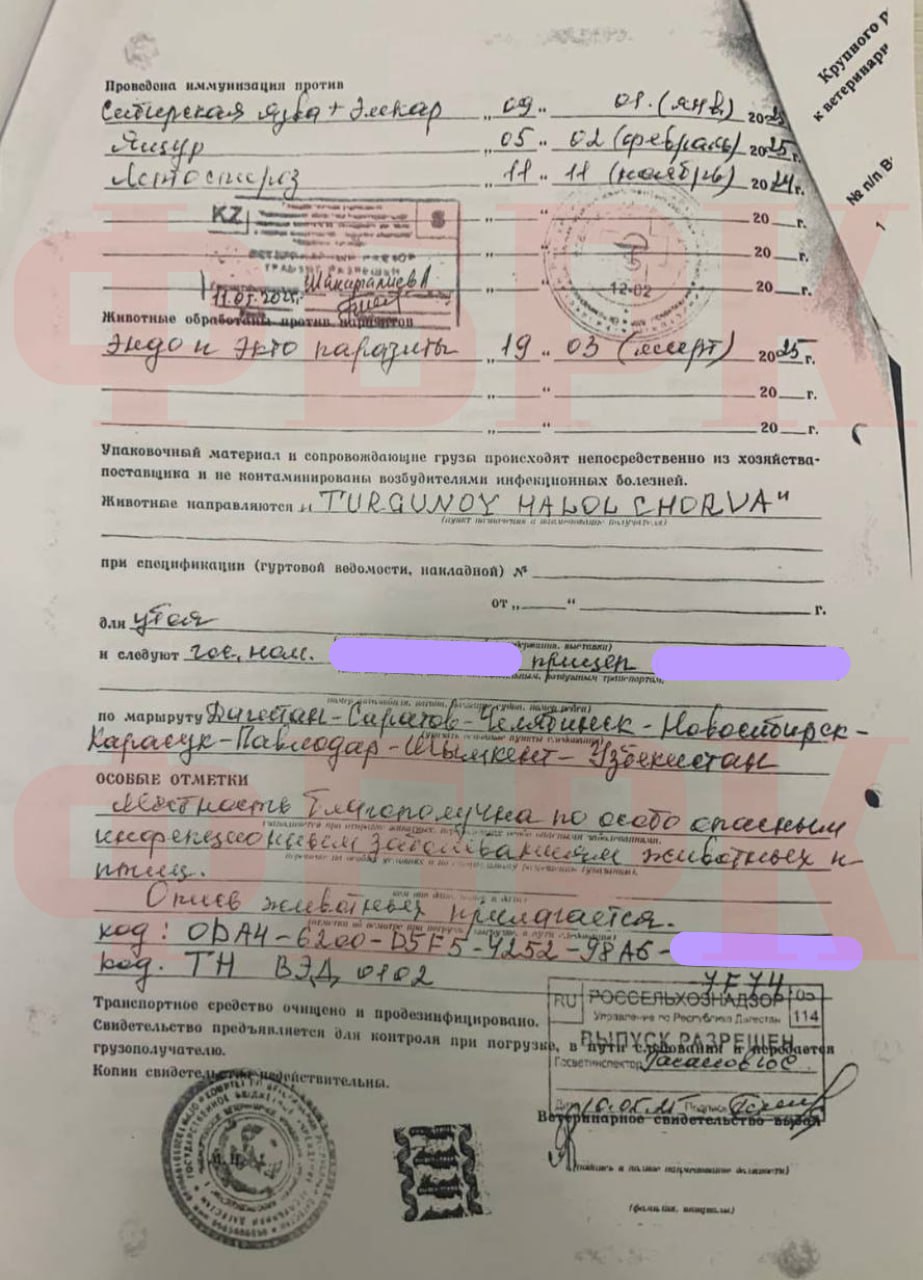
LLC "MYASEX" and LLC "Meridian", listed as senders in the documents, are not found in the "Cerberus" system — an automated information system of Rosselkhoznadzor. Registration in "Cerberus" is mandatory for all Russian and foreign companies importing or exporting controlled goods.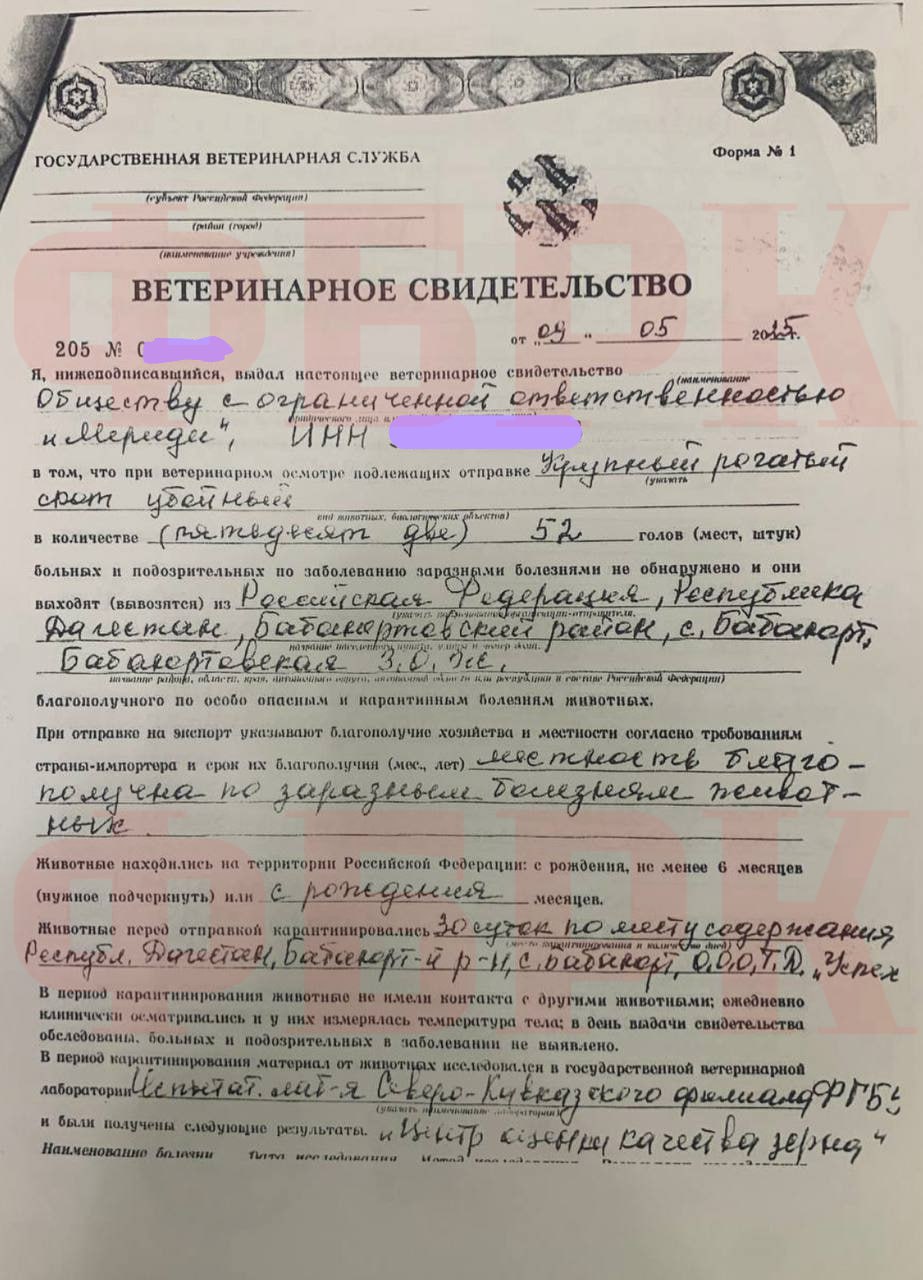
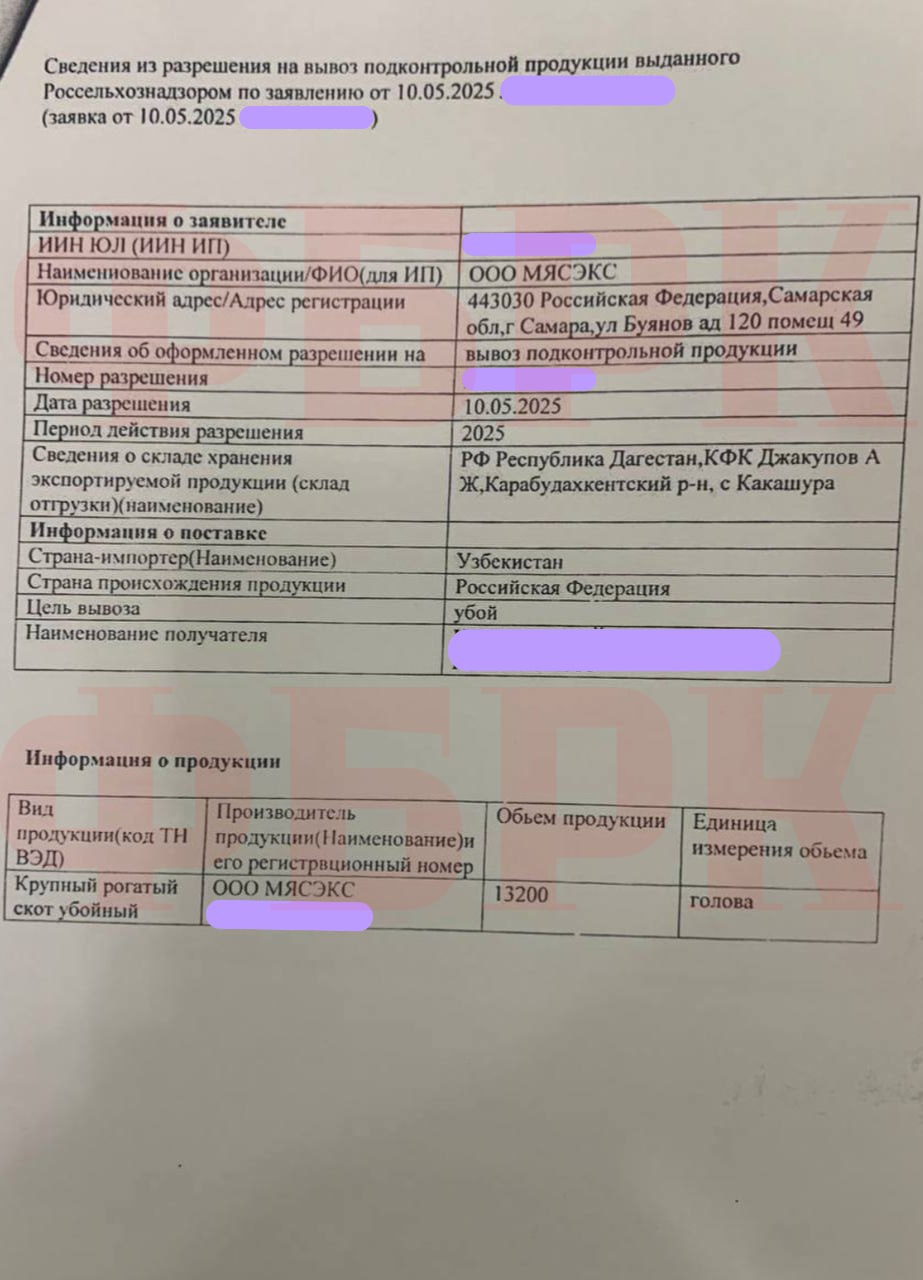
Their absence from the system may indicate that the companies either do not have the right to engage in such activities or are operating outside established procedures. This is likely what the Akim of the Turkestan Region is hinting at when he says in his appeal that "during the transit of live animals and meat, cases of incorrect documentation are often identified".
Also, in the documents, the results of tests for brucellosis and foot-and-mouth disease, as well as the numbers of laboratory test reports, coincide for different farms and different dates, which seems highly unlikely in real inspections.
The source claims that up to 6,000 head of cattle may have been smuggled out in this manner. If this information is correct, questions arise about the direction of movement of these animals and the impact of this process on the domestic market of Kazakhstan.
Possible export schemes
Analysis of the identified peculiarities suggests an alternative scenario. According to the documents, the livestock is in transit from Russia through Kazakhstan to Uzbekistan. However, it is possible that this is actually Kazakh livestock not authorised for export due to lack of permits, veterinary documents, or quotas.
In this case, Kazakh animals are documented using Russian transit documents, formally making them cargo moving in transit. As a result, the livestock leaves the country legally on paper, but in reality, these are domestic resources being taken out in circumvention of restrictions.
The following detail may serve as evidence for this version: the documents record the point of entry of the vehicle into Kazakhstan, but there are no records of exit from Russia. The vehicle appears already on the Kazakh side. Meanwhile, the exit point from Kazakhstan is clearly recorded. This may indicate that there was no actual crossing of the Russian border — the cargo was originally formed inside Kazakhstan, and the "transit" documents were prepared to legalise the export.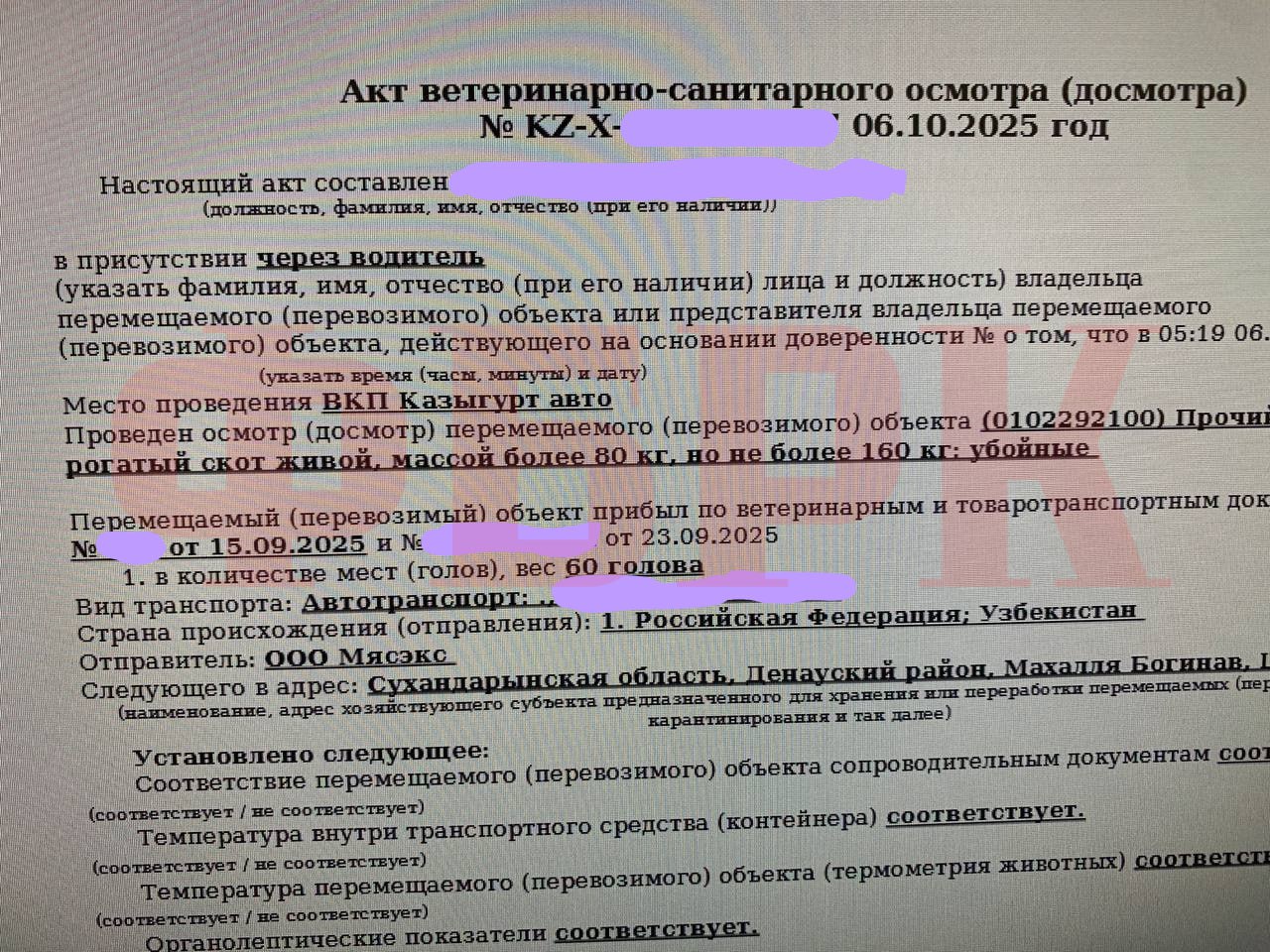
The source claims that since 2022, participants in foreign economic activity have mastered the production of documents of sufficient quality. This creates a situation where databases accumulate records about animals that supposedly passed through transit, but were actually removed from the country under the guise of someone else's cargo. As a result, statistics do not reflect real changes in livestock numbers, and regulatory authorities rely on distorted data.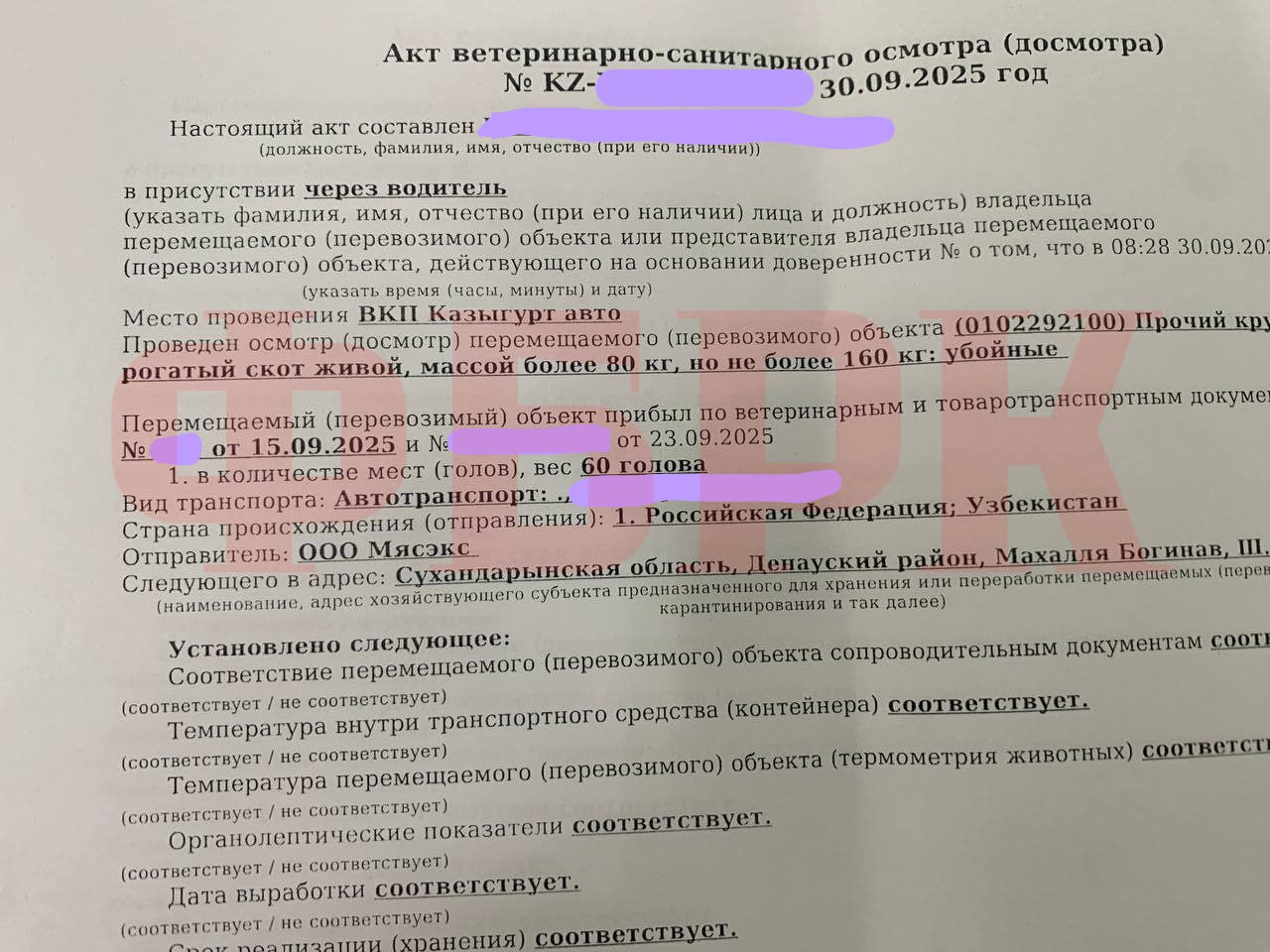
Economic consequences
When live animals are exported instead of processed meat, the state loses a significant portion of potential revenue. Meat exports generate several times more revenue (approximately a threefold difference in price), plus income from offal and hides remains outside the country.
If livestock is removed under the guise of transit, the state suffers double losses. Firstly, it loses income from processing. Secondly, such livestock effectively bypasses all established quotas and restrictions on export, leading to distorted statistics and decisions made by regulatory authorities based on incomplete data.
The rise in meat prices in Kazakhstan stands at around 25-28% per year for basic items. For a significant part of the population, beef and lamb are primary sources of protein, and their price increase impacts household budgets. Explanations of price rises based on global market conditions or inflation raise questions if, at the same time, tens of thousands of livestock are leaving the country and processing capacities are operating at 30-40%.
If the information presented is true, a situation may exist where a deficit is created on the domestic market, prices rise, and those who control export channels benefit. Meanwhile, consumers pay more for products, farmers cannot utilise their capacity, and the state budget loses billions of tenge.