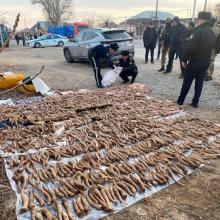
At the CITES conference in Samarkand on 5 December, 111 countries voted in favour of removing the zero export quota on saiga horns from the Kazakhstan population. The decision, which the authorities present as a triumph of environmental policy, in reality marks the end of a period full of contradictions, secrecy and unanswered questions.
The CITES Secretary General, Ivonne Higuero, justified the decision with impressive statistics: the number of saiga in Kazakhstan had allegedly grown from 21,000 to more than 4 million individuals. Only seven countries, including Mongolia, voted against. Kazakhstan’s Ministry of Ecology assured that the proceeds would be used to conserve biodiversity and restore ecosystems.
It is worth noting that from July to November 2025, Kazakhstan had already removed approximately 196,000 saiga. The carcasses were handed over to local processors.
The editorial team at FBRK began tracking the latest campaign to ‘remove’ saiga back in February 2024, when the Ministry of Ecology first announced its intention to obtain permission to sell horns.
By May, when the department began reporting allegedly record population numbers, we had published articles about the possible economic motives behind such a policy. The horns of the steppe antelope have traditionally been highly valued in Asian medicine, particularly in China, where they are believed to have healing properties.
On 27 June, Kazakhstan submitted an official application to the CITES Secretariat. This happened shortly before the official start of the campaign for the mass removal of saiga, which began in July. At that time, the state announced plans to remove up to 750,000 individuals.
The scientific data justifying the need for such unprecedented intervention remained unavailable to the public. Departments vacillated between justifications: at times citing copyright, and at others official secrecy. Concurrently, FBRK documented cases of illegal trade in saiga meat – the shadowy side of the campaign.
Notably, in 2023 the country had already undergone a saiga culling campaign, the catastrophic results of which were acknowledged (with promises to learn lessons) even by the relevant departments themselves. At the time, we documented scattered animal entrails, carcass processing at car washes, and spontaneous street trading. Meanwhile, the ministry was throwing around figures, the reliability of which provoked a storm of questions. Questions that never received any coherent answers.
In 2024, the scenario repeated itself with frightening precision, only on a larger scale. The Ministry of Ecology methodically deprived the public of any means of oversight. The scientific rationale was hidden behind bureaucratic excuses, while officials monotonously repeated the same figures, like a broken record.
Requests were ignored, open scientific debate was not permitted, and critical voices were dismissed.
Now the state has received international sanction to turn a conservation campaign into a commercial enterprise. Of course, it is a source of revenue – no one disputes that. But the stakes extend far beyond economics.
Complete secrecy surrounding processes that affect the public interest. Systematic disregard for citizen requests. A refusal of basic transparency under the pretext of official secrecy. These are all symptoms not of environmental policy, but of something entirely different.
And this brings us to the main question, which cannot be ignored. Who will control the sale of horns on the international market? Who will guarantee honesty in the distribution of profits? The same bodies that ‘ensured’ transparency during the removal campaign? The same officials who refused to provide scientific justifications, citing copyright and official secrecy?
The saiga story has long ceased to be simply an environmental issue. It is a perfect illustration of how a system operates without public oversight.
It is no coincidence that FBRK founder Kirill Pavlov now sits on the International Public Commission on Compliance with the Principles of the Aarhus Convention. FBRK is preparing a legal claim against the Ministry of Ecology for violation of the right of access to environmental information, guaranteed by that convention.