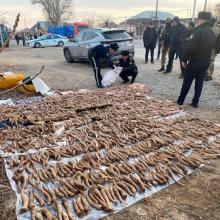
The horns of Red Book saiga antelopes are officially becoming a commodity. Vice-Minister of Ecology and Natural Resources Nurken Sharbiyev announced at a meeting of the Senate Committee on Agricultural Issues: the state will export the horns of the steppe antelope through a specially created company.
"We will export the horns entirely, they are entirely the property of the state," — stated Sharbiyev, answering senators' questions.
Currently, the trophies are stored in the warehouses of Okhotzooprom using a method supposedly recommended by scientists. However, exactly which scientists and what this method is — is not specified.
Recall that back in February 2024, the Ministry of Ecology announced its intention to obtain permission to sell horns by the beginning of 2025. In May of the same year, when the department began talking about supposedly record figures for the saiga population, the editorial board of FBRK already warned about the possible reasons for such a policy.
After all, the horns of the steppe antelope have traditionally been highly valued in Asian medicine, especially in China, where they are attributed with healing properties, and the international black market is willing to pay significant sums for them.
On 4 August, Kazakhstan submitted an official application to the CITES Secretariat for the removal of the zero quota on the export of saiga derivatives.
Now the authorities have moved to the final stage. It is reported that at the end of November — beginning of December, a meeting of an international environmental organisation will be held in Uzbekistan, with the participation of the European Union (and will they be shown the biological justification?), where the Kazakhstani issue of removing the quota will be considered.
If permission is granted, a company subordinate to the ministry will trade the horns — through electronic trading and auctions. The minimum price is planned to be set based on those countries where there is demand for the horns.
Incidentally, Mongolia, which once introduced this very quota, sets a condition — to export only processed products. Kazakhstan, however, is ready for any conditions: whether in powder form or as finished preparations.
According to the vice-minister, many investors are already entering the republic. It is reported that discussions are already underway "at the akimat level" with those who "want to set up factories and process them".
The authorities, it seems, are no longer even trying to hide the true reason for "regulating the saiga population". A commercial interest shines through any talk of "scientific" population management. And the most interesting thing is that the ministry is making grand plans even before receiving international permission to trade.
At the same time, according to the same Sharbiyev, over the past two years, more than 17,000 horns and over 500 saiga carcasses have been confiscated from poachers. The figures are impressive, but they only confirm the scale of poaching and the value of the horns on the black market. But do not worry. Because the state has now decided to take this market under its control, probably using the well-known principle - "if you can't beat them, join them".
And what about the biological justification? It remains hidden from the public. And although the editorial board of FBRK spent months trying to gain access to the biological justification for culling saigas, we met with one refusal after another. And when our editorial board appealed with an open letter to the Prime Minister, we were redirected with mocking politeness back to the Ministry of Ecology — to the very officials who built this non-transparent system.
Meanwhile, the saiga horns are "entirely the property of the state," as Sharbiyev made clear. But which state? The one where Red Book animals belong to the people? Or the one where decisions are made behind closed doors, scientific justifications are hidden from the public, and the profit from the sale of horns flows to a subordinate company?
The answer seems obvious. The state here is not us, but those who manage. They create companies, they trade, they profit. And for us, they have left the role of spectators who are not even shown the script of the performance.