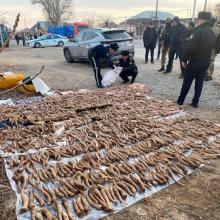
Kazakhstan has officially submitted an application to the CITES Secretariat for permission to sell saiga horns abroad.
This was reported by the Ministry of Ecology and Natural Resources in response to a request from BES.media.
On 27 June 2025, Kazakhstan submitted a corresponding application for the removal of the zero quota on the export of saiga derivatives. The final decision on this matter will be made at the CITES Conference of the Parties. Currently, trade in the horns of the rare steppe antelope is banned.
For reference: The Convention on International Trade in Endangered Species of Wild Fauna and Flora (CITES) is an international governmental agreement signed as a result of a resolution of the International Union for Conservation of Nature (IUCN) in 1973 in Washington.
The ministry noted that work is currently underway to determine the cost of saiga horns for sale outside of Kazakhstan. The pricing decision will be made taking into account the views of government bodies, scientific organisations, and in accordance with international obligations under the CITES Convention.
It turns out that the application was submitted before the official start of the campaign for the mass culling of the steppe antelope, which began in early July this year. Recall that the state plans to cull up to 800,000 saiga individuals. At the same time, the scientific data which supposedly justify the need for such large-scale intervention remain inaccessible to the public.
The authorities cite copyright on the one hand, and official secrecy on the other — apparently, they have not yet been able to settle on a definitive explanation. It gives the impression that transparency and openness in nature conservation matters have taken a back seat. Incidentally, will the justification be shown to the CITES parties?
Alongside the culling, trade in saiga meat has already been established at an approximate price of 1,600 tenge per kilogram. The Minister of Ecology, Erlan Nysanbaev, has even taken personal responsibility for the quality of the product. However, one can only guess whether he personally conducted a tasting before giving guarantees to consumers.
Returning to CITES, it is worth noting that in February last year, the Ministry of Ecology already stated its intention to obtain permission to sell saiga horns abroad by the beginning of 2025. And in May of that year, when representatives of the Ministry of Ecology had only just begun discussions about supposedly record population numbers of saiga, the FBRK editorial team already warned of the possible reasons behind such a policy.
After all, saiga horns have traditionally been highly valued in Asian medicine, particularly in China, where they are attributed with healing properties. The international black market is willing to pay significant sums for them. So, is the mass culling of saiga a way to legalise the trade in their horns under the guise of scientifically-based population management?
After all, the scheme appears quite neat: first, they classify the scientific justification for the need for culling, then they carry out a mass cull of the animals, while simultaneously submitting an application for the removal of international trade restrictions. And the end result is a legal commodity for export to international markets.
Of course, the Ministry of Ecology will claim that this is solely about scientifically-based population management. But why then is the scientific data classified? Why is the decision on mass culling being made at the same time as the application for international trade? And why is the ministry in such a hurry to obtain CITES permits?
One can only hope that the international community will carefully examine Kazakhstan's application and make a decision based on the interests of species conservation, rather than commercial gain.