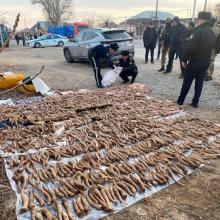
Kazakhstan has expanded the list of goods subject to mandatory digital marking, including saiga horns for the first time. The new rules will come into force on 1 December 2025. This sudden measure seems no coincidence against the backdrop of the state's active preparations for the commercialisation of steppe antelope derivatives.
Officially, digital marking is intended to track the path of goods from production to consumer and, according to the words of Deputy Minister of Trade, Asset Nusupov, to reduce the scale of illegal trade and counterfeiting. However, in the case of saiga horns, this measure appears in the context of long-standing preparations for their export, which has only been discussed relatively recently.
At the end of September, Vice-Minister of Ecology and Natural Resources, Nurken Sharbiyev, directly stated at a Senate committee meeting that the horns would be exported. According to him, the derivatives of the unique steppe antelope are "entirely the property of the state".
A specially created company subordinate to the ministry was supposed to trade them via electronic auctions. Currently, trophies from dubious 'seizures' are stored in 'Okhotzooprom' warehouses using a method supposedly recommended by scientists, but which specific specialists and what this method is are, as usual, not specified.
It is worth recalling that back in February 2024, the Ministry of Ecology announced its intention to obtain permission to sell horns by the beginning of 2025. When in May the department began talking about supposedly record saiga population numbers, the intentions seemed obvious to us: steppe antelope horns have traditionally been highly valued in Asian medicine, especially in China, and the international black market is ready to pay significant sums for them.
This is likely why, at the end of June, Kazakhstan submitted an official application to the CITES Secretariat for the removal of the zero quota on the export of saiga derivatives.
In November, the CITES CoP20 conference was held in Samarkand, where the Kazakh side's proposal to start trading saiga horns was discussed. The international wildlife conservation organisation WCS called for it to be rejected, warning that opening trade would increase demand for horns, complicate control of illegal trade, and pose a threat to the more vulnerable saiga populations in Mongolia, Russia, and Uzbekistan.
"The necessary systems for stock control, law enforcement, and compliance have not yet been created," said WCS Vice President for International Policy, Susan Lieberman.
The introduction of marking for saiga horns right now looks less like a conservation measure and more like technical preparation of the infrastructure for the legalisation of trade. We assume the goal of the digital accounting system is to create the appearance of control and transparency when the state enters the international market. And, judging by everything, neither an outraged public nor the opinion of international partners will stop the Ministry of Ecology on this path.
Note that in addition to saiga horns, mandatory marking will apply to brewing products and motor oils - from 1 February 2026, as well as light industry goods - from 1 December 2026.