The Ministry of Agriculture has officially stated that there is no foot-and-mouth disease in Kazakhstan. Meanwhile, the editorial team of the FBRC continues to receive reports from farmers in the West Kazakhstan Region (WKR), Aktobe Region, and North Kazakhstan Region (NKR) — about mass livestock deaths, ineffective vaccines, and complete bewilderment in the face of a disease whose symptoms state veterinarians are not officially naming.
MINISTRY OF AGRICULTURE DENIES FOOT-AND-MOUTH DISEASE
In response to a request from the «APK News» agency, the Ministry of Agriculture (MoA) officially reported that, «as of the current date, no cases of foot-and-mouth disease have been registered on the territory of the Republic of Kazakhstan. The epizootic situation is being monitored by the veterinary service.»
Furthermore, in connection with the worsening epizootic situation in Russia, a large-scale vaccination of livestock was announced. The vaccines supposedly even contained relevant strains produced by JSC NH «QazBioPharm» and FSBI «ARRIAH».
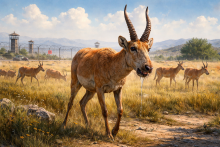
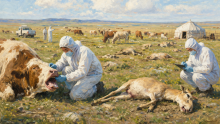
As an explanation for the „depressed“ state of the saiga antelopes, the department cited a «high degree of ectoparasitic infestation» — that is, infestation with ixodid ticks. Foot-and-mouth disease was not detected. According to the ministry, biological samples have been sent to the laboratory.
Thus, the official position remains unchanged: there is no threat, the situation is under control, and prevention is ongoing.
THREAT OF AN EPIDEMIC
Majilis deputy Albert Rau holds a somewhat different assessment. In his words, installing fences around fields and lands is not capable of stopping the saiga invasion, and therefore, also not the spread of diseases. The deputy again raised the issue with the Ministry of Ecology regarding the need for manual population control of these animals.
The situation, according to the deputy, is «very serious», and farmers are right in their concerns about pasteurellosis — he says nothing like this has occurred since the 1970s.
«There is no other option besides population control,» the deputy stated, adding that the issue is no longer just a threat to agriculture, but a potential threat of an epidemic.
WHAT LIVESTOCK BREEDERS ARE SAYING
The FBRC continues to receive reports from livestock breeders. Moreover, the picture painted by people on the ground differs dramatically from the official rhetoric.
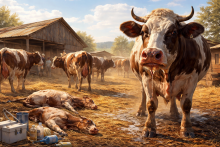
In the Zhanibek district of WKR, farmers report that initially, vaccination was carried out against foot-and-mouth disease, but they say they are now being told it is pasteurellosis. People are confused. In the Kaztalovka district of WKR, they speak of horses being affected: muscles swell, animals go lame, foals are stillborn or die shortly after birth. The administered vaccine shows no results, and antibiotics have no effect.
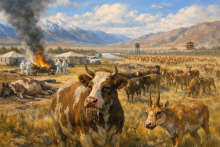
In NKR, the head of one farm reports the death of saiga antelopes in the steppe — not near homes, but close by. People are forced to burn the carcasses of the dead wild animals themselves. Concurrently, the death of mares is being recorded — including those that had previously produced offspring without issue for many years. This year, farmers are observing a sharp deterioration: death during or immediately after birth, and in several cases both the mother and foal die simultaneously. According to the observations of the livestock breeders, horses and cattle (bovines) show different clinical pictures.
Furthermore, farmers definitively link the onset of the mass livestock deaths to the arrival of the saiga antelopes.
SELF-MEDICATION AS A FORCED SYSTEM
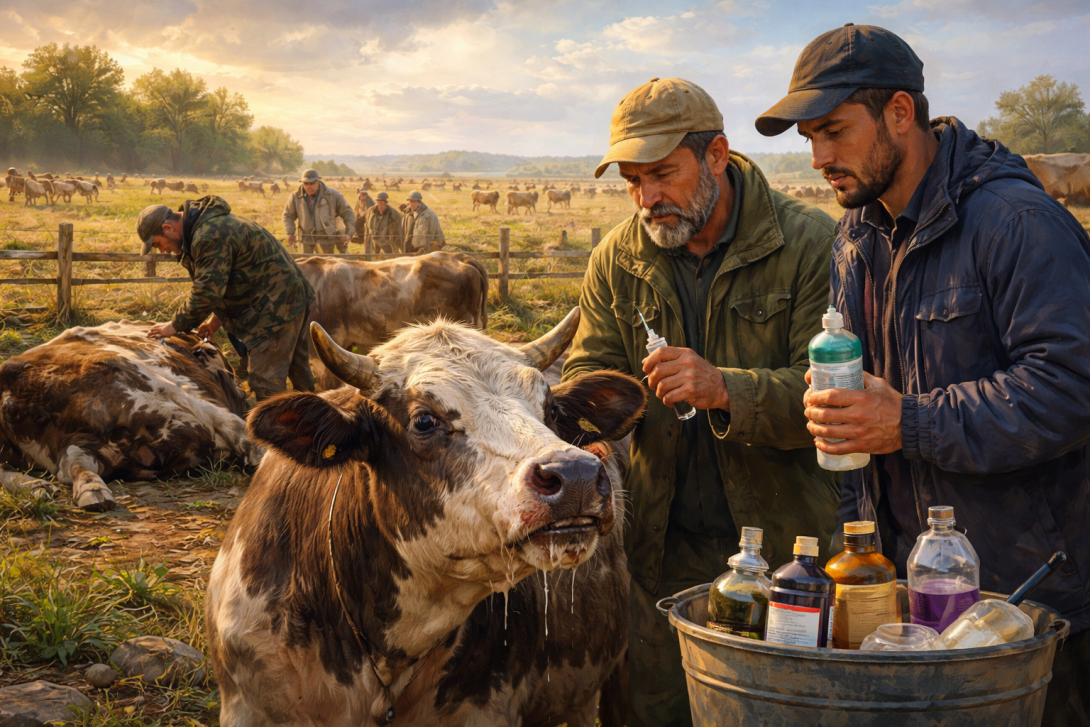
Against the backdrop of diagnostic uncertainty and the absence of clear official recommendations, farmers were forced to develop their own treatment regimens. These include washing the oral cavity with potassium permanganate solution, local treatment with special sprays, lubricating damaged tissues with a mixture of cod liver oil and tar, treating limbs in copper sulphate footbaths, and administering antibiotics and vitamin preparations.
It is worth noting that recently, the editorial team of the FBRC reported on other methods of «self-treatment», where animals are treated with diesel fuel, kerosene, and used oil — substances unacceptable in veterinary medicine. Concurrently, as reported by Professor Gaisa Absatirov, there is the uncontrolled use of antibiotics, which are powerless against the causative agent during a viral infection but instead create antimicrobial resistance — resistant strains of bacteria that are already dangerous to human health.
More details about this are available on the FBRC website and on our YouTube channel «Fund-Bureau for Corruption Investigation», where you can see the full picture of what is happening.
One of the frequently mentioned drugs is «Nitox Forte», a combined injectable antibiotic based on oxytetracycline with an anti-inflammatory component, used, among other things, for pasteurellosis in cattle. Farmers note a sharp increase in its price. This indirectly indicates the scale of demand, as well as the fact that people are trying to cope on their own, without systemic support.
It is fundamentally important to note that foot-and-mouth disease is a viral disease, and antibacterial drugs do not work on its causative agent. If the diagnosis is foot-and-mouth disease, the use of antibiotics may only alleviate secondary bacterial complications but will not stop the disease. The farmers themselves understand this, and therefore, the question of an accurate diagnosis is not abstract for them, but a purely practical one.
QUARANTINE OR COVER-UP?
Among the farmers' complaints, another alarming theme emerges — an economic one. Some livestock breeders openly state that if the disease were officially recognised and quarantine declared, the WKR would lose access to export meat markets for a year or two. Prices would collapse. It would become impossible to service loans.
Farmers point to Russia's experience, where after the introduction of quarantine due to pasteurellosis, affected parties supposedly received compensation for losses from the regional budget.
A fundamental question in this regard: Does a mechanism for compensating losses exist in Kazakhstan when quarantine measures are imposed? Is its absence or lack of transparency an additional incentive for livestock breeders and local veterinary services to prefer not to officially register the disease?
THE SAIGA AS THE ETERNAL SCAPEGOAT
The saiga is a wild animal, migrating across the steppe. It bears no legal responsibility for the epizootic situation in the country. Its population is a matter for the Ministry of Ecology. Its potential role as a disease carrier is a matter of veterinary monitoring, which is the duty of the Committee for Veterinary Control and Supervision of the MoA.
When a Majilis deputy directs his complaints to the Ministry of Ecology demanding they «control the population», and farmers demand «permission to cull» — this is an understandable reaction to a specific threat. However, it sidesteps a more important question: why has the veterinary control system reached a point where farmers are themselves searching for treatment regimens on the internet and in messenger apps, buying antibiotics themselves, and burning carcasses themselves? Are the saiga to blame for this too?
Veterinary control is not the function of the saiga. It is a function of the state. Planned vaccination, epizootic monitoring, prompt laboratory confirmation of a diagnosis, clear protocols for farmers when a particularly dangerous disease is suspected — all these are tools that should exist independently of how many saiga antelopes roam the steppe.
Professor Gaisa Absatirov, even during the height of the crisis, insisted on signs of foot-and-mouth disease in the WKR and pointed out that the authorities were passing it off as pasteurellosis. The MoA refuted this. Biological samples are under analysis. Neither side possesses publicly verifiable laboratory data that would allow drawing a definitive conclusion in the debate over the diagnosis. It is this diagnostic vacuum, not the saiga themselves, that is the main crisis factor.
The official position currently is: foot-and-mouth disease is not confirmed in the country. However, this statement still does not answer the main question — which exact disease are farmers facing in different regions. Until the results of laboratory tests are presented publicly and verifiably, the situation remains in a state of diagnostic uncertainty. This means we are not dealing with a closed topic, but with an ongoing crisis in which a key element is missing — a clear and proven diagnosis.