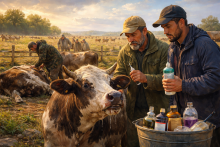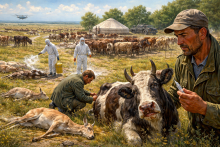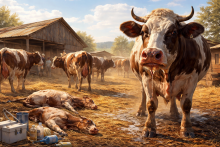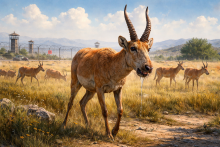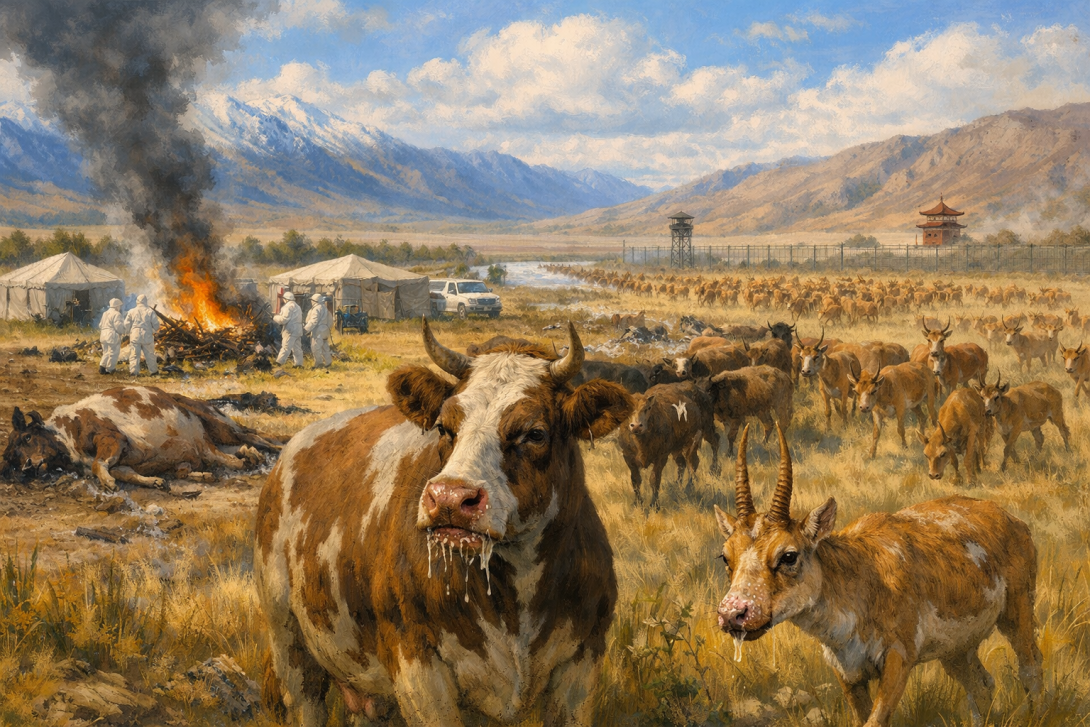
The editorial team of FBRK has been monitoring the potential spread of foot-and-mouth disease in the region since February 2026. During this time, we have published several major pieces — on the mass slaughter of livestock in Russia, on the disease approaching through saiga antelopes, and on classified veterinary statistics. On each occasion, official agencies remained silent. However, today the situation has reached a point where silence is no longer possible: everything indicates that the disease is within the country, saiga are dying, farmers are raising the alarm, and the ring of epizootic pressure — from Siberia to Xinjiang — has closed. Our editorial office continues to receive reports from livestock farmers, video footage from the ground, and internal documents which, we believe, state bodies would prefer not to bring to light.
WHAT HAPPENED
In February 2026, FBRK was one of the first Kazakhstani publications to draw attention to the large-scale slaughter of livestock in the Novosibirsk, Omsk, and Sverdlovsk regions, and the Altai Republic, describing the link between Russian veterinary measures and the epizootic situation in Kazakhstan. Officially, Russian authorities spoke of pasteurellosis and rabies. But the protocol used — destruction of all susceptible animals within a radius of up to 5 km, burning of carcasses, police checkpoints, refusal of independent expert examination — exactly replicated the procedure for combating foot-and-mouth disease. At the time, the founder of FBRK, agricultural expert Kirill Pavlov, noted that the scale of the measures clearly did not resemble pasteurellosis.
In March, we highlighted the fact that veterinary statistics in Kazakhstan are closed with the classification "DSP" — "for official use only". FBRK's request to the Committee for Veterinary Control and Supervision of the Ministry of Agriculture (CVCV MA) for the number of disease outbreaks and vaccination coverage was met with a refusal. Notably, the Committee for Sanitary and Epidemiological Control of the Ministry of Health provided similar statistics on brucellosis in humans openly.
As early as April, our editorial team recorded the first videos of sick saiga antelopes from the Kaztalovka district of the West Kazakhstan Region (WKR) and published the assessment of Doctor of Veterinary Sciences Gaisa Absatirov: the symptoms — elevated temperature, lesions of the oral mucosa, lameness, mass mortality — exactly matched the clinical picture of foot-and-mouth disease.
Today, these publications are no longer a forecast, but rather an accomplished fact, which the relevant departments are somehow in no hurry to discuss.
SAT1 FROM SIBERIA
While Russian officials denied foot-and-mouth disease, attributing the death of thousands of livestock to pasteurellosis, Siberian media and independent sources reported something quite different. A recently published report from the Siberian Interregional Directorate of Rosselkhoznadzor, dated 29 January 2026 and addressed to the head of the federal service for veterinary and phytosanitary surveillance, Rosselkhoznadzor, Sergei Dankvert, proved particularly interesting. The document is signed by the directorate's head, Alexander Bayev.
The document indicates that foot-and-mouth disease was detected in the Cherepanovo district of the Novosibirsk region, on the premises of ZAO Stud Farm "Medvetsky" and OOO "Sibirskaya Niva" (the livestock complex "Ogneva Zaimka"). The first clinical signs were recorded on 16 January 2026. Laboratory confirmation was obtained on 24 January. According to the document, clinical manifestations were registered in approximately 2,500 head out of about 10,000 on the aforementioned premises.
Moreover, laboratory tests at the veterinary laboratory in Vladimir identified the subtype SAT1 — the very strain that is not included in the vaccine currently in use. This same strain was previously detected in China (Gansu Province and the Xinjiang Uygur Autonomous Region) — on the border with Kazakhstan.
Contaminated raw milk, totalling 2,672,840 kg, was shipped to processing plants in the Altai Territory, Omsk Region, and Novosibirsk Region. 58 head of cattle were moved from the affected farms. 388 people were placed under medical observation. Products from companies such as JSC "Wimm-Bill-Dann", OJSC "Tatarsky Maslokombinat", JSC "Tolmachevsky Dairy Plant", and OOO "Gulliver" were in circulation. Preliminary orders were given for the destruction of approximately 4,000 head of cattle — using a bloodless method followed by incineration.
The document has existed since the end of January. According to Siberian media, Rosselkhoznadzor suspiciously quickly moved to denials when information began to surface in the public domain. The fact that internal documentation was made public not through official channels but via an unknown source is, in itself, quite telling.
If you overlay this data on the picture FBRK described back in March, only one conclusion is possible: there was foot-and-mouth disease in Siberia, strain SAT1, and it was spreading under conditions of information control.
KAZAKHSTAN SURROUNDED
The situation that Professor Gaisa Absatirov described and that the FBRK editorial team recorded can no longer be called hypothetical. It appears that Kazakhstan has found itself within a ring of epizootic pressure.
From the north and west — Russia. The document-confirmed presence of SAT1 in the Novosibirsk region, whose range covers an area bordering the North Kazakhstan and Pavlodar regions. Mass livestock slaughter in the Omsk and Sverdlovsk regions, the Altai Republic, and several other areas.
From the east — China. An officially confirmed outbreak of foot-and-mouth disease in Gansu Province and the Xinjiang Uygur Autonomous Region — directly on the Kazakhstani border. The identified strain is highly contagious, resistant to the vaccines used in China, and was presumably introduced from abroad. This is the only country in the region that has submitted an official notification to the World Organisation for Animal Health (WOAH).
From the south and southwest — attempts to transit sick livestock have been recorded through Kazakhstan towards Uzbekistan and Kyrgyzstan, whose veterinary services, according to Professor Absatirov, are also concealing the true epizootic situation.
From within — the saiga antelopes. This is a separate and perhaps the most unmanageable threat.
THE SAIGA AS A LIVING VECTOR
The FBRK editorial office continues to receive video footage from the WKR: lame, disoriented animals with profuse drooling. Farmers from the West Kazakhstan Region describe how sick saiga approach their herds — staggering, foaming at the mouth, with sores on their muzzles. It is reported that animal carcasses lie everywhere — not only along roads, where they are occasionally cleared, but also on pastures where no one comes. According to farmers, veterinarians are overwhelmed: they are constantly visiting farms, treating livestock, and physically have no time to deal with wild animals. There is a shortage of specialists.
Incidentally, the saiga are expected to give birth to lambs soon. During this period, the antelopes gather in huge concentrations in one place — the entire region, all individuals together. Then the herds will move along traditional migration routes. If the disease is not brought under control by then, it will be dispersed across the steppe by thousands of animals that cannot be stopped by quarantine or checkpoint.
This is precisely why Professor Absatirov calls the saiga "a very dangerous vector from an epizootic perspective": an animal can cover hundreds of kilometres in a day, cross several regions, and not present any documents at the border.
WHERE DID FOOT-AND-MOUTH DISEASE COME FROM, AND WHY ARE WE ONLY FINDING OUT NOW?
SAT1 is the so-called "South African territorial type" of the foot-and-mouth disease virus. Its appearance in Siberia and Xinjiang is, in itself, an event requiring explanation. Where did it come from in the centre of Eurasia?
The most obvious version is introduction through trade chains. The movement of live animals, products, and feed. China itself indicated that the appearance of the strain "is presumably linked to introduction from abroad". But from which border? Through which corridor? These are questions that WOAH, national services, and joint investigations should be answering. Instead, each country remained silent in isolation while the disease spread.
The concealment mechanism is the same everywhere: admitting to foot-and-mouth disease means losing WOAH disease-free status, closing export markets, and paying compensation. Russia obtained disease-free status from foot-and-mouth disease in May 2025. Losing it would have immediate economic consequences. Kazakhstan is also interested in maintaining its veterinary status. The administrative logic is understandable. But this is precisely where the line lies between administrative interest and the real threat to millions of animals and hundreds of thousands of farmers.
The epizootic continues. Farmers continue to lose livestock. Saiga continue to die in the steppe. And against this backdrop, one wants to ask: where is the Ministry of Ecology, responsible for the saiga? Where is the Ministry of Agriculture with its plan to combat the unknown strain? Where is the CVCV with open data on the real vaccination coverage? Finally — where is the vaccine that actually works against the circulating virus?
These are not questions our editorial team is asking for the first time. But now they sound different — because the ring around Kazakhstan has already closed, and the virus is no longer over the horizon.