In three regions of Kazakhstan, livestock and saiga antelopes continue to die with identical symptoms: ulcerated oral cavity, lameness, mass mortality of young animals. The official diagnosis is pasteurellosis, and the situation, as usual, is "under control". Doctor of Veterinary Sciences Gaisa Absatirov claims the opposite: this clinical picture does not occur with pasteurellosis. The FB RK editorial team continues to investigate why an accurate diagnosis has not yet been made — and who benefits from this uncertainty.
WHAT THE AUTHORITIES SAY: PASTEURELLOSIS, VACCINATION, CONTROL
On 28 April 2026, the head of the veterinary department of the West Kazakhstan Region (WKR) Abzal Braliev spoke at a briefing of the regional communications service. The picture he painted seemed relatively manageable: in 22 rural districts of the WKR — covering 130 farms and 69 private homesteads — out of more than 40,000 head of cattle, signs of disease were identified in 5,484 head (15%), of which 3,732 (68%) have already been treated. 217 head of cattle have died, of which 189 were calves, as well as 11 sheep. According to the official, the disease is spreading from saiga habitats.
The diagnosis is pasteurellosis. 4.5 million doses of veterinary drugs have been delivered to the region. In turn, vaccination against foot-and-mouth disease, according to the department, has already covered 1,822,921 head.
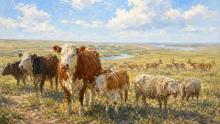
Simultaneously, the head of the territorial inspectorate for forestry and wildlife of the WKR, Nurlan Rakhimzhanov, reported on the saigas. Preliminary data indicates there are between 1.9 and 2 million individuals in the region. To date, 3,281 saiga carcasses have been destroyed — 1,547 males, 1,617 females, and 117 young. The diagnosis for the dead animals, unsurprisingly, is also pasteurellosis. The first samples from two dead individuals were taken as early as 8 April near the village of Saikhin. A laboratory in Astana supposedly confirmed this diagnosis.
"The situation is under control" — this is the general leitmotif of the official statements. Burial pits are overflowing, there are not enough excavators, the death of saigas is increasing daily, but this is presented as a logistical problem, not an epizootic one.
WHAT FARMERS SEE: A PICTURE THAT DOESN'T FIT PASTEURELLOSIS
While officials talk about figures at the briefing, the FB RK editorial office continues to receive appeals and video recordings from livestock farmers.
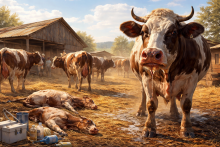
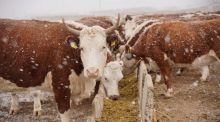
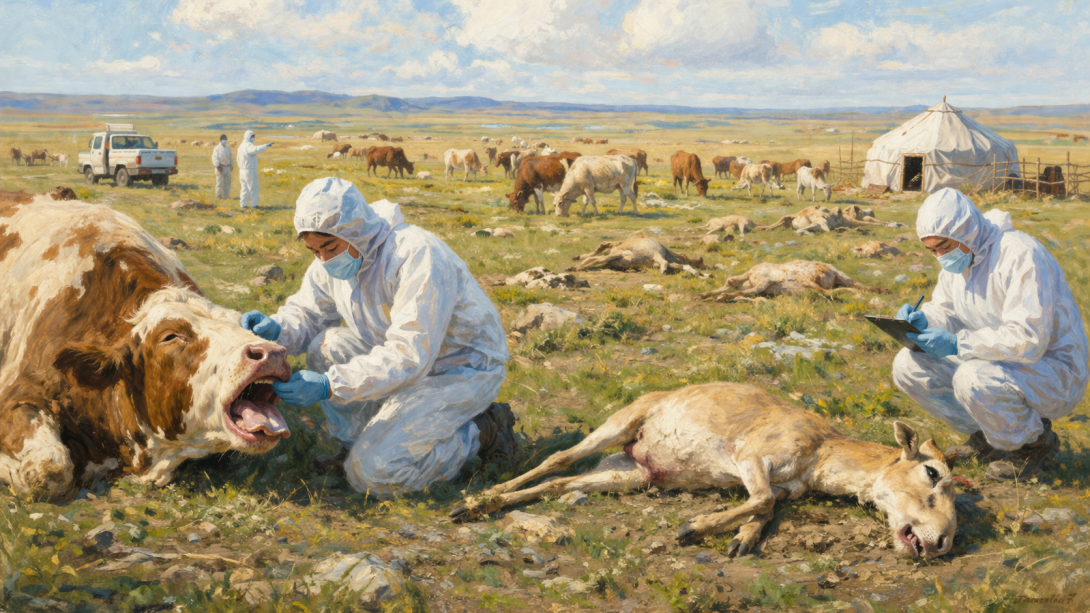
Among them are numerous videos showing cows with torn tongues and deep lesions in the oral cavity. The wound does not resemble a mechanical injury: the mucous membrane is destroyed, the animal cannot eat. Other recordings show cows and saigas limping in the same way: unnaturally, as if every step causes pain. The lameness affects several legs at once; the animals literally drag themselves. Footage from the steppe shows scattered saiga carcasses — not individual ones, but dozens, lying in heaps right out on the open plain, where, according to farmers, no one comes to clear them away. Particularly alarming are video recordings of live saigas near fences: the antelopes try to overcome the obstacle, some fall and do not get up again.
Reports are coming not only from the WKR. Farmers from the Kostanay region are also writing about an "unknown disease" in livestock. On social media, concerned livestock farmers are openly recording what is happening. Video recordings from farms are spreading across the internet.
Farmers' appeals, as well as the video recordings we have received, can be expected in our next release on our YouTube channel "Fund-Bureau for Corruption Investigation", where the full picture of what is happening can be seen.
DIESEL INSTEAD OF A DIAGNOSIS: WHAT LIVESTOCK ARE TREATED WITH WHEN THE STATE DOES NOT RESPOND
And here begins a story which, undoubtedly, deserves a separate discussion, and which the official briefings apparently prefer to ignore.
When the state does not provide a diagnosis, and the vet is overloaded and visits at best once every few days, the farmer acts as best he can. Professor Gaisa Absatirov documents what is happening on farms right now: veterinary specialists and owners of private subsidiary plots are attempting to carry out treatment procedures using diesel fuel, used engine oil from vehicles, and kerosene. These substances are unacceptable for use in veterinary medicine, but today they are being used to treat affected hooves and mucous membranes of sick animals in the WKR, Karaganda, and Kostanay regions.
Simultaneously, there is uncontrolled use of antibiotics. This is an understandable reaction: with inflammation and ulcers, an antibiotic seems like a logical solution. Only, if the disease is viral — and the clinical picture of foot-and-mouth disease is exactly that — antibiotics are powerless against the pathogen. They may dull secondary bacterial complications, creating an illusion of treatment while the virus continues to spread.
But the consequences of this therapy are not limited to its uselessness. Professor Absatirov notes that the uncontrolled and incorrect use of antibiotics leads to antimicrobial resistance — the formation of resistant bacterial strains that then cannot be treated in humans. Dysbiosis, allergic reactions, diseases becoming chronic — these are not hypothetical risks; these are the documented consequences of precisely this practice.
This is a direct consequence of the information vacuum: without an accurate diagnosis, the farmer treats blindly. And pays for it twice — first with livestock that do not recover, and then with antibiotic resistance, which will remain in the environment long after the epizootic is over.
WHAT SCIENCE SAYS: PASTEURELLOSIS DOES NOT LOOK LIKE THIS
Professor Gaisa Absatirov is certain: the symptom complex currently recorded in cattle, small ruminants, and saigas — fever, excessive salivation, ulcerative lesions of the oral and nasal cavities, lameness and skin lesions of the interdigital cleft, mass mortality of calves — does not correspond to the clinical picture of pasteurellosis. In saigas, additional symptoms include infestation by blood-sucking ticks and abortions of underdeveloped embryos.
"Pasteurellosis occurs in oedematous, thoracic, and septic forms," Professor Absatirov points out, "that is, without clinical signs of damage to the mucous membranes of the oral and nasal cavities, lameness, and damage to the skin of the interdigital cleft."
In other words, the official diagnosis and the observed symptoms are two different diseases.
In turn, the described picture exactly corresponds to foot-and-mouth disease — a highly contagious viral disease of cloven-hoofed animals, which manifests precisely in this way: blisters and ulcers on mucous membranes, lameness due to lesions in the interdigital area, mortality in young animals, mass spread within the herd.
Professor Absatirov raises another critical question. In mid-April, a commission consisting of specialists from the National Reference Centre for Veterinary Medicine, the Committee for Veterinary Control and Supervision of the Ministry of Agriculture (CVC&S MA RK), and local authorised bodies travelled to the locations and migration routes of the saigas. Following the visit, pathological material was collected — from one saiga. The results of the laboratory examination are promised within 20 days.
The question arises naturally: is biological material from one animal sufficient for an expert conclusion? And, crucially, is such a waiting period justified? For reference, by generally accepted standards, a diagnosis of foot-and-mouth disease with determination of the circulating virus type is made within 3 days. Pasteurellosis is diagnosed within 5 days. Delay in this case benefits neither the farmers nor the state.
A MIRROR FROM SIBERIA: PASTEURELLOSIS THAT WAS TREATED FOR FOOT-AND-MOUTH DISEASE
To understand the logic of what is happening in Kazakhstan, it is enough to look at what happened several months earlier in Russia.
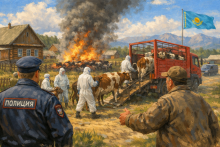
In late 2025 and early 2026, a large-scale outbreak of livestock disease was recorded in Siberia. The official diagnosis was pasteurellosis. Russian authorities maintained this version consistently. However, the protocol applied — destruction of all susceptible animals within a radius of several kilometres, burning of carcasses, checkpoints involving security forces, refusal of independent expertise — exactly replicated the procedures for combating foot-and-mouth disease, not pasteurellosis.
The FB RK has previously described the outcome of this story in detail: an internal document from the Siberian Interregional Directorate of Rosselkhoznadzor, dated 29 January 2026, confirmed the detection of foot-and-mouth disease strain SAT1 in the Novosibirsk region. This strain was not included in the vaccine being used. And it had previously been recorded in China, in Gansu Province and the Xinjiang Uyghur Autonomous Region, right on the Kazakh border.
Now the same scenario is playing out in Kazakhstan: the official diagnosis is pasteurellosis, but everything happening around it points to foot-and-mouth disease. Simply put, Kazakhstan is now in the same position Russia was in January.
"THE DISEASE IS SPREADING FROM SAIGA HABITATS"
Among the official statements, there is one phrase worth reading with particular attention. The head of the veterinary department of the WKR, Abzal Braliev, stated directly: "The disease is spreading from saiga habitats".
This admission is important, and not just factually. Pasteurellosis in saigas is a known phenomenon, registered periodically. However, it does not lead to mass mortality on such a scale, does not produce a clinical picture with destruction of the oral cavity and lesions of the interdigital cleft, and, crucially, does not transmit to agricultural animals with such rapidity.
The saiga as a vector is the key epizootiological argument against the pasteurellosis version. Because foot-and-mouth disease spreads through contact between wild and domestic cloven-hoofed animals with that very speed. It is foot-and-mouth disease that produces the symptoms seen in video recordings from the steppe: a bloody oral cavity, disoriented movement, collapse, and death.
Professor Absatirov specifically draws attention to the fact that abortions of underdeveloped embryos are recorded in affected saigas — a sign uncharacteristic of pasteurellosis and fitting the picture of severe viral infection.
EXPORT OR LIVESTOCK: WHAT IS TRULY AT STAKE FOR THE AUTHORITIES
According to Professor Absatirov, official veterinary bodies directly acknowledge their concern about the potential suspension of animal and product exports if a dangerous diagnosis is confirmed. This largely explains the caution in diagnosing: admitting foot-and-mouth disease means losing veterinary status in the system of the World Organisation for Animal Health (WOAH) and closing export markets.
But what exactly is intended for export if the productivity of sick animals sharply declines? If calves are dying en masse, then herd reproduction is already decreasing, without any quarantine. If saigas, whose derivatives are a valuable export resource, are dying in their thousands and being burned in a general mass of carcasses without counting or separate disposal, these are direct losses that no export status can compensate.
The professor suggests the Ministry of Agriculture conduct a simple analysis: what will Kazakhstan gain by protecting its export status through concealing the diagnosis, and what will it lose if the epizootic situation continues to deteriorate without targeted intervention? This question remains publicly unanswered.
In other words, currently the authorities are trying to save exports while losing their livestock. And the longer the delay lasts, the less there will be left to export in principle.
The factual picture, emerging from reports from farmers in the West Kazakhstan, Karaganda, and Kostanay regions, video recordings from the field, expert opinions, and comparative analysis with the Russian precedent, casts serious doubt on the official diagnosis of "pasteurellosis".
And the diagnosis determines everything here: which vaccine to use, how to impose quarantine, where to request international aid, who is eligible for compensation. The Siberian story has already shown what delay leads to. There, the count was in the tens of thousands of head. In Kazakhstan, at stake are the herds of thousands of farming families, almost two million saigas, and the health of those people who eat meat and drink milk obtained from animals treated with used engine oil instead of the correct drug.
And as long as the state's silence continues, the impression is that farmers are left without proper support. There is a feeling that the situation of diagnostic uncertainty is not receiving the necessary resolution, perhaps due to the desire to preserve export status. And this looks like a conscious decision, which inevitably raises the question of responsibility for its consequences.