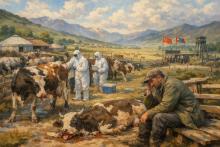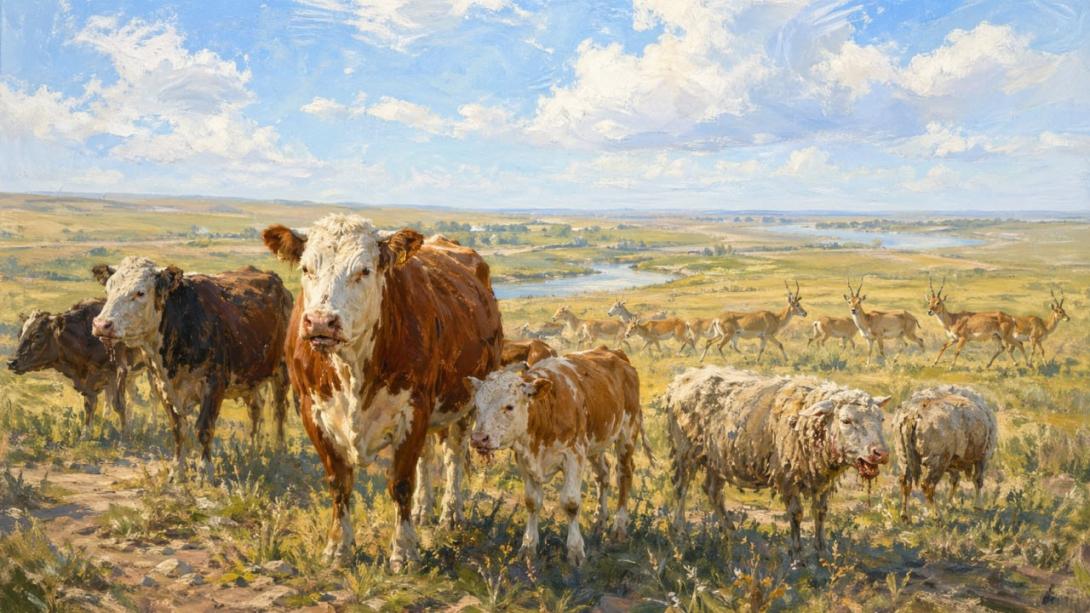
Borders are closed, vaccination has been carried out, but livestock in the West Kazakhstan Region (WKR) continues to fall ill and die. Experts warn: saiga antelope brought foot-and-mouth disease from their wintering grounds, and the vaccine being used does not match the circulating strain. Doctor of Veterinary Science Gaisa Absatirov continues to record the discouraging epizootic situation in the country, which the authorities, apparently, are in no hurry to acknowledge.
FIVE NEIGHBOURS, ONE DIAGNOSIS
Doctor of Veterinary Science, professor and chairman of the public association "Veterinary Doctors of WKR" Gaisa Absatirov wrote that today Kazakhstan finds itself at the very epicentre of the disease. The country is surrounded by states on whose territory foot-and-mouth disease is registered — Russia, Kyrgyzstan, Turkmenistan, Uzbekistan and China.
At the same time, according to Absatirov, the veterinary services of most of them are "trying in every way to hide the true epizootic situation", calling what is happening an "unknown disease", pasteurellosis or rabies. The only country to submit an official notification to the World Organisation for Animal Health (WOAH) was China. And it is the Chinese case that causes particular alarm among specialists, because the SAT1 strain detected there cannot be neutralised by existing vaccines, which increases the risk of its rapid spread many times over.
The epizootic process, as Absatirov writes, "develops according to its own evolutionary laws, regardless of borders". And attempts to make a silk purse out of a sow's ear do not negate these laws.
An example of this is the documented attempts to transit livestock trucks with sick animals through Kazakhstan towards Uzbekistan and Kyrgyzstan. And the mass culling of bovines in Russian regions, which, according to the professor, has spawned "social tension and mass protests among animal owners".
Absatirov characterises the response of the Russian Federal Service for Veterinary and Phytosanitary Surveillance (Rosselkhoznadzor) to what is happening as causing "surprise and bewilderment" — especially telling is that it was Rosselkhoznadzor which, in 2021 when foot-and-mouth disease was registered in Kazakhstan, promptly introduced mandatory blanket vaccination in nine border regions — from Saratov Oblast to Novosibirsk Oblast and the Altai Republic. Back then, the Russian side acted quickly and transparently, but today it prefers to remain silent.
HOW A WILD ANIMAL BECAME AN EPIZOOTIC VECTOR
The main issue that Absatirov notes in his post concerns not the neighbouring states, but the West Kazakhstan Region. This time, the mechanism for introducing the infection is not a livestock truck or illegal trade. It is the saiga antelope.
During the winter period, saiga antelopes migrated to the territory of the Astrakhan and Atyrau regions. In spring, following their instinct, they moved back to their usual calving grounds in the WKR. It was at this moment that the animals, already infected, came into contact with the farm animals of farmers and personal subsidiary plots (PSPs). This contact could now prove fatal.
In professional chats and social networks, video materials showing the clinical picture of foot-and-mouth disease in cattle and sheep are already being circulated. Mass mortality of calves is being recorded. The editorial board of FBRK also has video footage of saiga carcasses and animals with characteristic lesions of the oral cavity — exactly what residents of the Kaztalovka District filmed recently. Incidentally, these and other video materials — footage from the scene, eyewitness accounts and documents — we publish on our YouTube channel "Foundation-Bureau for Corruption Investigation", where you can see the full picture of what is happening.
But let us return to the epizootic situation in Kazakhstan. Saiga antelopes are dying. Absatirov lists the clinical signs recorded in the antelopes: a temperature rise above 40°C, salivation mixed with blood, ulcerative lesions of the oral cavity, widespread lameness, depression and significant mortality. This is the classic, acute form of foot-and-mouth disease. To deny it with such symptoms is to deny the obvious.
What took years to create and restore is now disappearing before our eyes. "Қасықтап жинағанды, шөмішпен төкті" — you gather bit by bit with a spoon, but spill it all with a ladle: it is probably hard to describe what is happening with the saiga in the country more accurately than that.
THE VACCINE DOES NOT WORK
According to Gaisa Absatirov, the currently used vaccine "AusylVak", based on feedback from farmers and PSP owners, does not provide protection: vaccinated animals still become ill. The professor directly states that the preparation being used does not match the type and strain of the virus circulating in the foci. This means that even those farms that have conscientiously carried out vaccination are not protected and, possibly, are unaware of this.
That is why Absatirov insists that diagnostic institutions must, in the shortest possible time, objectively determine the type and strain of the virus, and the Ministry of Agriculture (MoA) must supply the regions with an effective biological product matching this strain.
If you superimpose onto this the Chinese strain SAT1, resistant to their vaccines, and the general lack of transparency of the epizootic picture in the region, the question of exactly which strain is circulating in the WKR ceases to be purely scientific. The answer to it determines which vaccine to use for treating livestock and whether the spread can be stopped at all with the available means.
Against this background, the question of the readiness of the veterinary infrastructure itself becomes particularly acute. Not long ago, schemes involving hundreds of millions of tenge allocated for the veterinary system were uncovered in Kazakhstan. In one episode alone, nearly a billion was siphoned off through fictitious procurement. In 2024, inspections showed that laboratories were working with violations or even without the necessary equipment.
And today, when prompt identification of the strain and a targeted response are required, a logical question arises — where is all this infrastructure, into which such funds have already been invested?
INFRASTRUCTURE IS NOT READY FOR DISEASE OUTBREAKS
In addition to the epizootic problem, the professor identifies a purely practical one, which is no less acute. The existing burial pits for animal carcasses in rural districts cannot cope with the increasing number of saiga carcasses. Disposal is currently being handled by the monitoring teams of the "Bokeiorda" reserve, but this, as Absatirov admits, "is not quite appropriate for their function", and the volume of work already exceeds their capacity.
This is an important detail that is easy to overlook amidst the overall scale of what is happening. Untreated carcasses are not just an aesthetic problem. They are additional foci of infection, accessible to scavengers, water and wind. Every unburied carcass is a continuation of the epizootic chain.
Absatirov formulates a specific list of necessary measures: immediate isolation of sick saiga and their bloodless slaughter using the drug ditilin; identification of sites for new burial pits; creation of specialised teams for collection and disposal; provision of effective vaccines to the regions; organisation of a compensation programme for owners of affected livestock.
WHY THE PROBLEM IS BEING HUSHED UP
There is a pattern that runs through this whole story — from Russian Novosibirsk to the Kazakhstani Kaztalovka District. Everywhere foot-and-mouth disease appears, the authorities' first impulse is not transparency, but information management. The disease is called by other names. Diagnoses are not disclosed. Independent expertise is not allowed. Officials deny the obvious.
The motive is clear. Confirmed foot-and-mouth disease means closed export markets, compensation payments, international oversight. In May 2025, Russia received WOAH status as a country free from foot-and-mouth disease, and losing it would have immediate economic consequences. Kazakhstan is also interested in maintaining its veterinary status. But it is precisely here that the line lies between administrative logic and the real threat to livestock farming.
As long as foot-and-mouth disease is not officially called foot-and-mouth disease, targeted vaccination with the correct preparation is not carried out, specific quarantine measures are not introduced, and international assistance in identifying the strain is not requested. Animals continue to fall ill and die. Livestock in PSPs continue to become infected. Saiga continue to go where nature leads them.
If the situation in the WKR continues to develop without targeted intervention, the consequences will be multi-layered. For livestock owners in the Kaztalovka and adjacent districts — direct economic losses are already occurring, without any guarantee of compensation. For the Ural population of saiga — a threat to numbers that have been recovering for decades. For neighbouring regions and states — the risk of further transboundary spread via migrating animals, which cannot be controlled by traditional border measures. Finally, if the circulating strain turns out to be resistant to existing vaccines, and this is what specialists suspect, the scale of a potential outbreak goes beyond a local crisis.