(12 February 2026 | Source: Facebook page of Gaisa Absatirov)
Several regions of Kazakhstan are facing disease outbreaks among cattle, which local veterinary services stubbornly refuse to name. Aphthous ulcers, lameness, and death of young animals are transformed in official protocols into "stomatitis" or "unknown aetiology". FBRK attempted to obtain basic statistics from the relevant authority and encountered a secrecy classification. Doctor of Veterinary Sciences Gaisa Absatirov is convinced: the data is not being concealed by chance.
WHAT IS KNOWN
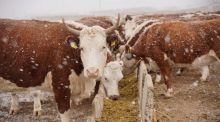
As reported by Doctor of Veterinary Sciences Gaisa Absatirov on his personal Facebook page, cases of mass disease in cattle have been actively recorded over the past few months in the Kyzylorda, Pavlodar, Atyrau regions and West Kazakhstan Region.
Animal owners report an identical clinical picture: lesions of the oral mucosa, ulcers on the udder and in the interdigital space, impaired movement, high fever, and death in young animals. Professor Absatirov points out that this symptomatology exactly matches the clinical description of foot-and-mouth disease from any textbook on epizootiology.
Recall that recently the FBRK editorial team sent an official request to the Committee for Veterinary Control and Supervision of the Ministry of Agriculture (CVCS MoA RK). We requested the total number of registered animal disease outbreaks for 2024 and 2025, broken down by month; the methodology for counting outbreaks; and statistics on vaccination coverage of the livestock.
However, the responses received to our request and subsequent complaint boiled down to one point: the requested information has the classification "For Official Use Only (FOUO)".
Thus, statistics on animal disease outbreaks in Kazakhstan are classified information. This means that livestock farmers, related industries, and neighbouring regions do not have official access to data on the real epizootic situation in the country.
At the same time, the Committee for Sanitary and Epidemiological Control of the Ministry of Healthcare of the Republic of Kazakhstan, to which we also turned for specific figures, provided open statistics on the incidence of brucellosis in humans from 2015 to 2025 — including a breakdown by all regions.
According to their response, over a decade over 8,800 cases of brucellosis in humans were recorded in the country. And note, the data was provided openly, without any classification. This is a stark contrast to the position of the veterinary authority.
FOOT-AND-MOUTH DISEASE OR "STOMATITIS": WHAT IS THE DIFFERENCE AND WHY IT IS FUNDAMENTAL
Professor Absatirov draws attention to the fundamental clinical difference between the diseases that appear in official protocols and what is actually being recorded in the animals.
Foot-and-mouth disease is an "acute, highly contagious viral disease of domestic and wild cloven-hoofed animals, characterised by fever and aphthous lesions of the oral mucosa, hairless areas of the skin of the head, udder, coronary band, and interdigital space, accompanied by impaired movement; in young animals, by damage to the myocardium and skeletal muscles."
Infectious Bovine Rhinotracheitis (IBR) is a disease with a fundamentally different pathogen, different location of lesions, and a contagion index half that of FMD. IBR affects the respiratory and reproductive organs; conjunctivitis and abortions are characteristic. Aphthous lesions of the limbs and udder, exactly what Kazakhstani farmers are filming, simply do not occur with IBR.
The difference between the pathogens is no less obvious: foot-and-mouth disease is caused by an RNA-containing virus of the genus Rhinovirus, while IBR is caused by a DNA-containing virus of the genus Herpesvirus. There is no genetic relationship between them. The morbidity coefficient for foot-and-mouth disease is 0.91, for IBR it is 0.31. That is, foot-and-mouth disease spreads almost three times faster.
A diagnosis is made not on a single sign, but comprehensively: using epizootiological, clinical, pathoanatomical, and laboratory methods, taking into account data on anti-epizootic measures carried out. According to Absatirov, specialists in the field have enough data for a reasonable hypothesis about the nature of the outbreaks. However, official protocols record something else.
EPIZOOTIOLOGY OF FOOT-AND-MOUTH DISEASE: WHY THE AUTHORITY'S SILENCE IS DANGEROUS
Even if we assume that some of the diagnoses remain debatable, the epizootiological characteristics of foot-and-mouth disease make any delay in identifying the disease extremely risky.
The foot-and-mouth disease virus is spread aerogenously — via exhaled air, carried by meteorological currents that cannot be controlled. It is shed in saliva, milk, faeces, urine, and semen.
What is particularly dangerous is that animals are already contagious during the incubation period, 6–7 days before symptoms appear. The virus can survive on walls, feeders, in soil, on staff clothing, and in roughage.
Sheep carry foot-and-mouth disease in a subclinical form, often without pronounced symptoms, and thus become "reservoirs" of the virus. Cattle, on the other hand, are the most sensitive "indicator"; the disease manifests obviously in them. This means that by the time mass clinical signs appear in cows, the virus could have already been circulating for a long time in the small ruminant population, unnoticed by official records.
A separate risk is posed by recovered animals; they remain virus carriers for a long time. Treatment of the symptomatic manifestations of foot-and-mouth disease does not eliminate this risk, but only prolongs the epizootic situation. The only effective tool for prevention and control remains full vaccination of the livestock.
That is precisely why the vaccination coverage statistics, which the FBRK editorial team requested from the CVCS, are key, and it is precisely this data that has been classified.
NOTIFICATION: AN INTERNATIONAL OBLIGATION BEING IGNORED
Kazakhstan is a member of the World Organisation for Animal Health (WOAH). In accordance with WOAH standards, member states are obliged to promptly notify of the emergence of new outbreaks of diseases covered by the notification system (official notification). Foot-and-mouth disease is on this list.
Professor Absatirov writes directly that the current practice of assigning neutral or other diagnoses to outbreaks "is a violation of WOAH notification requirements".
This means that livestock farmers in unaffected regions do not receive timely warnings, that insurance and trade partners make decisions based on understated data, and that vaccination coverage statistics, if they exist at all, are not verified in the public domain.
POSSIBLE CONSEQUENCES
If the outbreaks recorded in several regions of Kazakhstan are indeed caused by foot-and-mouth disease, and official diagnosis and notification are systematically delayed or falsified, the potential scenarios for the situation's development could be as follows.
For instance, the disease continues to spread along transport corridors and through small ruminants, where clinical signs are unnoticeable. Livestock losses increase; farmers, receiving neither a diagnosis nor recommendations on vaccination, continue trading and moving animals.
Alternatively, the outbreak statistics, classified under the FOUO designation, do not enter either the public or the international arena. This creates risks for the export of livestock products from Kazakhstan — trading partners, possessing their own surveillance data, may introduce restrictive measures without official warnings from Kazakhstan.
A third scenario is that recovered animals remain virus carriers and form a reservoir of infection. Of particular concern here is the possibility of the virus persisting in small rodents on livestock farms, which are subject to neither tracking nor control.
If all three scenarios were to occur simultaneously, they would create conditions for a stable enzootic situation — that is, the constant presence of the disease in a given territory. This is a qualitatively different situation from manageable outbreaks with transparent notification.
In summary, it cannot be overlooked that the FBRK request concerned basic epidemiological statistics: the number of disease outbreaks, the methodology for counting them, and vaccination coverage. This is not a commercial secret or a state secret in the generally accepted sense — it is operational data necessary for assessing the veterinary well-being of the country.
Classifying this data under the FOUO designation, while simultaneously lacking public notification, creates an information vacuum in an area where the cost of a delayed reaction is measured not in administrative penalties, but in livestock losses and increasing risks for related industries.
We simply cannot assert, based on available public data, that foot-and-mouth disease is currently spreading in Kazakhstan. However, the position of the CVCS MoA RK, by which neither diagnostic nor vaccination data are disclosed, makes any independent verification of official diagnoses impossible.
So, is the secrecy of statistics and the vagueness of official diagnoses a consequence of administrative inertia, or rather a clear reflection of a deliberate position of the authority?