(28 January 2026 | Source: FBRK)
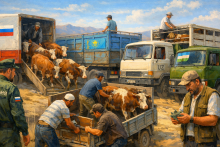
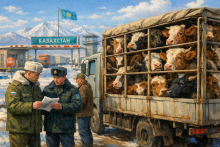
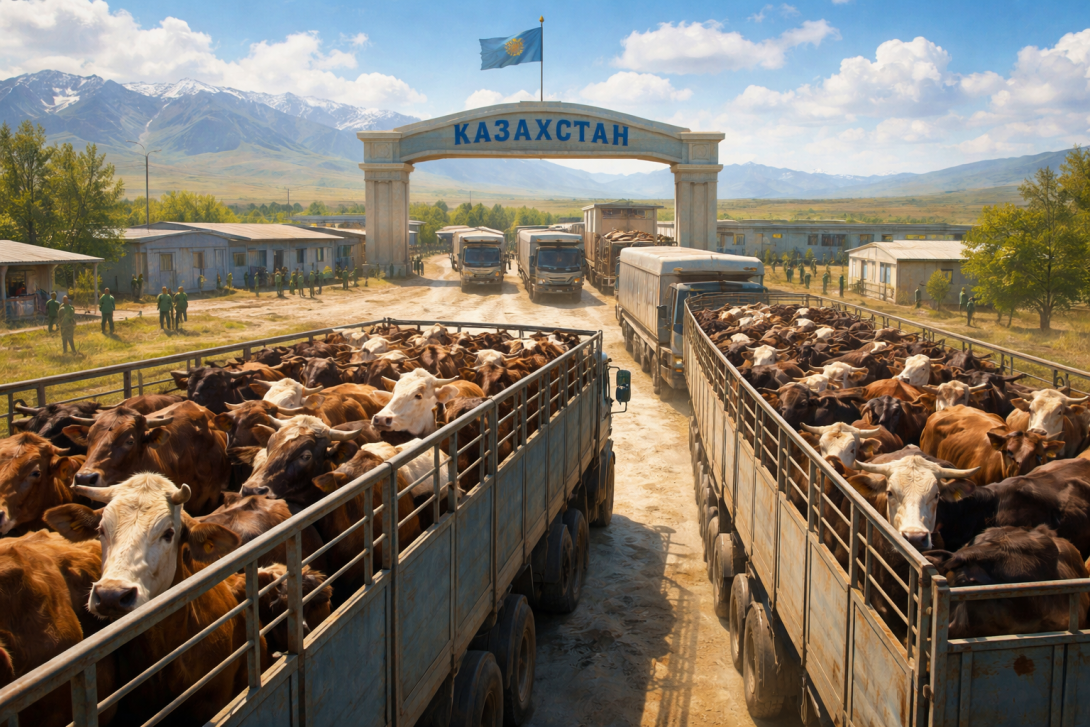
Russian companies are exporting tens of thousands of head of cattle to Uzbekistan and Tajikistan, which formally pass in transit through the territory of Kazakhstan. However, in Kazakhstan's accounting systems, the databases of the Border Service of the National Security Committee (NSC), customs, and veterinary control, data on the movement of these animals is virtually absent.
FACTUAL BASIS
Regular readers of FBRK are probably already familiar with Rassvet-N LLC. The company, registered in the Kabardino-Balkarian Republic, is one of the largest exporters of livestock from Russia to Central Asian countries. We have encountered it repeatedly in previous articles. And on 1 January 2026, in the Beyneu district of the Mangystau region, customs and veterinary services drew up four administrative violation reports specifically against Rassvet-N LLC, which point to cargo substitution schemes.
According to information obtained by FBRK from an anonymous source, between September 2025 and January 2026, the company Rassvet-N processed 131 customs declarations for the export of 18,360 head of cattle with a total weight of over 36.5 million kg. The official destinations were Uzbekistan (2,176 items in the declarations) and Tajikistan (731 items). All cargoes were supposed to pass in transit through the territory of Kazakhstan.
However, when comparing Russian customs data with Kazakhstan's accounting systems, significant discrepancies can be found.
For example, it is revealed that out of 299 transport items, 293 (98%) records have no data on the date of entry into Kazakhstan, no entry border checkpoint, and no data from the veterinary authority (UVED). Meanwhile, only 6 records contain information about exit from Kazakhstan through the B. Konysbayev checkpoint (border with Uzbekistan, Turkestan region).
It is important to note that the analysis of transit data only covers those shipments for which information was obtained for comparison. The array of export operations of Rassvet-N LLC, to which FBRK gained access through the collection and analysis of numerous reports from various sources, includes 2,907 items across 131 declarations. Transit data through Kazakhstan is only available for 299 of them. How many more shipments could have passed without being recorded in Kazakhstan's accounting systems is currently unknown.
MISMATCH BETWEEN DECLARATION DATES AND ACTUAL EXPORT DATES
Comparing the dates of Russian declarations with data on the actual crossing of the Kazakhstan border points to chronological inconsistencies that simply cannot be explained by technical glitches.
The key problem is that vehicles are recorded upon exit from Kazakhstan, for example, through the B. Konysbayev checkpoint, but data on their entry into the country is often completely absent. This makes it impossible to track the actual route of the cargo and verify the conformity of declared volumes with actual shipments.
Below we provide just a few episodes from the many identified inconsistencies. To avoid disclosing personal data of vehicle owners, their registration numbers have been replaced with arbitrary letters.
In early January 2026, Vehicle A exited Kazakhstan into Uzbekistan with a load of 30 head of cattle. However, Kazakhstan's databases record that this same vehicle left the territory of the Republic of Kazakhstan back in late November 2025 - exiting back into Russia through a different checkpoint. Meanwhile, there is absolutely no record of the truck re-entering Kazakhstan.
This means that a vehicle that left the country a month ago suddenly materialises on the border with Uzbekistan without a single record of crossing the Russian-Kazakh border.
An even stranger situation involves Vehicle B. This truck was registered at one of the internal checkpoints three times within a single day — 23 December 2025. Meanwhile, the number of animals transported changes from one registration to the next: 24 head, then 29, then 29 again.
It is physically impossible to make three trips across the border in one day with a constantly changing load, especially considering the distances between checkpoints. Moreover, two weeks earlier, the same vehicle had already left Kazakhstan, exiting into Russia through a completely different checkpoint. And again — not a single record of its return.
Here is another example: Vehicle C was en route from the internal checkpoint of Sharbakty (Pavlodar region) to the border checkpoint of B. Konysbayev for 26 days. For comparison: the usual transport time for live cattle over such a distance is no more than two or three days, considering the need to feed and rest the animals.
And if the journey really took almost a month, where exactly were the animals all this time and was the cargo substituted along the way? And again the same problem: there is not a single record of how this vehicle ended up in Sharbakty at all; data on entry into Kazakhstan is absent.
ANALYSIS AND INTERPRETATION
The totality of the identified discrepancies — the absence of entry data into Kazakhstan, chronological inconsistencies, vehicles "materialising" at the border, and physically impossible routes — suggests that in a significant number of cases, the livestock is, in fact, not imported from Russia.
In all likelihood, the animals are already on the territory of Kazakhstan, and the Russian export declarations are used as a tool to legalise their origin and grant the cargo the formal status of being "Russian".
Under such a scheme, Kazakh livestock can be sold on external markets as Russian, which facilitates bypassing restrictions, simplifies veterinary and customs control, and redistributes income among the participants in the chain. This is precisely what explains the systemic absence of traces of real transit in the presence of correctly filed declarations and recorded exits to third countries.
The scale of the operations, their regularity, and the involvement of several state accounting systems almost entirely rule out the version of random glitches or "oversight". Given such volumes, the scheme could hardly have functioned without at least tacit complicity.
And if tens of thousands of head of cattle have been "lost" in accounting systems for years, while declarations continue to be filed routinely, has no one noticed that a cargo declared as Russian may physically never leave Kazakhstan? And if someone has noticed, why has this still not become grounds for an official investigation?