Police in Kostanay Region accused the head of Kazak Tulpary LLP, Sholpan Murzagulova, of defaming the head of the Barys peasant farm, Askhat Tuleuov. The trigger was FBRK's first publication, which was based on a post by a civil activist. The case went to court and was terminated, and the prosecutor himself asked for it to be terminated. What matters in this story is not only how the case ended, but also how a dispute between two farms over a contract turned into administrative prosecution.
WHAT THE FARM IS
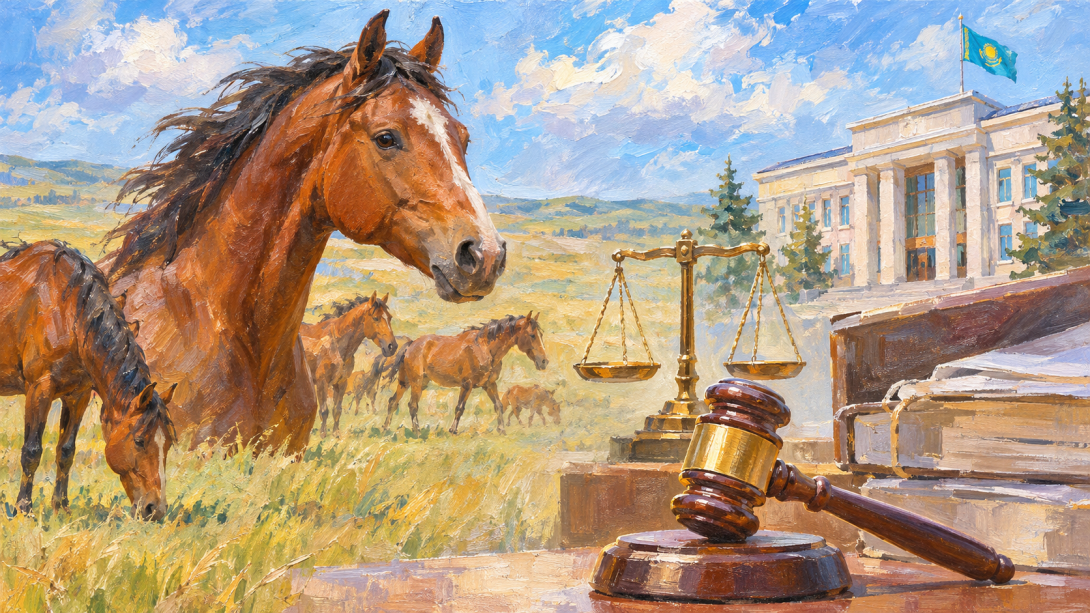
The Kostanay breed is the only domestic saddle horse breed. Officially, it is bred only by Kazak Tulpary LLP, a subsidiary of the National Agrarian Scientific and Educational Centre (NASEC). Only this farm can issue pedigree passports and therefore claim state subsidies for preserving the breed.
Until roughly 2022, the LLP was funded by NASEC, and then it had to look for investors under a "joint activity" arrangement. From March 2026, that investor became Askhat Tuleuov's Barys farm. In the summer, according to Murzagulova, the farm refused without warning to look after the herd, the horses were found without a herdsman, water or feed, and the breeding stock fell to fewer than 100 head. FBRK wrote about this in July.
WHAT HAPPENED
On 22 August 2026, inspector Timofey Malyk of the Kostanay district police department drew up a protocol against Murzagulova under part 2 of Article 73-3 of the Administrative Offences Code of the Republic of Kazakhstan ("Defamation committed using mass media or telecommunications networks"). For an individual, this article carries a fine of 180 MCI (778,500 tenge) or arrest for 20 days; for an official, 650 MCI (2,811,250 tenge) or 25 days.
The offence is described in the protocol as follows: on 24 July 2026, "an interview was posted on the website fbrk.kz" by the acting chair of the LLP's management board, "in which she disseminated knowingly false information discrediting the honour and dignity" of Tuleuov. The date of the offence coincides with the date our first article was published.
On the morning of the same day, 22 August, before the protocol even appeared, Tuleuov sent a pre-trial claim to Murzagulova, Kazak Tulpary LLP and FBRK. In it, he called both our articles, of 24 and 28 July, an "interview" given by Murzagulova, even though he quoted our text together with the markers "according to her". He demanded a retraction and 20 million tenge in compensation for moral harm from Murzagulova and the LLP, and a retraction on the website from FBRK. We wrote about this claim in September.
On 15 October 2026, a judge of the Kostanay Interdistrict Court terminated the proceedings for lack of the elements of an administrative offence. The prosecutor at the hearing also asked for the case to be terminated, and the inspector who drew up the protocol left the decision to the court's discretion.
WHICH PUBLICATION ENDED UP IN THE PROTOCOL
Our first article, of 24 July, was based on a video interview that Murzagulova gave to civil activist Serik Baibekov. We prepared the second article, of 28 July, after a personal conversation with Murzagulova. In it, she spoke about threats against her.
Baibekov, questioned in court as a witness, confirmed that he had recorded the interview in the summer of 2026 in Tobyl on his phone with Murzagulova's consent and that he had not known about FBRK's publication. Tuleuov's representative told the court that the interview had been circulated on TikTok and Instagram, and that the Barys farm side saw it "when it had already been circulated on the fbrk.kz website".
On the evening of 22 August, a person presenting himself as the same inspector, Malyk, wrote to FBRK's Telegram bot. He said that Tuleuov had filed a complaint and asked, "who gave the interview?". The first message arrived at 18:07, 35 minutes after the time stated in the protocol. On 24 August he clarified: "did you publish this article yourselves or from the words of the interview?" The editorial team refused to disclose sources in a messenger and suggested sending an official request.
So it turns out that Murzagulova was entered in the protocol as the author of the "interview on fbrk.kz" before the police had even found out from the editorial team what the publication was based on. The material listed in the protocol as an "interview" is one in which the editorial team retold a blogger's post. And the second article, the only one based on Murzagulova's conversation with FBRK, was not included in the protocol, although it was mentioned in Tuleuov's complaint. Both sides drew the court's attention to this.
WHAT WAS ACKNOWLEDGED IN COURT
Murzagulova's defence relied on the joint activity agreement, an supplementary agreement to it with obligations concerning the horses, an order of 1 June 2026 transferring the horses to the Barys farm, the LLP's claim of 17 July and a notice of termination of the contract of 28 July.
Tuleuov's representative insisted that the LLP itself, which has debts to creditors, should keep the horses, and that under the contract of 20 March 2026 the farm merely cultivates its land and leaves 20% of the harvest to the partnership. At the same time, he acknowledged that there was "no direct contract that would establish obligations" regarding the horses, and that the assistance had been "voluntary". Tuleuov himself said that the horses had not been transferred to him under any act.
The court did not decide who was right in this dispute. It assessed only one thing: whether Murzagulova had disseminated deliberate falsehood. The answer was negative. In the court's wording, she "expressed her own personal opinion, conditioned by her subjective perception of the problem of preserving the Kostanay horse breed, rather than an intent to slander anyone".
WHY THIS MATTERS
Defamation is not simply unpleasant or unfair words, but deliberate falsehood that a person knows to be false. When the head of a state enterprise speaks publicly about problems with an investor and relies on orders, claims and a notice of termination of contract, what is at issue is a dispute to be resolved through civil proceedings. This is precisely what the defence told the court, and the outcome of the case matched this.
Pressure came from two directions at once: an administrative defamation case against Murzagulova and a demand for 20 million tenge from her and from the state partnership, which, according to the Barys farm side itself in court, already has debts to creditors.
If such disputes are shifted into the administrative sphere, heads of subordinate enterprises receive a clear signal: it is better to keep quiet about problems. All the more so since, according to Murzagulova in our second article, a representative of NASEC advised her to "keep mum".
The story of Kazak Tulpary is not the only one in which publications about NASEC structures are answered through the courts. The director of the A.I. Barayev Scientific and Production Centre for Grain Farming (SPCGF), Bauyrzhan Kalibayev, filed a claim against FBRK founder Kirill Pavlov and the Centre's chief accountant Gulnar Kabdina over publications based on her appeal to state bodies. On 20 October, the Astana Interdistrict Court for Civil Cases partially upheld the claim: of three groups of information, one was found to be untrue, and instead of the claimed 2 million tenge in moral harm, the court awarded 100,000 tenge from each defendant. The decision has not entered into force, and FBRK is appealing it.
WHAT NEXT
The ruling can be appealed to the Kostanay Regional Court within 10 days of delivery of a copy. Whether Tuleuov or the prosecutor filed an appeal is unknown to the editorial team.
The contractual dispute between the LLP and the farm, if the parties wish to resolve it, remains a matter for civil proceedings. And the main question with which this story began remains open: who today keeps the last breeding stock of the Kostanay breed, and what will happen to it next.
EDITORIAL OPINION
In this case, the defamation accusation did not withstand scrutiny in court, and the prosecutor also expressed doubts about it. We still believe that the problems around Kazak Tulpary should be resolved by checking the performance of contracts and the management of state assets, not by prosecuting those who speak about them, and not by claims against journalists. We remind you that under Article 38 of the Law "On Mass Media", the Barys farm may publish its comment free of charge in our materials, and this offer remains open.