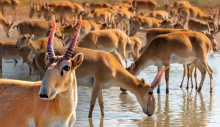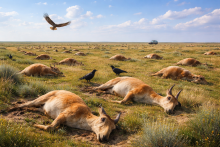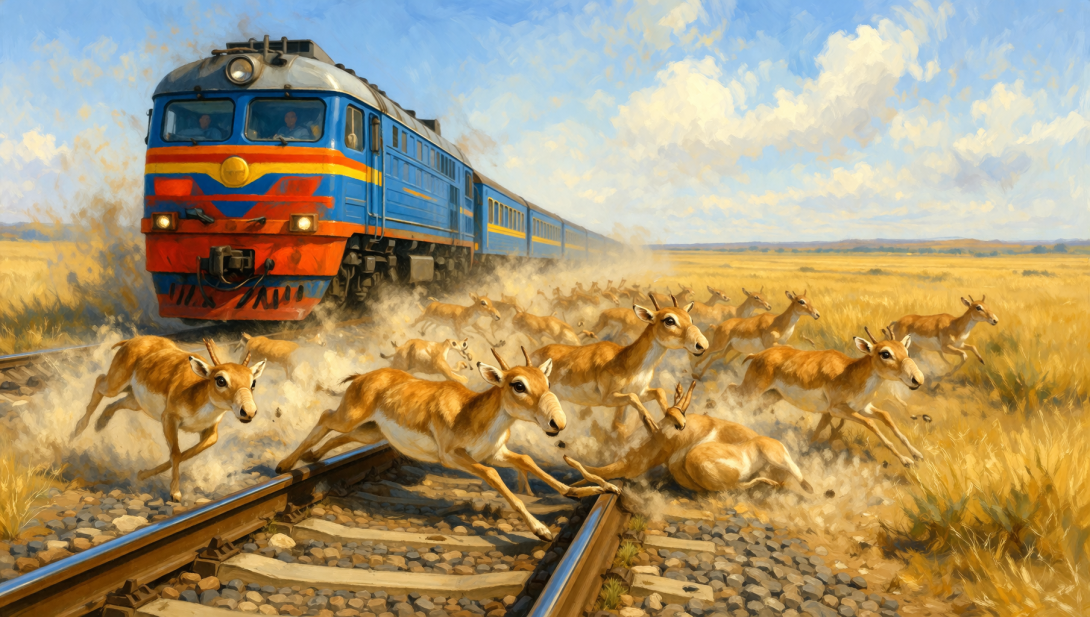
A video has circulated online showing a moving train ploughing into a herd of saiga antelope at speed. The animals try to cross the tracks but do not make it in time. JSC "NC "Kazakhstan Temir Zholy" (KTZ) clarified that the footage dates from 2024–2025 and was taken on the Koluton — Zhaltyr and Zhenis — Kyzylzhar sections in the Akmola Region.
THE AGE OF THE INCIDENT DOES NOT CHANGE THE FACTS
The first thing KTZ did was point out the date of the footage. But the age of the incident does not make the death of the animals any less real. The tragedy is no less severe for having occurred a year or two ago, rather than yesterday. A poacher faces criminal liability for killing a saiga. A train, it seems, only gets a press office comment citing the date.
THE FENCING PROBLEM
As Ulysmedia.kz reports, citing "Kazakhstan Temir Zholy", at the time the video was filmed, there were no cattle guards on the Koluton — Zhaltyr and Zhenis — Kyzylzhar sections. They are now installed, but this creates a new contradiction: territorial forestry and wildlife inspectorates are demanding their removal, as the structures hinder the natural migration of saiga antelopes. If removed, the animals will come back onto the tracks.
This deadlock did not arise from disagreements between departments, but because the railway was originally laid through the animals' migration route.
THE PROBLEM WAS PREDICTED BACK IN 2012
As the FBRK previously reported, researcher Kirk A. Olson from the Smithsonian Conservation Biology Institute had already prepared a report with specific recommendations in 2012–2013: railway corridors must not pass through saiga migration zones.
The researchers even proposed an alternative route, Zhezkazgan — Baikonur, which would have been $67–201 million cheaper and added less than 1% to transit time. Kazakhstan did not adopt these recommendations and laid the railway on the original routes. What is now captured on video is not an accident at all, but a practical consequence of that decision.
WE KNOW HOW TO SELL
Against this backdrop, another part of state policy regarding saiga antelopes is telling. The Ministry of Ecology authorised the so-called regulation of saiga numbers, and subsequently secured official trade in their derivatives. As is well known, saiga horns are in demand on the traditional Asian medicine markets.
Meanwhile, the biological basis for the decision to cull them remains classified. A state that fails to incorporate migration corridors at the infrastructure design stage finds a way to commercially exploit the same animals.
Over decades, the country has failed to build infrastructure that accounts for the needs of wildlife. Coexisting with nature is difficult. Selling it off is considerably easier.