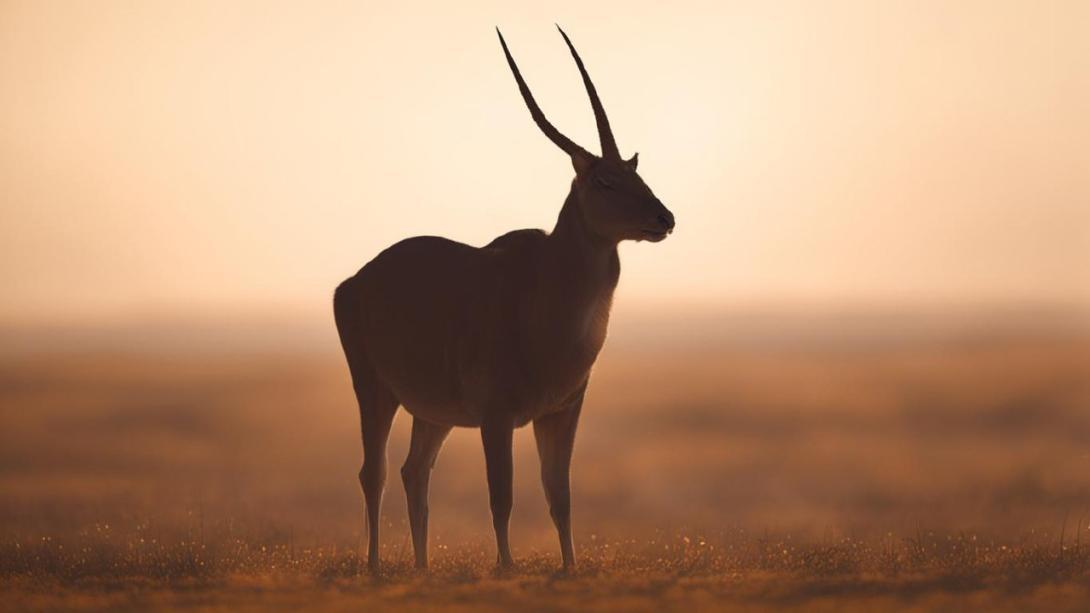
The FBRK editorial team continues to report on the saiga 'population regulation' campaign. Read the beginning in the previous part of the article: How the 'removal' of saigas took place in Kazakhstan. The Beginning
Let us turn to the 'saiga conservation strategy'. The text of the article states that "saigas eat only 12–23 kg/ha of vegetation per year (about 1.5-2% of crops), while domestic animals use 100 kg/ha or more (12-18%)", which indicates a low load on pastures as a result of saiga activity.
Later, the authors report that "the forage capacity of the republic's pastures can, in full abundance, provide an annual diet for 1 to 3 million saigas without causing harm to the environment". Moreover, "thanks to the hooves of saigas, many rare plants endemic to the steppe are pollinated".
According to the information above, it can be concluded that the increase in saiga numbers will not become a serious problem. However, the authors then state that "antelopes trample crops and eat all vegetation in pastures", which is why, in the authors' opinion, an increase in their numbers could cause colossal damage to agriculture. An oxymoron, don't you think?
While the Ministry of Ecology was trying to find a strong justification for the extermination of saigas, the uncontrolled shooting of steppe antelopes was in full swing.
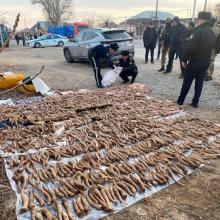
In early February 2024, officers of the Kyzylorda city patrol police, during the 'Poacher' operation, stopped two cars on the 'Zhezkazgan – Kyzylorda' highway, in which, during an inspection, they discovered 47 saiga carcasses.
600 horns were found on a poacher from the Atyrau region, and in the Zhetysu region, 1,382 saiga horns were seized from three Kazakhstani citizens.
Even then, the FBRK editorial team was asking questions about the possible leakage of the aforementioned derivatives from the storage facilities of the RSEE 'Okhotzooprom'. After all, as we found out, the horns obtained as a result of 'regulating' the saiga population were marked and transferred for storage to this very institution.
However, neither the identified facts of poaching, nor the appeal of outraged public activists to the president, shielded the Ministry of Ecology from some rash decisions.
By 2025, the ministry intended to amend the Convention on International Trade in Endangered Species of Wild Fauna and Flora (CITES), thereby striving for the legalisation of the export of saiga horns, which, as is known, are highly valued in some foreign countries, including those directly bordering Kazakhstan.
In addition to these bold initiatives, the Minister of Ecology and Natural Resources of the Republic of Kazakhstan, Yerlan Nysanbayev, stated at the beginning of the year that in 2024 the country planned to introduce amateur hunting for saigas.
At the end of March 2024, it became known that during the period of the so-called 'population regulation' of saigas, from October 6 of last year, the RSEE 'Okhotzooprom' had 'removed' 43,503 saigas from the natural environment.
The FBRK editorial team found out that in the period from October 30 to December 10, 2023, 1,132 saiga carcasses were shot and delivered to the meat processing plant LLP 'Torgai Et' (Arkalyk city). According to information provided by the plant's management, 734 carcasses were subsequently sent for processing into canned meat, and 398 were deemed unfit. As representatives of 'Torgai Et' assure, they were disposed of.
Incidentally, later the Ministry of Agriculture announced somewhat different volumes of canned saiga meat production. According to the ministry, in 2023, 5,425 kg of canned meat was produced from saiga meat.
Considering that the weight of a saiga varies from about 25 to 60 kilograms, the minimum weight of the 734 carcasses sent for processing would exceed 18,000 kg. A significant difference, isn't it?
Saiga carcasses were accepted by a commission at slaughter weight with skin and head (without internal organs of the chest and abdominal cavity) at a price of 315 tenge per kilogram.
According to data from LLP 'Torgai Et', about 11,243 units of canned meat were produced from saiga meat, which are sold exclusively on the domestic market. The retail price for 1 can of stew was 1,000 tenge. As of April 1, 2024, 10,288 cans of stewed meat had been sold, with 955 cans remaining in stock at that time.
At the same time, according to the same Ministry of Ecology, 110 hunters and falconers were involved in the work on the 'removal' of saigas, who were paid 7,354 tenge and 8,113 tenge per saiga carcass respectively.
Thus, considering the 43,503 carcasses previously announced by the ministry, the state spent at least 319 million tenge on catching saigas, and this is without taking into account associated works. And if we take into account the retail price for 1 can of stew, there can be no question of a full reimbursement of expenses.
Moreover, if, according to the Ministry of Agriculture, 1,132 saiga carcasses were delivered to meat processing plants, where did the rest of the 43,503 carcasses announced by the Ministry of Ecology go? Either the Ministry of Ecology is again confused with the figures, or more than 40,000 saiga carcasses mysteriously disappeared. One can only guess.
But let's try to step back from the data of the central state bodies and turn to the bare facts. The Ministry of Ecology and Natural Resources legalised the killing of steppe antelopes. Animals sacred to Kazakhs, which evoke admiration in foreign countries, have become a bloody target for a department that, ideally, is supposed to protect them.
And despite the presidential cancellation of the 'population regulation' of saigas, no one has yet been punished for the decision on the mass killings of sacred animals. No one, except perhaps nature itself, which the not-so-clever homo sapiens constantly tries to manage as they see fit.
Now, after the failed attempt to exterminate saigas, the Ministry of Ecology has decided on an aerial survey of argali, and in the media, materials about the 'increase in numbers' of these rare animals are increasingly appearing.
Are argali next on Mr. Nysanbayev's bloody list?