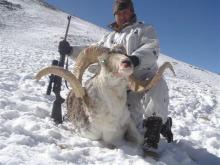
Not so long ago, Kassym-Jomart Tokayev promised to ban the so-called “removal” of saiga antelopes from their natural habitats.
This decision by the president marked a new stage in the fight to preserve the population of steppe antelopes and became an important event for all those who had long and persistently championed the saiga’s right to exist.
The editorial board of FBRK decided to compile the entire chronology of the campaign to “remove” saiga antelopes, so that, in light of the changes, a full picture of what is happening becomes clear.
Before we delve into the analysis of the issues surrounding the decision to cull saiga, it is necessary to recall that 95% of the world’s saiga population is concentrated precisely in Kazakhstan.
In 1996, the saiga was listed in the Red List of the International Union for Conservation of Nature (IUCN) as a vulnerable species, and by 2002 it was classified as endangered.
In 1999, Kazakhstan introduced a ban on hunting saiga antelopes, with some exceptions for scientific research. It is worth noting that this protective measure was extended six times and subsequently led to an increase in the population.
The need for “population control” of the steppe antelopes supposedly arose due to them destroying farmers’ crops. At that time, the Ministry of Ecology and Natural Resources faced the task of finding a harmonious balance between efforts to conserve the saiga and the needs of a growing population, without harming agriculture.
However, the ministry chose what probably seemed the simplest method at the time: culling the animals.
In July 2023, the West Kazakhstan Agrarian and Technical University named after Zhangir Khan submitted to the Ministry of Ecology a biological justification for the so-called “management of saiga populations”, which, incidentally, was kept from the public under the classification “For official use only”.
In October 2023, it became known that the Ministry of Ecology had begun hiring hunters to cull saiga antelopes at night in the West Kazakhstan region. The average cost of the service was 4,000 tenge.
At the beginning of November that same year, the ministry established the period for permitted hunting of saiga antelopes, regardless of their sex, age, or habitat: from 1 October to 15 November.
At the same time, in the West Kazakhstan region, mass livestock deaths were recorded. Hundreds of animals died from an infectious disease then.
The barbaric, almost uncontrolled killing of saiga antelopes, along with scattered organs and hides of dead animals across the steppe, illegal slaughter at car washes, and subsequent illegal meat trading could well have been triggers for the spread of diseases.
By 10 November 2023, 38 cases of anthrax had been recorded in Kazakhstan in the Zhambyl, Akmola, Karaganda regions, and even in Astana.
The Ministry of Ecology’s failed attempts to “protect” farms from saiga antelopes resulted in even greater problems. However, abandoning erroneous conclusions bordering on criminal negligence was apparently not part of the ministry’s plans. Hence, the latter preferred to influence public opinion by leaking dubious data.
Today, even the simplest and, most importantly, unbiased analysis is enough to find discrepancies and inconsistencies in ministerial statements dating from both 2023 and 2024.
For example, figures for key indicators such as the saiga population size in the country and the volumes of the so-called “regulation” announced by the Ministry of Ecology endlessly differed.
According to the republican agency, the number of steppe antelopes in 2023 was either 1.7 million, or 1.9 million, or even 2 million or more, and the victims of the so-called “population control” were either 200,000 head, or 250,000, and so on.
FBRK founder and journalist Kirill Pavlov sent an official request to the Ministry of Ecology, where, when asked about the damage caused by saiga antelopes, they replied that in the West Kazakhstan region alone, allegedly 1,350 farms and peasant holdings covering an area of 3.0 million hectares were affected by saiga crop damage.
At the same time, the data from the regional akimat turned out to be completely different: acts of pasture damage were drawn up for only 2,800 hectares of arable land.
The lack of reliable data, or a surprising weakness in mathematics, was attempted to be hidden behind a new “saiga conservation strategy”. After analysing the population dynamics, as well as the factors affecting the number of steppe antelopes, the authors concluded that, under current conditions, the saiga population still needed to be controlled.
True, even here the FBRK editorial board found fundamental contradictions.
Read the continuation in the next part of the article: How the “removal” of saiga antelopes in Kazakhstan took place. Continuation