The Ministry of Agriculture (MoA) is proposing changes to the rules for accessing beef exports, lowering the entry threshold for feedlots with their own meat processing plant to 500 head and opening up exports through third-party enterprises for farms with a herd size of 5,000 head or more. The initiative is presented as support for domestic producers, but, as usual, it also has a downside.
WHAT THE MINISTRY OF AGRICULTURE IS PROPOSING
According to the 'Open Legal Acts' portal, on 14 March 2026, the MoA published a draft amendment to the order 'On Some Issues of Exporting Bovine Meat'. The document was developed in implementation of a decision by the Interdepartmental Commission on Foreign Trade Policy and Participation in International Economic Organisations (IC FTP&IEO) dated 5 March 2025.
The draft provides for two key changes to the criteria for participation in beef exports. First: for feedlots with their own meat processing plant, the minimum herd size threshold is proposed to be reduced to 500 head of cattle. Second: feedlots with a herd size of 5,000 head or more that do not have their own processing facility will be able to send meat for export through third-party meat processing plants.
GLOBAL CHANGES
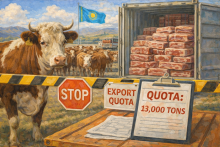
This is not the first change to export rules in recent months. Since 31 December 2025, rules for distributing quotas for the export of bovine meat to third countries and EAEU states have been in effect until 30 June 2026. The total quota volume was set at 20,000 tonnes of beef. The new draft essentially adjusts the access criteria for the existing quota, expanding the pool of participants.
The reason for introducing the initial quotas was the practice where certain companies effectively resold livestock without fattening or investment in production. The quota mechanism was aimed at eliminating export intermediaries who were not involved in raising and fattening livestock.
Now the state is relaxing these restrictions, opening up access to exports through third-party meat processing plants. The logic is clear. Many large feedlots do not have their own processing facilities. Locking them within the country means hindering the development of an industry which, according to calculations by industry associations, has the potential for export revenue from beef and lamb to reach around $4 billion by 2030.
UZBEKISTAN AS A MIRROR OF THE SYSTEM
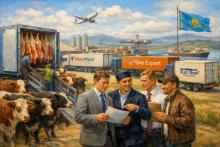
The overwhelming volume of Kazakh beef goes in one direction. In 2025, Kazakhstan exported 66,100 tonnes of fresh, frozen and chilled meat and offal to Uzbekistan, worth $189.9 million — 1.8 times more by volume than in 2024.
However, Uzbekistan is not just the largest buyer; it is a destination with a long history of grey schemes. In 2019–2020, it was the surge in demand from Uzbek buyers that triggered a crisis, when over 66,000 head of cattle were exported from Kazakhstan in a few months, jeopardising the development of the domestic industry.
Kazakhstan then banned the export of live animals. Uzbek processors, nevertheless, prefer live animals to chilled meat, and are therefore interested in circumvention schemes.
This is precisely what the editorial board of FBRK wrote about extensively. And now we see the problem is not solved, it has merely changed form: live animals have been replaced by paper meat at a reduced price.
WHAT NEXT
The document published on the 'Open Legal Acts' portal does not specify:
- how it will be confirmed that the livestock processed at a third-party meat plant actually belongs to the quota applicant?
- whether mandatory livestock tagging will be introduced?
- which body will verify that the declared number of livestock matches the actual number?
Without answers to these questions, the new rules risk suffering the same fate as the previous ones. After all, quotas were introduced precisely because the old system did not ensure traceability of meat origin.
The public consultation on the draft ends on 19 March.