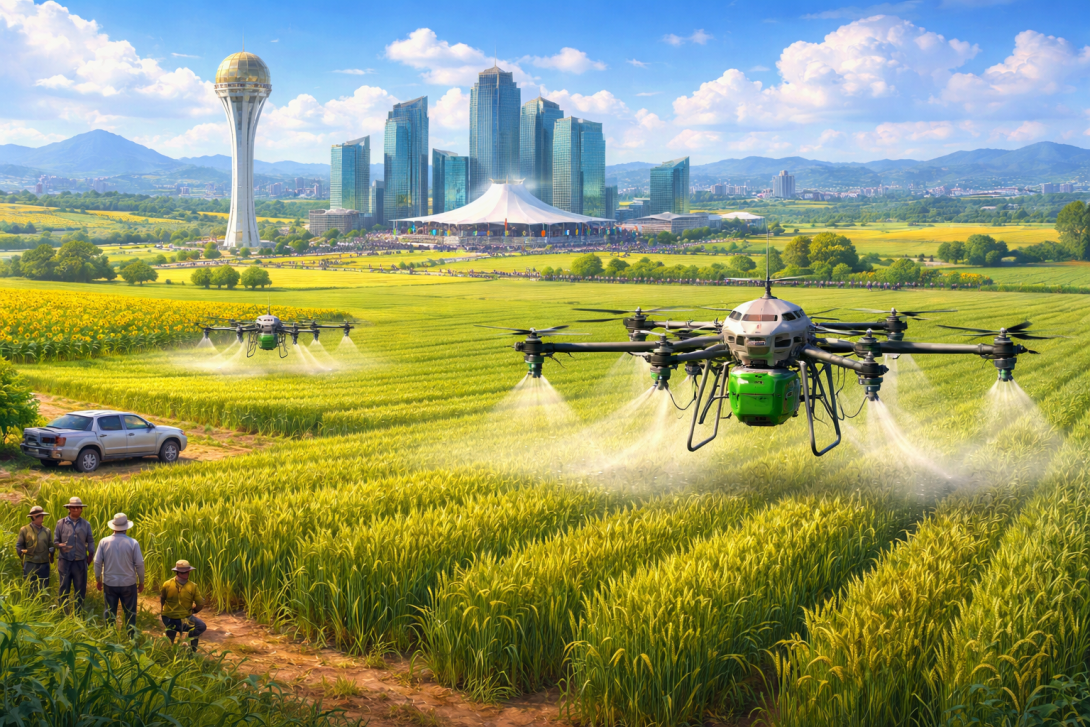
In Astana, at the AgriTek exhibition, a panel session was held on the introduction of agricultural drones in Kazakhstan's agriculture, with participation from the Ministry of Agriculture (MoA), businesses, and industry organisations. The government and the market discussed transparent rules and support measures. Against the backdrop of the government's ambitious plans, the FBRK editorial team believes it is necessary to remind everyone how these rules actually work in practice.
AGRITEK EXHIBITION
In Astana, at the international AgriTek exhibition, a panel session titled "Agricultural Drones: The Future of Agriculture and State Regulation" was held. Representatives from the MoA, the Skyworker academy training centre, JSC "KazAgroFinance", the insurance company Freedom Insurance, and agricultural drone market participants gathered around the round table.
The discussion was about useful and pressing issues: regulating the use of drones, safe operation, industry infrastructure, and state support measures. The session organisers called the open dialogue between the government and the market "an important role in shaping the sustainable and transparent development of the industry".
The wording is precise and, essentially, correct, because it is transparency that remains a key deficit in that part of the industry where the state acts not as a regulator, but as a buyer.
368 MILLION TENGE AND 27 DRONES BEING REPAIRED
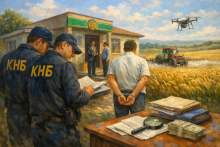
We believe that, given the government's promising plans, it would be appropriate to recall the existing experience. For example, in 2024, the MoA purchased 46 agricultural drones at 8 million tenge each — totalling 368 million tenge.
As of the end of 2025, 27 out of 46 drones, that is almost 59% of the fleet, were "under warranty repair" without any explanation.
Interestingly, as the FBRK editorial team discovered, the 46 drones were not purchased as part of planned agricultural spending, but from the remaining budget funds allocated for locust control. The supplier of the drones was LLP "Sunkar Eavision International LLP" — a Kazakh-Chinese enterprise established under a memorandum between the MoA and the Chinese company Eavision.
Incidentally, this drone story never received a public review — no internal investigation, no official explanations. Instead of working on and monitoring the drone fleet, the department focused on "reputation protection", as if its reputation is damaged not by its own failures, but by the journalists who merely record them.
PESTICIDES, CONNECTIONS, AND A VICIOUS CIRCLE
Agricultural drones are just part of a bigger picture. Last year, the FBRK editorial team also examined the market for the supply of anti-locust pesticides, which these drones were supposed to use. An analysis of government contracts showed that over 440 million tenge in 2024 was distributed among formally independent companies, whose directors and founders are interconnected through LLP "Pesticides".
Competition in this market appears more like a façade: different names, but the same people.
The quality of these products turned out to be a separate issue. According to a source from the FBRK editorial team within the industry, it was precisely the unsatisfactory quality of pesticides from key suppliers that derailed the MoA's experiment with a "single executor" system — contractors refused to take responsibility for the results when working with ineffective chemicals. This failure was never publicly acknowledged.
According to the same source, the attempt to procure a modern laboratory for a full analysis of pesticide composition allegedly cost the former chairman of the relevant committee his position.
DIALOGUE AND ITS CONTEXT
Returning to the AgriTek panel session: the discussion about transparent operating rules and the safe operation of agricultural drones is undoubtedly needed.
The problem lies elsewhere. The state as a regulator and the state as a buyer are currently two different states. The first talks about transparency at industry forums. The second buys equipment from budget leftovers, sends more than half of the fleet for warranty repairs, does not keep track of flight hours, and, apparently, cannot explain where state property worth over 200 million tenge is physically located.
Open dialogue is useful, but only if both sides are honest in it.