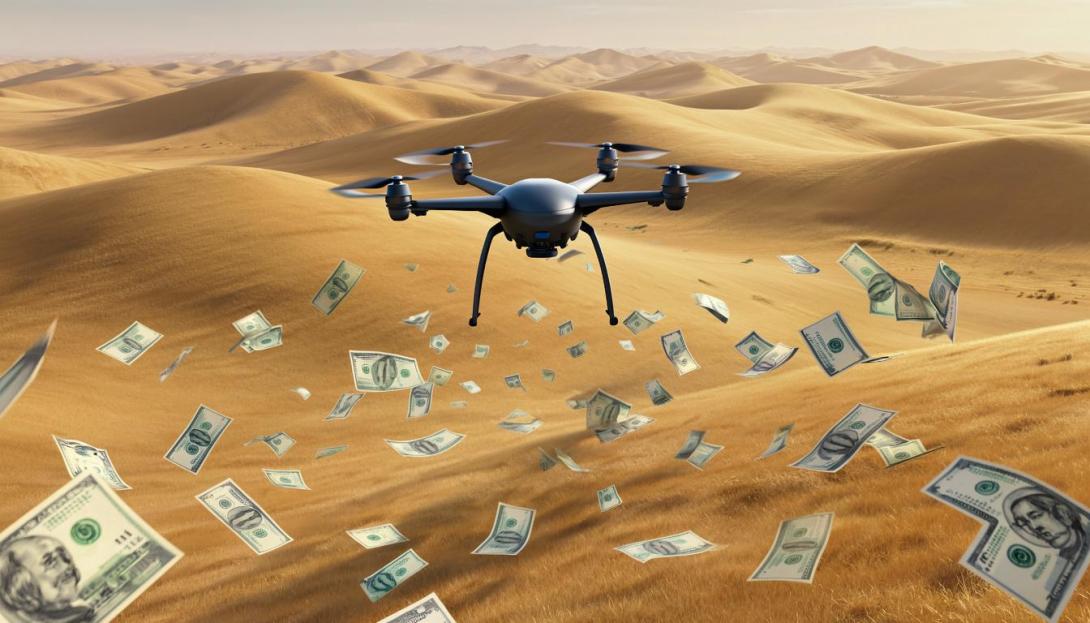
Almost 695 million tenge from the Government's reserve for locust control in 2024 was planned to be spent, among other things, on the purchase of 100 drones. At the same time, basic arithmetic inconsistencies were found in the technical documents, and the delivery times for equipment from China do not guarantee its receipt in the current financial year. The FBK editorial team investigates how technological innovations are turning into a way to spend budget leftovers.
When Deputy Prime Minister Serik Zhumangarin convened a specialised meeting on the introduction of agricultural drones in agriculture in November 2024, the picture looked more than noble. International experience of using drones in more than 100 countries, treating over 500 million hectares of fields, saving 210 million tonnes of water — impressive figures.
A representative of a company working with agricultural drones in Kazakhstan, Sanzhar Nurgazinov, enthusiastically spoke about a fifteen-fold saving in water compared to traditional sprayers and the absence of damage to crops from wheeled machinery, which ruts the soil and deprives farmers of 6% of their harvest.
Furthermore, the Ministry of Agriculture of Kazakhstan signed a memorandum with Chinese company Eavision for the import of 80 agricultural drones, agreed on the creation of a joint Kazakh-Chinese enterprise for assembling drones in the SEZ "Alatau", and worked out issues regarding the opening of demonstration centres in the regions.
Serik Zhumangarin even set the task of studying the possibility of developing own software for managing agricultural drones, and the Ministry of Agriculture was instructed to create a roadmap for the industry's development by the end of February 2025.
Sometime ago, the FBK editorial team sent an official request about the purchase of drones to the Ministry of Agriculture, where we were kindly provided with links to the relevant contracts on the government procurement portal.
According to the technical documents for the purchases, more than 3.2 billion tenge was allocated from the Government's reserve for locust control in 2024. Of these funds, about 443 million was spent on the purchase of pesticides, and over 2.8 billion tenge on chemical treatments, which resulted in a balance of almost 695 million tenge.
It was this very balance that was proposed to be used for the purchase of 100 drones and vehicles for the needs of the Committee of State Inspection in the Agro-Industrial Complex. The main goal, as stated in the document, is full utilisation of the remaining funds. The wording speaks volumes.
Initially, it was planned to use the savings to purchase 100 drones, including in the near future 30 research drones. In reality, using a single-source method, the following were purchased: 46 drones for chemical treatments at a price of 8 million tenge each for a total of 368 million tenge and 7 research drones at a price of over 2 million tenge each for a total of about 14.5 million tenge, as well as 38 vehicles for the sum of 304.3 million tenge. In total, about 686.8 million tenge was spent.
It would seem, given the stated balance of 695 million tenge and planned expenditure of 686.8 million, about 8 million tenge should remain unspent. But clearly, something went wrong and the committee calculated only 290 thousand unspent tenge, which, according to the document, had to be returned to the treasury.
We emphasise that all these calculations are being made within the framework of single-source contracts. And now is the time to return to international cooperation.
As already noted, the assembly of the drones is to be carried out by a Kazakh-Chinese enterprise - Sunkar Eavision International LLP. It is headed by Azat Betekbayev, and among the founders, besides Betekbayev, are Zhanar Razzhan and the company Eavision Robotic Technologies Co., LTD. The head and founder of the latter is Hui Zhang.
It was Sunkar Eavision International LLP which, as a potential supplier in the contracts we are examining, offered to sell 80 drones for chemical treatments at a price of 7.1 million tenge each with a delivery date of 20 December 2024. Another supplier, Skyworker LLP, reported the availability of 30 drones for chemical treatments at a price of 9.7 million tenge and 7 research drones at a price of 2.07 million tenge.
In the end, as we already know, the company Sunkar Eavision International LLP received a contract for 46 drones at a price of 8 million tenge each, although it had offered 80 drones at 7.1 million. (Incidentally, wasn't this the 80 drones mentioned in the memorandum?)
Formally, the second contract, for about 14.5 million tenge, was concluded with Ranked Soul LLP, which, in turn, subcontracted the execution to Skyworker LLP. So it turns out that Skyworker, through subcontracting relations, offered drones for chemical treatment at almost 2 million more than its competitor. Incidentally, Ranked Soul LLP is headed by Bakytgul Altybayeva, and the founder is Zhuldyzai Zhaksymbetova. She also heads Skyworker LLP, whose founders also include Aliya Koshtayeva and Togzhan Tankinova.
And another interesting point. The Committee acknowledges that the production of agricultural drones is absent in Kazakhstan, and all equipment is mainly imported from China, where there are export difficulties. It was then proposed to make the purchase specifically from those companies that state a specific delivery date. The only such company turned out to be Sunkar Eavision International LLP. Incidentally, Skyworker LLP's delivery date is missing from the same document, but, apparently, this did not bother anyone.
It is also amusing that the protocol instructions contain a wording about the need to purchase from a domestic producer, although the Committee itself later points out that domestic production of drones does not exist in Kazakhstan.
There is also no justification in the document for the quantitative need: why specifically 100 drones, why exactly 30 research drones, and how they will be distributed and used. It gives the impression that the figures were selected based on the available balance of funds, and not on the real needs of the agro-industrial complex.
It is worth recalling that our editorial team has previously investigated the system of purchasing insecticides in Kazakhstan, discovering organic solvents in the composition of commercially available preparations, which under certain conditions could be used in the synthesis of narcotic substances. Back then, we questioned the effectiveness of the control system and the volume of purchases combined with the effectiveness of treatments. Now, another layer of problems is added to these questions.
Furthermore, the FBK editorial team analysed the supply market for anti-locust preparations, gathering information about supplier companies of insecticides. Let us note that when gathering information about companies, we unearth the most significant and striking facts related to their activities and management. What conclusions a thoughtful reader will draw from this mosaic of facts is a matter for their own analysis and common sense.
We propose to think and analyse this further: if agricultural drones are truly so effective — saving 15 times more water, not damaging crops, working in any weather — then why are they being purchased only from leftover funds for locust control, rather than being planned as a primary agricultural production tool?
Perhaps agricultural drones will indeed become a breakthrough in the fight against agricultural pests. But for now, the impression is that the main task is not to increase the efficiency of agricultural production, but to spend leftover budget funds before the end of the financial year. And in this sense, technological innovations are turning into a very convenient tool for solving completely different tasks, where the development interests of Kazakhstan's agro-industrial sector may prove secondary.
The FBK editorial team, for its part, intends to gather information about companies providing chemical treatment services against locusts. There is no doubt that their own "leaders" operate in this sphere as well.
To be continued...