This spring, colleagues from the Caravan media portal published an article about the fight against locusts, citing a report from the Food and Agriculture Organization of the United Nations (FAO) following the November 2024 technical seminar in Central Asia. The news for Kazakhstan already seemed bleak back then. And, as we now know, the situation has not changed drastically in 2025.
Journalists found out that in 2024, pesticides were sprayed on 3.1 million hectares – twice as much as the year before. One would logically expect impressive results, but in reality, there are only more locusts.
It is reported that in the Turkistan Region their numbers increased by 42%, and in Akmola, Aktobe and Kostanay regions – by 24%. An area of 4.9 million hectares was found to be infested, with 11.2 million hectares at risk.
Our officials explained this failure by rains and dense vegetation, which prevented the infested areas from being spotted in time.
But isn't the monitoring system supposed to work in all conditions? Well, yes and no.
As the FBKK found out, trendy new technologies are partly being purchased not out of necessity, but for the “full utilisation of the remaining funds”.
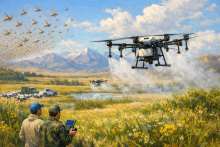
For example, this year 695 million tenge in “remaining” funds were urgently spent on purchasing drones. They planned to buy 100 drones, but acquired 53, and from a “domestic manufacturer”, even though the documents directly admitted: agricultural drones are not produced in Kazakhstan, all equipment is imported from China. What’s more, looking into the documents, it turned out that the Ministry of Agriculture also had problems with the calculations.
Furthermore, as early as March this year, the media reported that drones are proving practically useless. Their efficiency is only 5 hectares/day, whereas a single aircraft treats tens of times more area.
Incidentally, a separate list of approved chemical agents for drones has still not been created. The chemical arsenal still contains substances banned in the civilised world. Imidacloprid is banned in European Union (EU) countries due to the threat it poses to bees, lambda-cyhalothrin is dangerous for fish, and fipronil is restricted because of the risk to human health. But here, everything is permitted – use it by the tonne.
And this is despite the fact that for three years now, our editorial team has been reporting on which chemical agents are used to poison insects in various regions of Kazakhstan. And for three years we have seen the same thing: the authorities continue to use dangerous chemicals, ignoring the potential risks to public health.
Moreover, quite recently, the FBKK wrote that solvents suitable for the production of synthetic drugs: xylene, toluene, and acetone, can be easily extracted from the preparations used against locust pests. A few canisters of insecticide – and you have a mephedrone lab ready to go.
Speaking of business, the insecticide supply market is also not as transparent as it seems at first glance. Our editorial team discovered that formally independent companies turned out to be part of a single business group with overlapping lists of founders. Over half a billion tenge passed through these interconnected structures in 2024 alone.
Yet, at the beginning of the year, colleagues from the Caravan media portal wrote that a pilot project is operating in the Turkistan Region, where one company surveys the fields, sells the pesticides, and sprays them itself. In other words, the worse the locust situation, the more contracts there are.
And while Kazakhstan stubbornly pours out chemicals, China has switched to biological methods, targeted treatments and digital monitoring. Over 15 years, this has kept the situation under control.
At the same time, potential “cooperation” with China in agriculture carries geopolitical risks: who will control the data on our fields and harvests? And won't the fight against locusts turn into a diplomatic bargaining chip?
But then again, why bother discussing anything? Journalists write investigations, experts raise the alarm, and the system works like clockwork: billions are spent, reports are filed, locusts breed. The main thing is to promptly explain to the public that the rain, climate, and underfunding are to blame. And if someone asks awkward questions, you can always go to court to protect your unassailable reputation.