
Recently, the FBRK editorial team published a news article about the introduction of paid phytosanitary inspections in five regions of Kazakhstan. This neutral material, devoid of any value judgments, suddenly gathered dozens of comments identical in meaning, and some commenters, it appears, were closely linked to the territorial inspectorates of the Ministry of Agriculture (MoA). So what is this all about?
On 26 November, the FBRK published a news article about the pilot launch of a new procedure for conducting quarantine phytosanitary inspections on a paid basis. The publication cited official data on the implementation of the mechanism, the training of specialists, and plans to develop the sector using revenue from the provision of services.
A short time after the publication, a wave of comments appeared beneath the article. Almost all of them were positive and expressed support for the new measure. Phrases about the “right decision” were repeated in dozens of messages. Some users left several comments with slight variations on the same thought.
If you look closely, you can see that the wording is more reminiscent of official talking points than the spontaneous responses of ordinary readers. This is, however, merely a subjective impression.
But a closer look at the profiles of the commenters revealed some interesting details. In the profile pictures of some users, you can see administrative buildings or government agency insignia (incidentally, some of them hastened to remove their profile picture shortly after commenting, if, of course, that is not a coincidence). Some accounts had no photos at all, but the first and last names turned out to be familiar.
Among the commenters were users named Turysbek Baizakov - head of the Alakol District Territorial Inspectorate of the State Inspectorate Committee (SIC) in the agro-industrial complex (AIC) of the Ministry of Agriculture, Talgat Smakanov - chief specialist of the territorial inspectorate of the Abai Region, Arystanbek Zhakibayev - chief specialist of the plant protection department of the Aktobe Region territorial inspectorate, Mukhamed Amirzhanov - head of the Burabay District territorial inspectorate. Perhaps they are namesakes. Perhaps a coincidence.
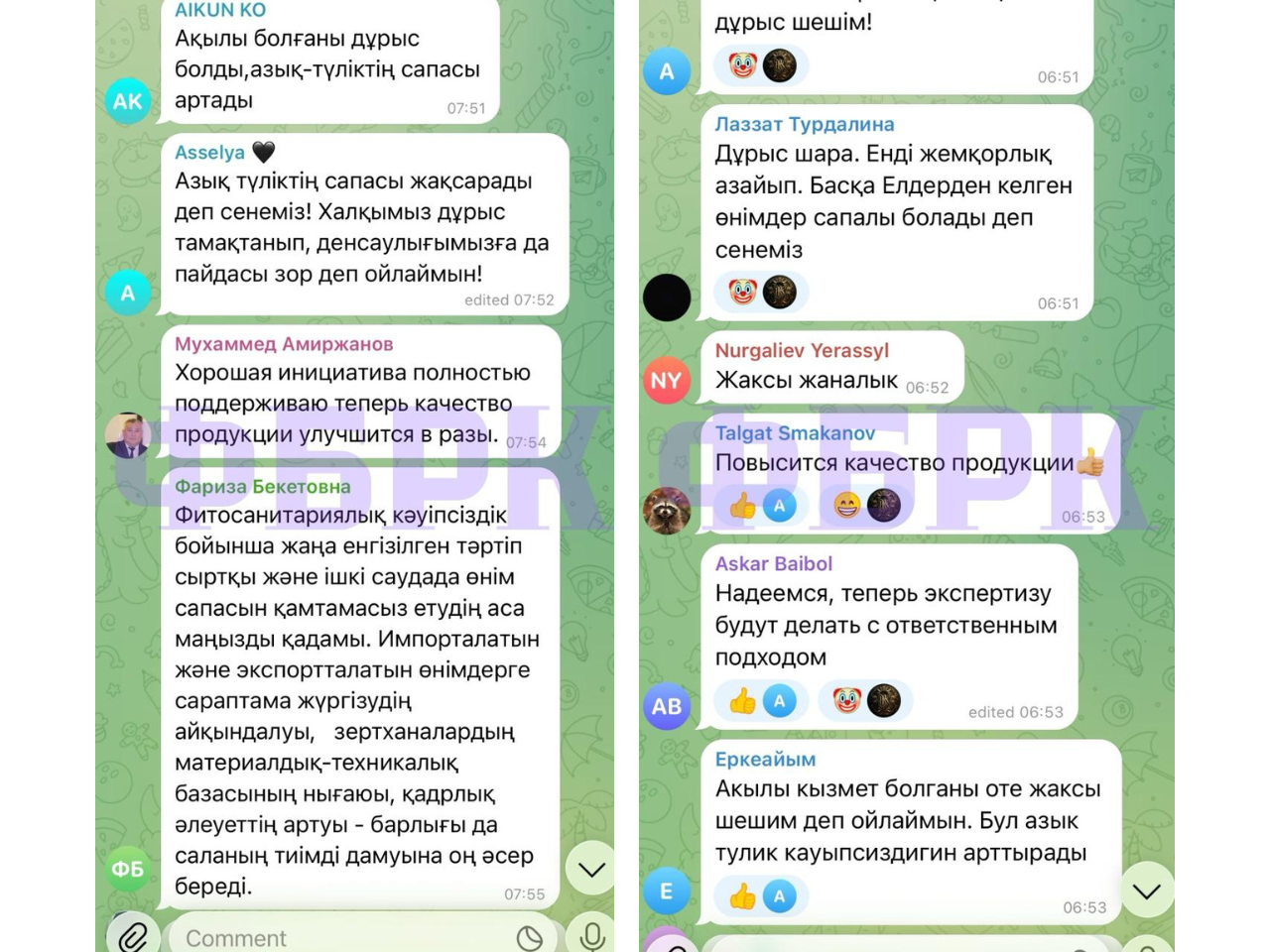
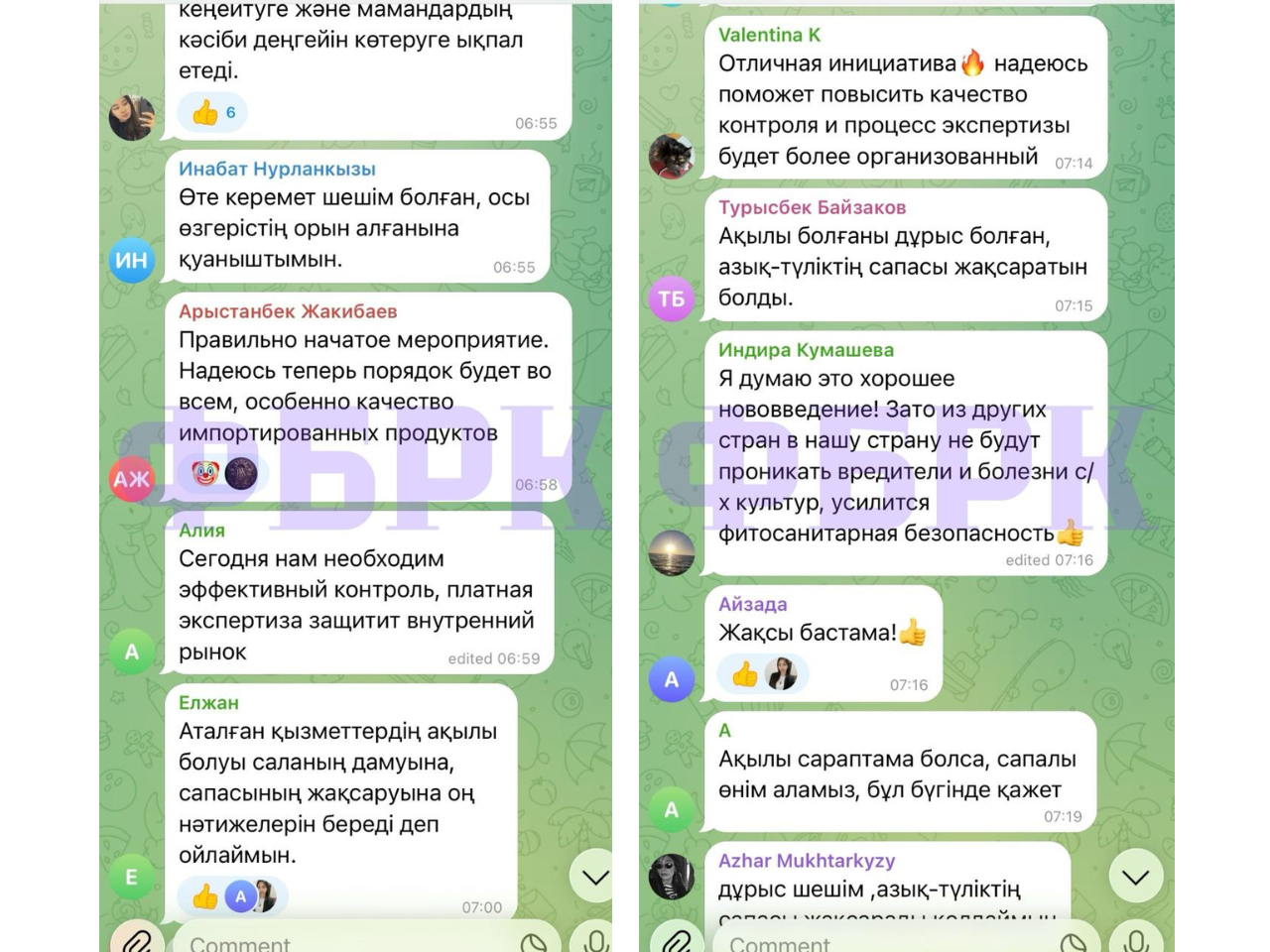
All the same, such a coordinated campaign looks at the very least strange. Usually, under informational articles, a discussion develops gradually, different points of view are present, and questions are asked about the details of implementation. Here, however, there was practically unanimous approval using similar wording.
Perhaps, for context, it is worth mentioning that previously an administrative case was brought against FBRK founder Kirill Pavlov following the publication of an article about state procurement of drones. The disputed information was, at that time, taken from an official document on the public procurement portal. The case was initiated by a company working within the framework of state projects in the agro-industrial sector.
The mass appearance of comments from potential employees of territorial inspectorates under the article about the new paid service looks unusual. Our editorial team is not making categorical conclusions about the nature of this activity. However, we believe that FBRK readers are sufficiently aware of the working methods of various departments and are capable of assessing the situation themselves.
It is worth noting that quite recently, State Advisor Erlan Karin described in detail the problem of information manipulation and astroturfing, where carefully planned influence campaigns are hidden under the guise of public initiatives.
He noted that the targeted creation of content “to influence public opinion” has become a widespread practice, and he called for the formation of a new digital ethics - a culture of responsible information dissemination based on common sense.
President Kassym-Jomart Tokayev has repeatedly outlined the “Law and Order” principle, which implies equality for all before the law: both citizens and state structures. If coordinated influence on public opinion requires attention from the state, then it is logical to assume that these standards should be applied universally.