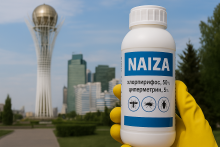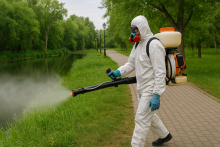
For the third year running, the FBRK editorial team has analysed disinsection preparations in the regions of Kazakhstan, consistently encountering aggressive resistance from local authorities. The experience accumulated from dealing with officials prompted us to use the example of Akmola Region, where cypermethrin is used, to examine in detail the systemic problems: contradictory data on the safety of preparations in official documents and the authorities' unwillingness to engage in constructive dialogue about public health.
STANDARD EXCUSES FROM THE AUTHORITIES
After each article on disinsection, the FBRK editorial team receives virtually identical objections from local executive bodies. The arguments are the same everywhere and boil down to three main points.
The first argument: the preparations are safe because they are officially registered in the state register. However, officials demonstrate a complete lack of understanding of the difference between certification for agriculture and use in an urban environment. Registration of a preparation by the Ministry of Agriculture does not grant the authority to use it in cities where people are in close proximity to treated areas.
The second argument: the solutions are prepared in the presence of experts according to all instructions. Members of the public are not allowed into the preparation process, and the quality of control raises serious doubts. In the reality of Kazakhstan, such procedures are far from the ideal adherence to protocols.
The third argument is the most absurd: the absence of complaints about poisoning after treatment. This ignores the real state of domestic medicine, where doctors are not competent to diagnose poisoning by chemical preparations. People do not always go to hospitals, and if they do, they are treated for allergies or bronchitis, without any suspicion of the impact of pesticides. The principle ‘no body, no case’ is inappropriate here.
CHAOS IN OFFICIAL DOCUMENTS
However, behind the superficial disputes with local authorities, a much more serious problem lies hidden. Let us examine it using the example of 25% cypermethrin, used in Akmola Region. This preparation demonstrates catastrophic contradictions in official sources — a situation typical of most disinsection agents.
Open sources, referencing international studies, indicate serious risks: hazard class 3 if ingested, but class 2 (highly hazardous!) for inhalation exposure to aerosol. The same sources contain warnings about high toxicity to bees and aquatic organisms with the H410 notation (very toxic to aquatic life with long-lasting effects).
Vendors of the preparation focus on softer formulations — ‘hazard class 3 for humans’, omitting information about inhalation risks and environmental danger.
But the most outrageous situation is found in the Unified Register of Certificates of State Registration of the Eurasian Economic Union. In the certificate from 2022, the preparation is simultaneously assigned to hazard classes 3 and 4 — the document's compilers clearly could not decide on the classification. In the document from 2015, the situation is even more absurd: it indicates three hazard classes — 2, 3 and 4.
The standards for maximum permissible concentrations also differ radically: open sources indicate 0.5 mg/m³, while the 2015 state register lists a figure ten times stricter: 0.05 mg/m³. Either the preparation has become significantly more dangerous over the years, or there has been a serious error in the calculations.
THE PROBLEM OF USE IN REAL CONDITIONS
An additional difficulty lies in the fact that most of the preparations used, according to international data, belong to the hazardous and particularly hazardous categories; some of them are completely banned in the USA and European Union countries. The FBRK editorial team has written repeatedly about the negative impact of cypermethrin on human health — detailed information can be found via the link.
However, in strictly controlled conditions, with correct application and proper dilution, they can be classified as ‘moderately hazardous’. The problem is that such conditions require the highest level of skill from the operatives and almost laboratory-grade precision. But in the reality of Kazakhstan's municipal services, such standards are unattainable and will never be met. Nevertheless, it is precisely this lower level of hazard that is cynically indicated in the state certification register, creating an illusion of safety.
A VICIOUS CYCLE OF PROBLEMS
With such confusion in official documents, it is impossible to demand a clear understanding of the risks from journalists and citizens. Is a ‘low-hazard’ agent of class 4 being used, or a ‘highly hazardous’ one of class 2 from the same state register? How can one combat the poisoning of the population by pesticides if the documentation contains such chaos?
Local officials may indeed be confident in the safety of the preparations — they blindly rely on the register data. However, preparations with similar effects are officially banned in developed countries, although according to the EAEU register they are freely permitted in Kazakhstan. Is the register so lacking in control that any supplier can enter any ‘nasty substance’ into it, and nobody cares about the consequences?
OUR POSITION
The FBRK editorial team understands that taking on the register of the Eurasian Economic Union is beyond our power. But we have no intention of giving up and will continue to analyse the preparations used in the regions, and relentlessly inform the public about potential risks. If our materials help even one person take precautionary measures during disinsection, then our work is not in vain.
People's health is more important than bureaucratic convenience and budget savings. Until a transparent system for monitoring the use of chemical substances in urban environments is created, citizens must take care of their own safety.
To be continued...