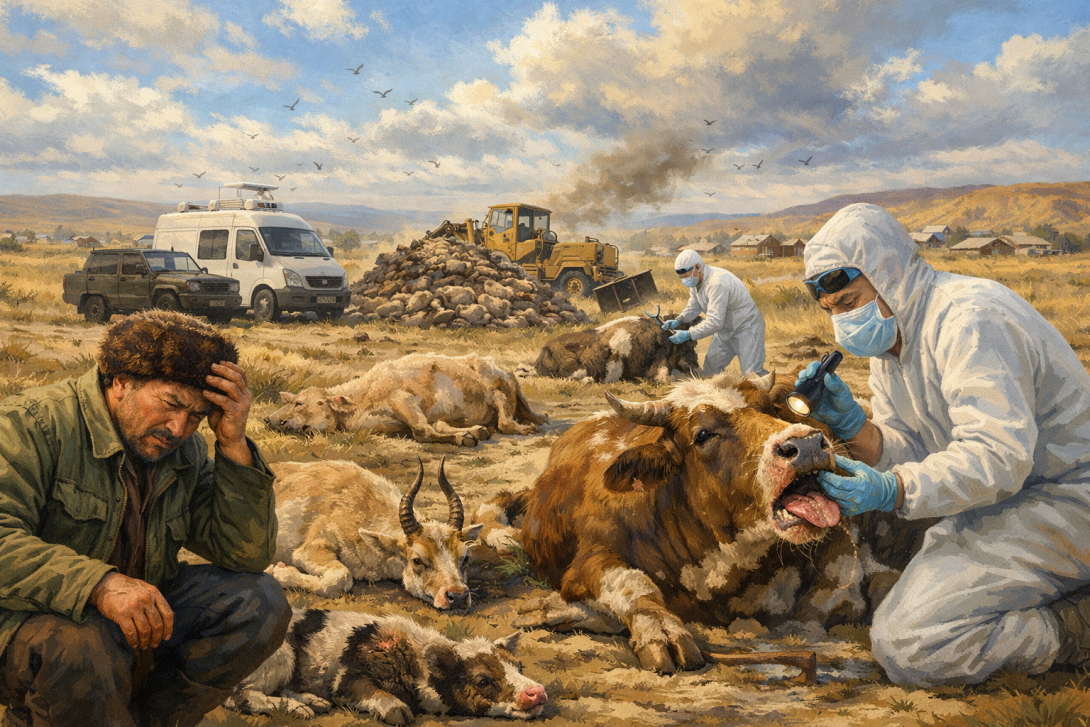
While the chairman of the Veterinary Control and Supervision Committee of the Ministry of Agriculture (VCSC MoA) of the Republic of Kazakhstan, Kazbek Tashimov, was touring the affected districts of the **West Kazakhstan Region**, farmers in anonymous appeals to the FBRK editorial office reported that the authorities' response was delayed by at least a month. The epizootic situation in the western regions of Kazakhstan has ceased to be local. It has become a systemic test — for the veterinary service, local government, and thousands of families whose income directly depends on their livestock. The FBRK continues to monitor the epizootic situation in Kazakhstan.
WHAT HAPPENED
According to the head of the regional veterinary department of the West Kazakhstan Region, Abzal Braliev, signs of the disease have been found in 5,484 head of cattle across 22 rural districts of the Bokeyorda, Zhanibek, Zhanakala and Kaztalov districts. As of the date of the briefing, 68% of the affected animals (3,732 head) have already recovered.
A working group led by the chairman of the Veterinary Control and Supervision Committee of the MoA, Kazbek Tashimov, visited the region on 2 May, meeting with the heads of the farms «Bereke», «Talpyn», «Bagisov» and residents of Nursay village in the Terenkol rural district of the Kaztalov district, West Kazakhstan Region. The delegation included the deputy akim of the region, Kaliyar Aitmukhambetov, heads of regional veterinary structures, and the deputy head of the territorial inspectorate for forestry and wildlife, Kairat Kadeshev.
Meanwhile, residents of Taipak village in the Akzhaik district report sick and dead saiga antelope on the pastures. In the Almaty region, in Karasaz village of the Raiymbek district, foot-and-mouth disease is being recorded among cattle, with reports that even vaccinated animals have fallen ill. According to the regional akimat, the situation there has stabilised, and over 2.5 million head of livestock have been vaccinated against foot-and-mouth disease.
Incidentally, the situation in the Almaty region aligns perfectly with the theory of the SAT1 serotype of foot-and-mouth disease — if the strain is identified incorrectly, the vaccine used simply offers no protection against the actual pathogen. This is precisely why the issue of diagnostic accuracy is not merely technical but practical: it directly determines whether vaccination works or merely creates an illusion of protection.
Meanwhile, in the Aktobe region, authorities have organised 30 mobile teams to protect 87,000 hectares of farmland from trampling by saiga antelope.
WHAT LIVESTOCK FARMERS SAY
The FBRK editorial office has been monitoring the epizootic situation in Kazakhstan since the beginning of the year, when the first signals began coming from Russia. Most recently, we reported how farmers are forced to treat livestock themselves — due to a shortage of veterinarians and a lack of rapid response from services.
More details on this are available on the FBRK website and on our YouTube channel «Fund-Bureau for Corruption Investigation».
Now, the bleak picture is being confirmed anew: anonymous appeals to the FBRK editorial office indicate that livestock farmers are independently selecting treatment regimens, medications and dosages because veterinarians are physically unable to cover all the sick animals.
The diagnostic issue is also fundamentally important. According to information received by the editorial office from farmers in the affected areas, in winter the RSE «National Reference Centre for Veterinary Medicine» (NRCVM) allegedly diagnosed «infectious rhinotracheitis» in the same villages where the disease has now broken out again.
Moreover, currently, according to the same sources, the diagnosis is said to be pasteurellosis, whereas the farmers themselves and some specialists point to a clinical picture characteristic of foot-and-mouth disease serotype SAT1. There is no official confirmation of this diagnosis. Nevertheless, the symptoms described by farmers — ulcers on the tongue and oral mucosa, hoof lesions, severe illness in calves, salivation, refusal to eat — correspond to the clinical picture of foot-and-mouth disease.
The official position of the head of the territorial inspectorate for forestry and wildlife of the West Kazakhstan Region, Nurlan Rakhymzhanov, is not to comment on the diagnosis of the saiga disease, as it falls outside his department's remit. The question, however, lies elsewhere: who, in that case, is responsible for the timely diagnosis and coordination between departments?
WHAT THIS MEANS
If we assume that the disease was mistakenly identified as rhinotracheitis in the winter, this would have meant the wrong treatment protocol and the absence of quarantine measures typical for particularly dangerous infections. The repeated outbreak in the same localities is a logical consequence. Farmers contacting the FBRK directly link the incorrect diagnosis to the current spread of the disease.
Another equally important issue concerns the pharmaceutical burden on farmers. According to data received by our editorial office, some livestock farmers have already spent around 500–600 thousand tenge on medications — despite only part of their herd being affected.
Prices for a number of drugs have multiplied: according to farmers, one commonly used antibiotic has increased in price from 3,500–3,600 to 12,000–15,000 tenge. The foot-and-mouth disease vaccine costs 1,420 tenge per dose at retail, with a booster required every six months. In a situation where a farm is already suffering losses from livestock mortality and rising costs, this burden represents a real threat to the survival of small and medium-sized farmers.
Furthermore, in the Kurmangazy district of the Atyrau region, farmers report the deaths of 50 to 80 calves on individual farms. Livestock farmers describe animals that did not survive to calving, cattle with affected legs, and severe disease in young stock. Against the backdrop of a long-term drought in the region and the need to transport feed over 300–400 km, livestock losses risk becoming irreplaceable for some farms. Farmers in the affected areas are increasingly considering closing their farms and moving to the cities as a realistic prospect.
We suggest paying attention to another point: the mismatch between the scale of the problem and the speed of response. The working visit by the chairman of the VCSC MoA of the Republic of Kazakhstan took place at the beginning of May — more than a month after the first signs of the disease appeared. The akim of the Kaztalov district, West Kazakhstan Region, Aslanbek Sarkulov, requested on site an increase in personnel to collect carcasses and the allocation of equipment — indicating that basic resources for eradication work had not been provided in advance. According to data available at the time of the visit, 3,120 saiga carcasses had been collected, with work ongoing, highlighting a scale that prevents their swift completion.
Against the backdrop of these events, more and more questions are being directed at the Vice-Minister of Agriculture, Amangaliy Berdalin, and the Chairman of the Veterinary Control and Supervision Committee of the MoA, Kazbek Tashimov: why, despite the existence of formal monitoring and coordination mechanisms, does the scale of the problem once again only become apparent after the fact, when the consequences are measured in farm losses and people's livelihoods, and, crucially, who will be held responsible for this?