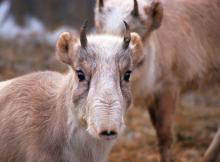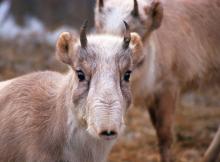
Kazakhstan's Ministry of Ecology has completed the development of a roadmap for regulating the saiga antelope population and is preparing to submit proposals to the government on "transitioning to sustainable use" of these animals.
Deputy Minister Nurken Shabiev informed Majilis deputies that the saiga population in the country has reached record levels — with expectations of over 5 million individuals compared to 2.8 million last year. The Institute of Zoology is preparing the biological justification for the cull, and the ministry has already taken into account "the experience of the 2023 cull" and promises to increase efficiency of the process.
Behind these vague formulations lies yet another attempt by the department, which, apparently, still hasn't learned to count, to reach for the guns again. And once more, under the guise of caring for nature, to orchestrate what the FBRK editorial team just a year ago rightly called a barbaric, almost uncontrolled slaughter of saigas.
As FBRK founder Kirill Pavlov previously noted, the official statistics on saigas resemble arithmetic from a parallel universe. The figures announced by the Ministry of Ecology look impressive but raise serious questions for anyone with even a basic understanding of population biology. According to official data, the saiga population grew from 1.3 to 4.1 million individuals by early May 2025 — an increase of over 200% in two years.
Such growth would indeed make the saiga the absolute champion of reproduction among all even-toed ungulates. If these rates continue, by 2026 there will be more saigas than people in Kazakhstan, and by 2030 — more than the wheat harvest in the best-ever years.
The counting methodology used by the ministry is simple to the point of being primitive. Aerial surveys are conducted along pre-determined routes in a narrow strip of steppe where saigas naturally congregate in large herds during certain periods, such as calving season. These local data are then extrapolated to the entire habitat area. The result is an impressive growth chart that delights officials and frightens deputies.
The main problem is that systematic observations are not carried out over vast territories where animal density is significantly lower or where they may simply not be present at the time of the count. In effect, the calculation is based on the assumption that the entire Kazakh steppe is a giant nursery with ideal breeding conditions.
Furthermore, the ministry's formulas seem to completely ignore natural mortality, which looks particularly cynical given that the same department explained mass spring die-offs of saigas precisely as being due to natural causes. When animals die, it's a natural process requiring no intervention. But when it's time to count the herd to justify a cull, that same natural mortality magically disappears from all calculations. Diseases cease to exist, the impact of droughts is ignored, dzuts (severe winters) and predators are not accounted for, and poaching only exists in reports about combating it. Excel spreadsheets generate steady growth, unburdened by the realities of the wild.
The history of the saiga population tells a completely different story. In 1993, after a drought, the population fell to 270,000 individuals. By 2003, only 21,000 animals remained. In 2015, a mysterious disease killed 200,000 saigas in a single season. In 2021, there was mass mortality among young saigas. But in the current reporting, such catastrophes seem impossible — every year only growth, every season only increase.
When biological models consider only birth rates, and all mortality factors are relegated to the category of statistical errors, this is no longer population science. It is administrative fantasy, where nature is obliged to conform to departmental plans, and the saiga is transformed into an immortal creature from presentation slides.
Need it be recalled that the Ministry of Ecology already has a sorry track record of "regulating" the saiga population? In May 2024, the FBRK editorial team compiled a complete chronology of the cull, uncovering numerous discrepancies not only in the animal count but also regarding how many saigas were actually shot and delivered to meat processing plants in 2023. Some 40,000 carcasses magically disappeared, not to mention the budgetary funds spent on the operation.
Back then, we witnessed true barbarism: organs and hides of killed animals scattered across the steppe, illegal slaughter at car washes, illegal meat trading. All of this could easily have triggered the spread of diseases among the remaining animals and created an epizootic threat. And saiga horns are highly valued on the black market, turning any "scientifically justified cull" into a cover for poaching.
Incidentally, last February, the Ministry of Ecology announced its intention to amend the Convention on International Trade in Endangered Species of Wild Fauna and Flora (CITES) and obtain permission to sell saiga horns abroad by 2025. Recall that the horns obtained from population regulation of saigas were tagged and transferred for storage to RSEE "Okhotzooprom", about which our editorial team had many questions even last year.
The ministry was ultimately unable to control the process that it itself had initiated. Promises to establish order and improve efficiency sound particularly unconvincing against the backdrop of the chaos that reigned during the previous "cull". When a department is incapable of organising a basic count of the animals it has shot, on what basis does it undertake new large-scale operations?
Deputy Pavel Kazantsev, during a committee meeting, declared an "obvious state of emergency" and called for immediate action, suggesting they should "blaze away" at the saigas, stating "there's nothing terrible about it". Such rhetoric eloquently demonstrates the level of understanding of environmental issues in the highest echelons of power. When complex biological processes are reduced to a simplistic "shoot everything in sight," it speaks not of a readiness to solve problems, but of a desire to create the appearance of vigorous activity.
The conflict between agriculture and wild animals does indeed exist, and it needs to be resolved. But it should be resolved intelligently, with the involvement of independent experts, with honest analysis of causes and consequences. As Sergey Sklyarenko from the Kazakhstan Association for Biodiversity Conservation rightly noted, the problem requires inter-agency cooperation and a comprehensive approach, not simply the removal of animals.
President Kassym-Jomart Tokayev promised a year ago to revoke the decision to cull saigas, calling them "symbols of the Kazakh steppe". Now there is a perceived need to "make a balanced decision" considering the changed situation. But if the situation has truly changed so dramatically, shouldn't we first figure out why the official statistics are so starkly at odds with reality?
If the Ministry of Ecology is incapable of competently performing its primary function of environmental protection, perhaps it should refrain from interfering in ecological processes without proper preparation. Experience shows that its intervention only makes things worse — for the animals, for the ecosystem as a whole, and for the reputation of a state that should be an example of responsible stewardship of natural resources.
Saigas survived the Ice Age, survived Soviet industrialisation, survived the wild 1990s. But whether they can survive the attention of the Kazakh Ministry of Ecology is a serious question.