Ministry of Ecology reports record growth in the population of brown bears in Eastern Kazakhstan, and the Vice-Minister of Ecology, Nurken Sharbiyev, seems to be hinting at a possible increase in shooting quotas. The episode is painfully reminiscent of the familiar story with the saiga, where population control increasingly resembles a non-transparent commercial operation. And once again, the same question arises: is the department protecting nature and people, or something else entirely?
Vice-Minister of Ecology and Natural Resources, Nurken Sharbiyev, shared optimistic news: the brown bear population in Eastern Kazakhstan is growing at a record rate. It is reported that there are currently about 4,500 individuals in the region, with an annual increase of 50%.
The Ministry does not rule out changing the bear culling limits next year. It all depends on the biological justification, the Vice-Minister assures.
The residents of the Abai Region are noticeably less enthusiastic about this data. Villagers from five settlements in the region have encountered a problem far more concrete than the department's statistical figures.
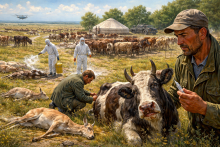
It is reported that bears are breaking into barns and attacking livestock right on the pastures. Meiramgalym Zharmaganbetov from the village of Kapanbulak lost 8 head of cattle, while his acquaintances lost 17 animals immediately. Residents of the Zharma District are particularly affected, where mutilated carcasses and remains of domestic animals are regularly found. Cattle breeders note: the raids have been ongoing for two years, and this summer the situation has escalated to the limit.
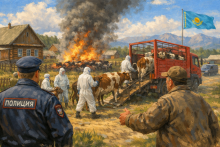
The Deputy Akim of the Zharma District, Berik Samezhanov, responded to the problem by creating a commission of 28 people, including representatives of executive and law enforcement bodies, as well as hunters with firearm permits. The commission is to take measures to protect the population and domestic livestock.
The situation with the bears inadvertently recalls the recent story of saiga population control. Both in 2023 and 2025, the process was initiated, supposedly due to complaints from farmers, but quickly descended into non-transparency and commercialisation.
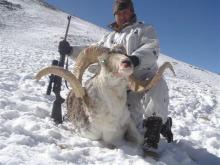
We know the result: scattered organs and animal skins are found on the steppe, while valuable horns become an item of trade. The pattern is clear: there are complaints, there is a threat, there is a promise of population control. And there is valuable raw material that can be sold.
And although the situation with the bears has not yet reached the point of 'population control', and such control might not necessarily be unjustified, when the Ministry of Ecology announces another species whose numbers require control, an observer inevitably wonders: what valuable commodity does this animal possess? For the Ministry's concern, as is well known, is not necessarily linked to natural resources (perhaps only to their market price).
What does this tell us? It's very simple. Through its actions, the Ministry of Ecology risks not only losing control of the situation with wild animals but also completely eroding public trust. When the logic behind the department's actions remains hidden, and the population sees no real protection of their interests, the institution's reputation erodes faster than the bear population grows.
And if the Ministry of Ecology continues to ignore the need for open dialogue with society, the public will stop taking it seriously. And that is precisely what we are witnessing.