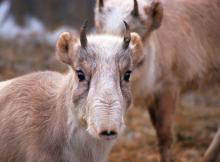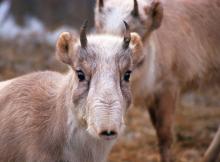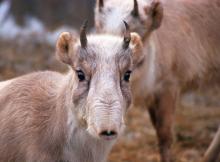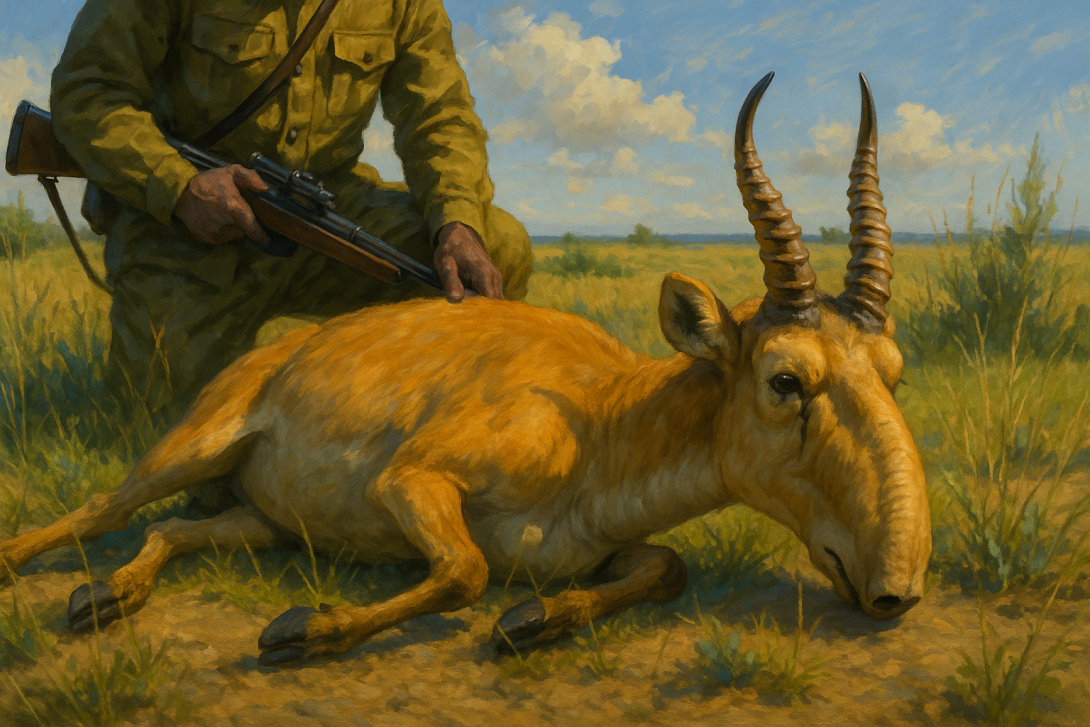
In Kazakhstan, a campaign to "regulate the numbers" of saiga antelope has officially begun, which could lead to the destruction of 800,000 steppe antelopes. The Ministry of Ecology has clarified that the carcasses of the killed animals will belong to the hunters, and the authorities have already started the process of establishing meat processing plants to process the meat of these rare animals and are preparing to announce its price shortly.
According to official data, the saiga population in the country has reached record levels — 3.9 million individuals, which is allegedly almost three times the historical peak of 1974. The decision to cull was made following complaints from farmers in the West Kazakhstan Region that saigas are destroying fields and depriving livestock of pastures. In this region, which is home to 2.3 million head, authorities plan to shoot up to 460,000 animals.
Minister of Agriculture Aydarbek Saparov reported that 18 enterprises with veterinary specialists have already been registered to process saiga meat. The price for the meat of these rare animals will be announced in 10 days, after which the format for selling the products will be determined.
The official hunt began on 3 July and will last until 30 November. However, different periods have been set for males and females: "males — from 1 July to 30 November, females and calves — from 1 September to 30 November".
For reference: calves are young born in the current year that have not yet reached sexual maturity, making their culling particularly controversial from a conservation perspective.
Furthermore, alongside the mass cull, President Kassym-Jomart Tokayev announced an intention to gift 1,500 saigas to China for resettlement in the western part of the PRC. The Ministry of Ecology stated that the issue of transporting the animals is in the development stage jointly with the authorised bodies of both countries.
But the story of saigas in Kazakhstan, as is known, also has another, less glamorous side. In 2024, the editorial board of FBRK compiled a full chronology of the saiga cull that occurred a year earlier. In 2023, the Ministry of Ecology allowed a barbaric, almost uncontrolled killing of saigas, and we had to witness scattered organs and skins of killed animals across the steppe, illegal slaughter at car washes, and the subsequent illegal trade in meat.
The scale of poaching was also shocking in 2024. In February last year, on the 'Zhezkazgan – Kyzylorda' highway, police discovered 47 saiga carcasses, in the Atyrau region, 600 horns were seized from a poacher, and in Zhetysu — 1,382 saiga horns.
Incidentally, at that time, the Ministry of Ecology stated plans to amend the CITES Convention and obtain permission to export saiga horns by 2025. Now, the department appears to be creating ideal conditions for a new mass cull under the pretext of scientific necessity and protecting agriculture.
Perhaps one should consider whether the state can guarantee that handing over the carcasses to hunters will not lead to a repeat of 2023, with cruel slaughter and a thriving black market for saiga horns?