
The department spent an entire page arguing that the direct procurement for the repair of the KNB building in Shchuchinsk was entirely lawful — only then, in the very next paragraph, to report that for violating that same law, the head of the department had already been fined. FBRK asked for an explanation of this contradiction via an official complaint, and the response from the Department of Housing and Communal Services and Housing Inspection of the Burabay District turned out to be surprisingly candid: the procurement method was deemed unlawful, the head of the department did not contest the fine, and the earlier justification of lawfulness remained merely the version put forward by the customer itself — a version that failed to withstand state audit scrutiny.
WHAT HAPPENED
As FBRK previously reported, on 23 June 2026, the head of the district’s Department of Housing and Communal Services (HCS) and Housing Inspection, Bekzat Baisakalov, signed an order to procure from a single source and on the same day concluded a contract with the sole trader “Favorit” for the repair of the administrative building. The basis for this was subparagraph 3) of paragraph 3 of Article 16 of the Law of the Republic of Kazakhstan ‘On Public Procurement’, which permits the direct conclusion of a contract when it is necessary to immediately eliminate the consequences of emergencies and breakdowns of engineering communications. However, the technical specification included, alongside basement waterproofing and pipe replacement, works bearing no direct relation to eliminating breakdowns: installation of decorative panels, construction of a platform, installation of state symbols, installation of ceilings and blinds, and a kitchen worktop. Neither the contract nor the order explained how these works were connected to an emergency situation.
To obtain clarification, the FBRK editorial team sent an official request to the Burabay District Akimat.
FIRST RESPONSE: JUSTIFICATION OF LAWFULNESS WITHOUT DISCLOSING DETAILS OF THE FINE
In response to our request, the Department of HCS and Housing Inspection consistently and at length defended the lawfulness of its actions. The department stated that the basis for the procurement was the need to promptly restore the building’s operational condition and eliminate defects in structural elements and engineering systems. 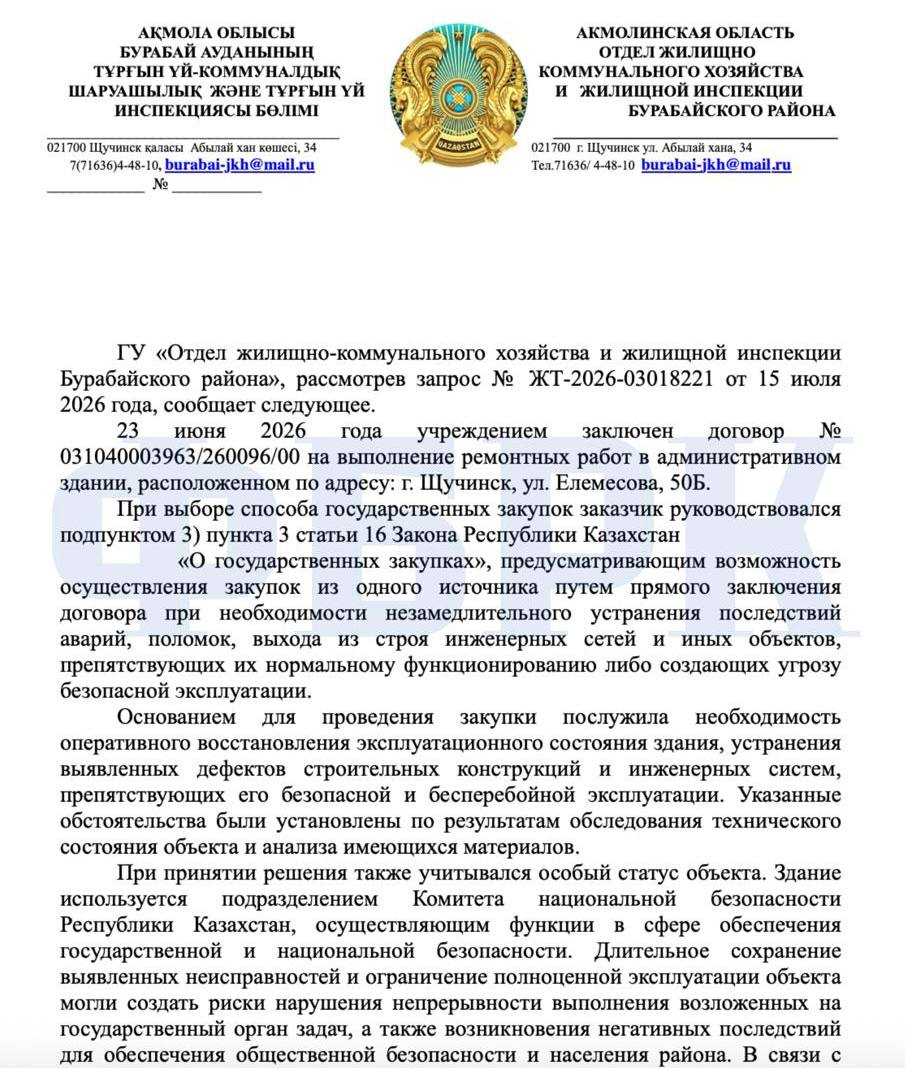
As for the decorative works, the department explained their inclusion by the technological and functional interconnection of the stages: the installation of panels, ceilings, blinds, state symbols and the platform was presented as a logical continuation of the works to eliminate structural defects — a single package of measures to bring the premises into a usable condition.
However, the same letter contained a paragraph that stood in stark contrast to everything set out above. Following administrative proceedings conducted by the Department of Internal State Audit for Akmola Region, a violation of procurement legislation was established in the choice of procurement method. A protocol was drawn up against the head of the department and a fine was imposed. However, neither the nature of the violation nor the audit findings were disclosed in the response.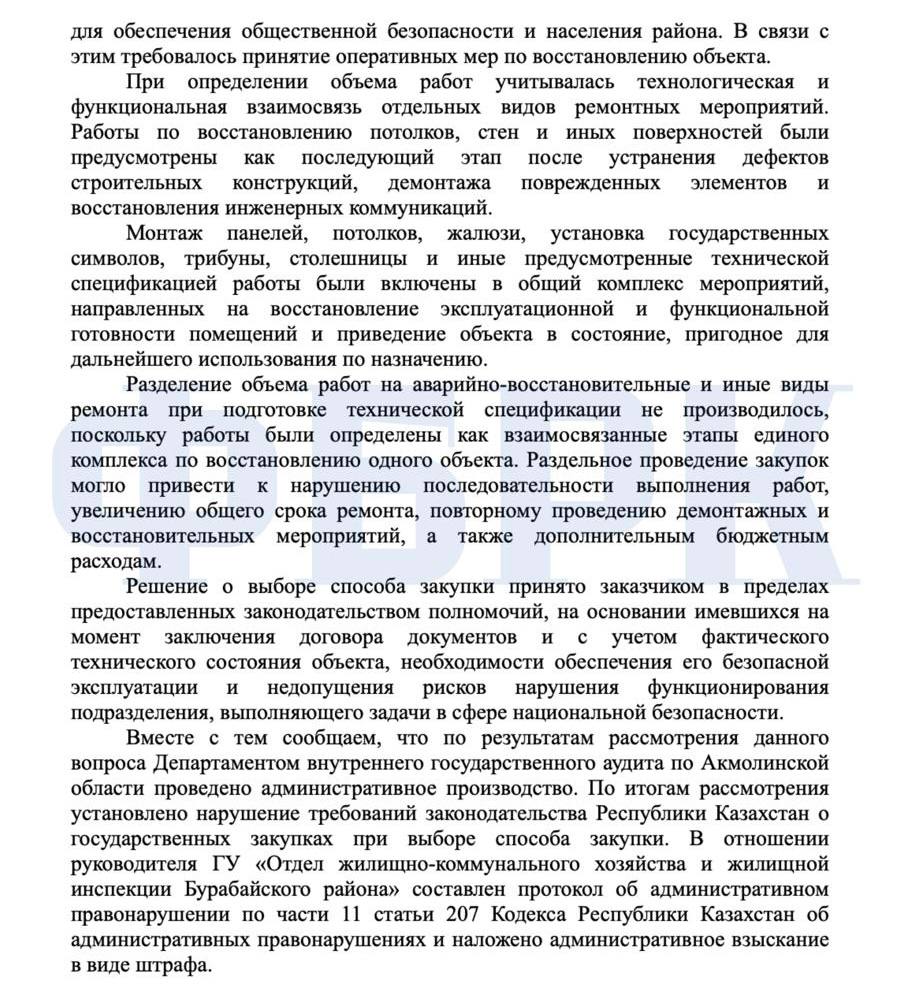
COMPLAINT: ONE LETTER — TWO MUTUALLY EXCLUSIVE ASSERTIONS
Having received such a response, FBRK lodged an official complaint, pointing out its internal inconsistency. On the one hand, the customer insisted on the lawfulness of the chosen procurement method, citing the powers granted by law. On the other hand, the authorised state audit body, following its inspection of the same contract, established a violation for which the official was held administratively liable.
The Department explained that the first response reflected the motives and factual circumstances that guided the customer at the time of concluding the contract, whereas the final legal assessment was given later by the authorised audit body.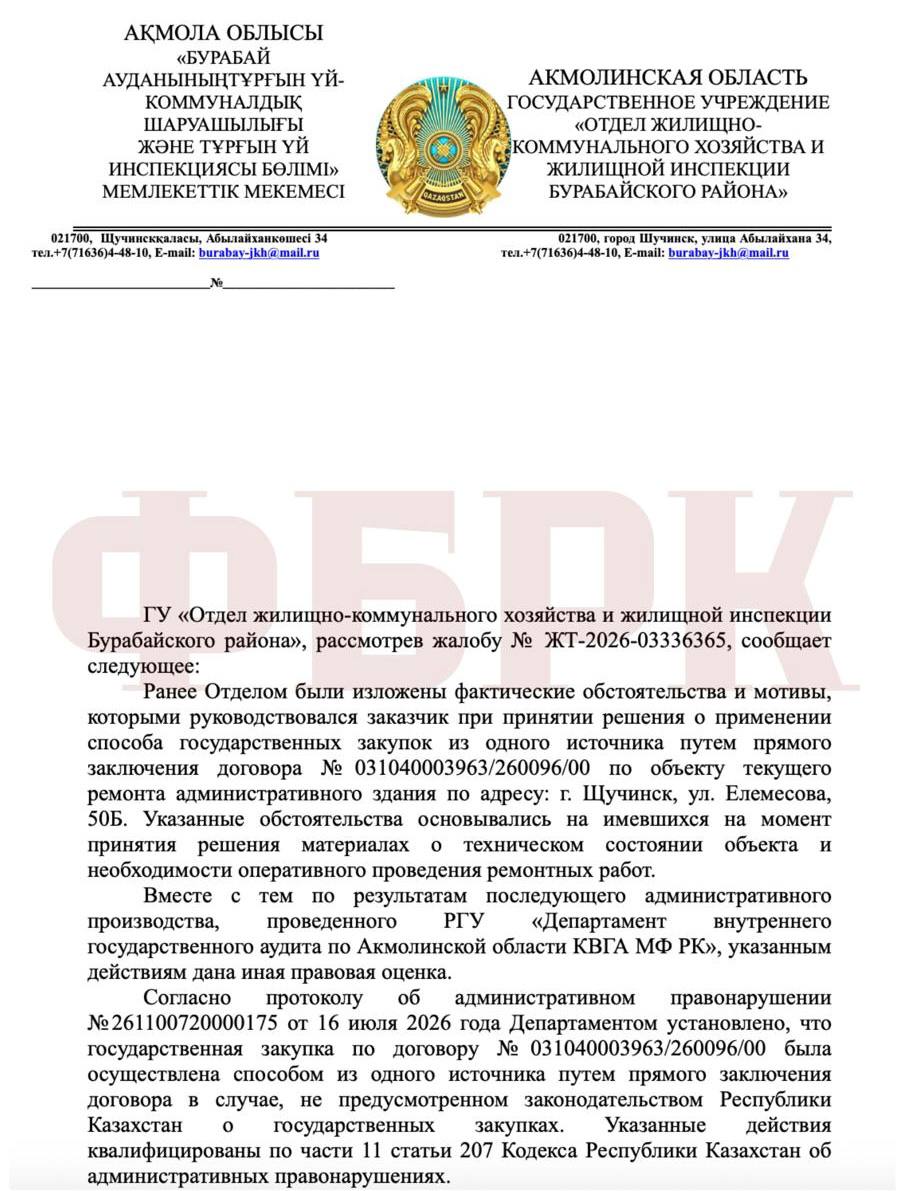
As it turned out, the Department of Internal State Audit for Akmola Region established that the procurement had been carried out by the single-source method in a case not provided for by procurement legislation. In other words, the circumstances the Department had cited as grounds for applying the exceptional provision — the emergency state, the need for the immediate elimination of defects — were not deemed sufficient by the audit to justify the use of this procurement method. The Department also reported that the head had agreed with the established violation, and the fine decision itself was not appealed. The department added that it would take the audit findings into account in organising future procurements.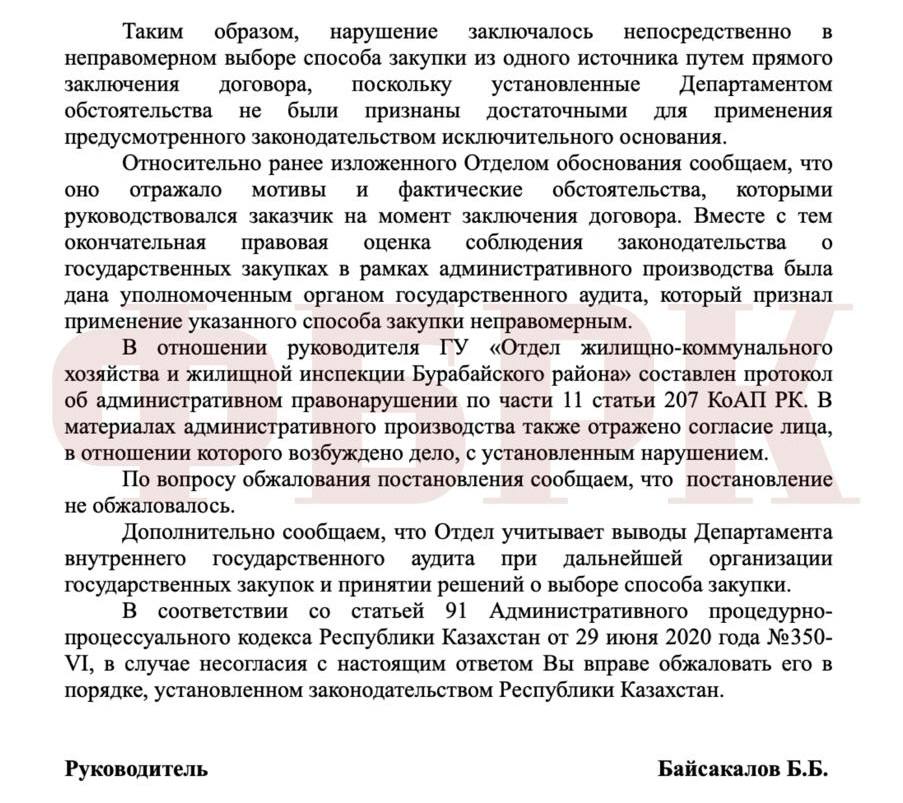
WHAT THIS MEANS
The admission that the decision was not appealed, and that the head of the department agreed with the audit findings, changes the weight of the entire argumentation set out in the first response. The detailed justification, it turns out, did not withstand scrutiny by the authorised body, and the Department itself does not dispute this. At the same time, the details of the audit itself — which materials exactly underpinned the conclusion of unlawfulness, and whether the decorative works were assessed separately — remain undisclosed. Moreover, a violation acknowledged after the fact does not undo the works already carried out, nor does it recover the budget funds.