The Department of Housing and Communal Services (HCS) and Housing Inspection of the Burabay District has concluded a direct contract for government procurement worth 26 million tenge for the repair of the building of the local branch of the Committee of National Security (CNS), citing a legal provision that allows single-source procurement in cases of emergency and crisis situations. However, the department did not disclose which specific incident necessitated the urgent signing of the contract. The editorial team of FBRK examined the documents and found that the grounds stated in the order only explain part of the work included in the contract.
WHAT HAPPENED
As reported by the Telegram channel "Journey Through Government Procurement", the direct contract for the repair of the CNS building in Shchuchinsk was concluded with reference to the provision on procurement in emergency situations, although no such circumstances had been publicly announced. A significant portion of the work stipulated in the contract relates to routine current repairs, which could typically be carried out through competitive procedures.
WHAT THE DIRECT PROCUREMENT ORDER SAYS
The head of the Department of HCS and Housing Inspection of the district, Bekzat Baisakalov, signed the order for government procurement from a single source on 23 June 2026 — the same day as the contract itself. According to the order, the procurement is justified by the need to urgently fix breakdowns and failures in engineering communications, as well as to restore building structures, the damage of which hinders the safe operation of the facility. In other words, this specifically refers to technical breakdowns, not an emergency situation, as the media has unequivocally reported.
Both formulations — regarding an emergency situation and technical faults requiring urgent rectification — are contained in subparagraph 3 of paragraph 3 of Article 16 of the Law "On Government Procurement", which the department cites.
DOES THE REPAIR MATCH THE ORDER'S WORDING
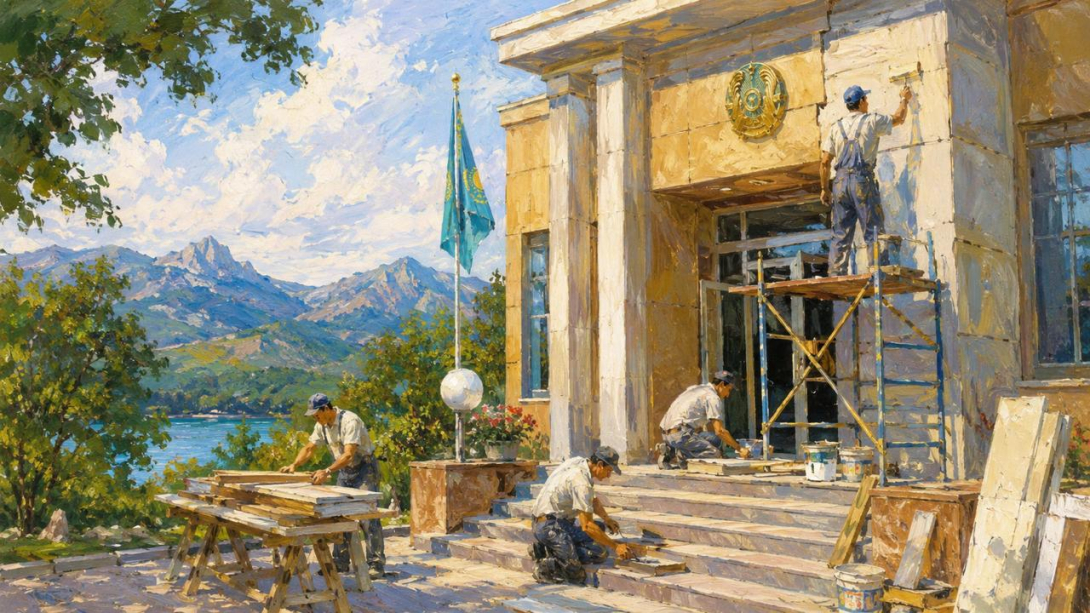
Part of the work in the technical specification does indeed relate to engineering systems: basement waterproofing, replacement of water pipes, rectification of faults in the heating unit, installation of a boiler and mixers. However, the list also includes work that is unrelated to emergencies or structural damage. Among these are painting 2,400 m² of walls, installing bamboo and decorative panels, constructing a stage, installing the state flag and coat of arms, a kitchen worktop, and others. Neither the contract nor the order contains any indication that this work was required to rectify an emergency.
WHO IS THE SOLE TRADER "FAVORIT"
The contract for the current repair of the CNS building was signed with a certain Sole Trader "Favorit". It is headed by Vadim Grünwald, who also runs the pawnshop "M. Lombard Maximum" and the construction company LLP "Burabai Kurylis", whose founder is Baurzhan Kushukpaev.
It is worth noting that during 2025–2026, Sole Trader "Favorit" concluded a total of 10 contracts worth over 155.6 million tenge with the Akimat of Burabay District and its subordinate Department of HCS, all through direct contract conclusion. These include a ditch-drainage system (17.05 million tenge), yurts and a stage (16.5 million tenge), bus stops (17 million tenge), and turf laying (17.3 million tenge). The latter contract for landscaping was concluded just one week before the repair contract was signed.
Unlike the repair contract, the turf laying contract was not arranged under the pretext of an emergency situation, but under another exception — subparagraph 28 of paragraph 3 of Article 16. This provision allows bypassing a tender process for a small annual volume of homogeneous procurement.
However, this approach is not new for the Burabay Akimat. Under the same grounds, a contract for the repair of children's playgrounds worth 14.8 million tenge was concluded in 2025. At that time, officials explained the waiver of the tender by the lengthy procedures and the risk of delaying work during the height of the summer season, when playgrounds are visited by the most children.
Judging by the documents, the Akimat is consistently using various exceptions to the Law that allow contracts to be concluded without a tender. However, the more frequently such mechanisms are applied in practice, the more important the transparency of their justification becomes.