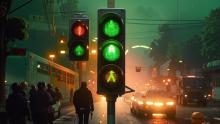
Recently, the editorial team at FBRK wrote about the sharp increase in spending on maintaining road infrastructure in the city of Kosshy.
A few years ago this budget item cost the city 1.4 million tenge, but now the figure has reached 237 million tenge. The explanation is simple — Kosshy recently received the status of a city of regional significance, and costs have skyrocketed.
But this is far from an isolated case. For instance, in Shymkent city, which, incidentally, was granted republican status in 2018, expenditure on the same items has soared to unprecedented levels.
If in 2016 maintaining road infrastructure cost 49 million tenge, this year the sum has reached 7.6 billion tenge.
Interestingly, in both cases the contractor is the same company — SMEU Astana LLP.
But let's take things in order.
Year after year, the Shymkent city akimat enters into contracts for the maintenance and technical servicing of traffic lights and other road facilities.
Under such agreements, the contractor typically inspects, maintains, and repairs equipment, ensures power supply, and installs the necessary software for road facilities.
In 2016, the city had 155 traffic lights in operation, of which 148 were LED and 7 were incandescent. 94 traffic lights were connected to the intelligent traffic management system (ASUDD), which helps monitor the condition of the equipment.
The contract with the supplier - SMEU Astana LLP - was concluded "from a single source due to failed procurement".
At the same time, the competition results protocol indicates that the company was an invited supplier.
It appears that in 2016, SMEU Astana LLP was the only candidate meeting all the criteria for performing the work under the contract.
The price offered by the supplier was 37.5 million tenge. The final amount stated in the contract was different — 42 million tenge, but this was later increased to approximately 49 million tenge.
In 2017, the akimat entered into a similar contract with SMEU Astana LLP, this time for the maintenance of 200 traffic lights.
The contract amount was initially around 41 million tenge, but soon increased first to 44 million tenge, and then to 49 million tenge.
Along with the increase in the amount, the parties agreed to extend the contract term until 1 March 2018 instead of the originally set date of 31 December 2017.
Interestingly, in this case too, the supplier initially offered a much lower price for the services – 36.6 million tenge. The method of concluding the agreement – from a single source – also remained unchanged.
In April 2018, the parties concluded a single-source contract for servicing 237 traffic lights: 234 LED and 3 incandescent traffic lights, with 97 connected to the ASUDD system.
Along with the increase in the number of traffic lights, the contract amount also grew. The supplier initially proposed 79.6 million tenge, but the final amount under the contract was over 89 million tenge.
In 2019, the parties entered into a contract for the maintenance of traffic light facilities and road signs for a term until the end of 2021.
The technical specification added clarifications regarding the maintenance of the technical equipment complex, covering monthly, quarterly, half-yearly, and annual works. It also listed the names of 236 traffic light junctions.
The contract amount was around 1.3 billion tenge, although the initial cost was lower — about 1.2 billion tenge.
According to the estimate documentation, the cost of annual traffic light maintenance was about 60 million tenge, meaning keeping one traffic light facility operational cost the budget approximately 253 thousand tenge per year.
For comparison, in 2016 the annual maintenance sum for 155 traffic lights was about 15 million tenge, and per facility it was roughly 95 thousand tenge.
This means that in just three years the cost of maintaining one city traffic light increased more than 2.6 times.
In 2022, the Shymkent city akimat held an open tender for the servicing of 280 traffic lights, with two potential suppliers participating – SMEU Astana LLP and SMEU Almaty LLP.
The companies submitted their prices, and factoring in a conditional discount, the most advantageous offer was from SMEU Astana LLP for about 1.6 billion tenge. As a result, the company won the tender.
However, the final contract amount was over 1.9 billion tenge. The contract execution period is scheduled to end on 31 December 2024.
This year, the Shymkent akimat again held a tender for the provision of similar services, with the same companies participating – SMEU Astana LLP and SMEU Almaty LLP.
The companies submitted their price proposals, and once again the lowest was from SMEU Astana LLP - 6.1 billion tenge.
The contract with the winning company, which ultimately cost the city 7.6 billion tenge, includes, among other things, the maintenance of 297 traffic light facilities until the end of 2026.
Without a doubt, the technical content of these contracts has changed each year, and therefore comparing them in terms of cost efficiency is quite difficult.
Nevertheless, we can observe a significant increase in expenditure year on year:
- 2016 – 49 million tenge;
- 2017 – 49 million tenge;
- 2018 – 89 million tenge;
- 2019 – 1.3 billion tenge;
- 2022 – 1.9 billion tenge;
- 2024 – 7.6 billion tenge.
Moreover, in all the mentioned contracts, the bulk of the costs went specifically towards maintaining traffic lights and road signs.
While the number of traffic light facilities increased annually, data on the quantity of road signs serviced remains somewhat unclear.
For example, in the estimate documentation, the number of road signs – 8,000 units – was only specified in 2018. It is known that their maintenance cost approximately 15 million tenge, or about 2,000 tenge per item.
Another aspect probably worth noting is the choice of supplier, which has remained unchanged since 2016.
On the one hand, this fact indicates stability and trust in a company that may have proven itself as a reliable contractor.
On the other hand, it could suggest the existence of certain barriers for new market entrants, which might affect the efficiency of tender processes.
And using the examples of Shymkent and Kosshy, one can see that a city's upgrade in status is accompanied not only by increased budgets but also by a growing interest in spending them.
The FBRK editorial team has sent an official request to the Shymkent city akimat in order to understand the reasons for the increase in contract costs.