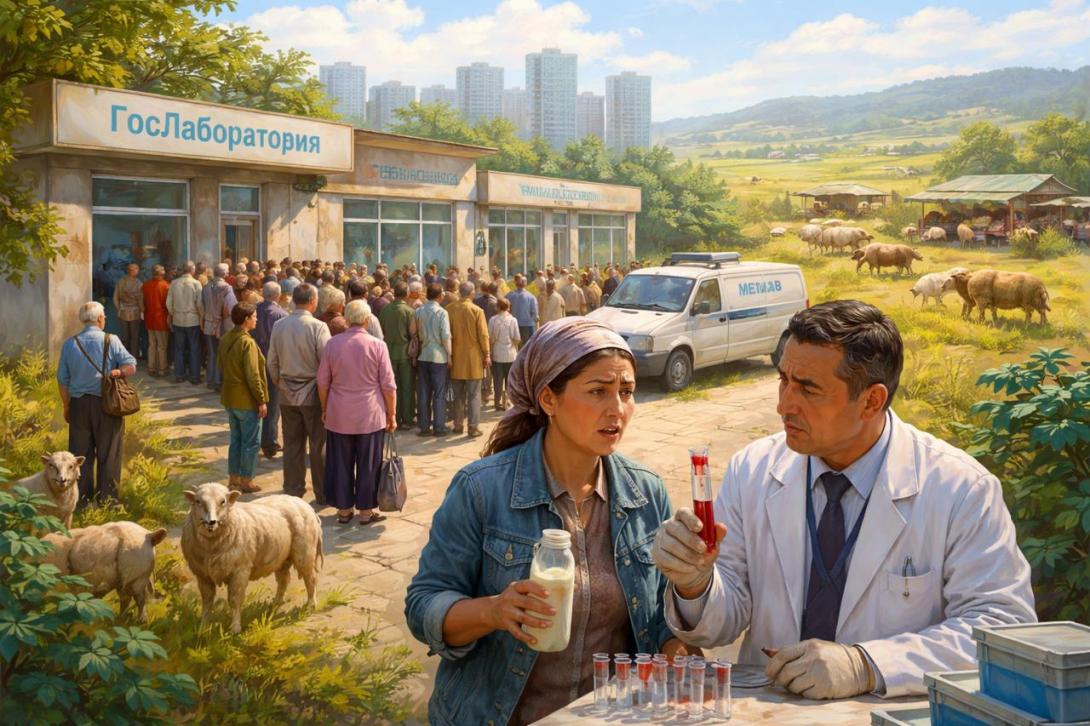
In Kazakhstan, a diagnosis of brucellosis has become a privilege - not a medical one, but an administrative one. You can only get the test done at a state laboratory, often located on the other side of the city. This is the situation reported by the publication Shyndyk․kz: while private laboratories with international accreditations sit idle, patients lose days, and sometimes their health, waiting in queues. The Director of Development and Innovation at the clinical diagnostic laboratory 'Olimp', Alexei Balas, told the FBK editorial team how an administrative decision turned accessible diagnostics into a monopoly.
HOW A MEDIEVAL DISEASE BECAME AN URBAN PROBLEM
Brucellosis was traditionally considered a disease of rural areas, but statistics are breaking this stereotype. According to data from sanitary services, in Akmola Region alone, the incidence rate rose by 33% in 2025. The main source of infection for urban residents remains unchecked dairy products from spontaneous markets.
The disease can mimic dozens of other diagnoses, and its symptoms can easily be confused with flu or sciatica. Advanced brucellosis affects the musculoskeletal system and the genitourinary system, and in severe cases leads to disability.
A BAN THAT DOESN'T PROTECT, BUT DELAYS
According to the official response from the Committee for Sanitary and Epidemiological Control of the Ministry of Health, cited by Shyndyk.kz, the Law on Biosafety classifies brucellosis as pathogenicity group two, meaning, according to the publication, only state institutions or companies with 100% state ownership are permitted to work with it.
The Committee allegedly justified this decision with 'high bio-risks' and 'inadequate staff training' in the private sector. However, in the same official response, the department acknowledged that for the whole of 2025, no cases of infection among laboratory personnel were recorded in Kazakhstan.
This paradox, according to journalists from Shyndyk․kz, was also exposed during a closed meeting between Ministry of Health officials and laboratory representatives. One department representative allegedly stated outright that the 'private sector' could have any equipment they wanted, but they would not be granted access to the analyses.
DIAGNOSTICS AS A PRIVILEGE
Private networks already cover most of the country with their treatment rooms. According to Shyndyk․kz, they perform around 60% of all laboratory tests. Some have obtained the international JCI accreditation - a standard met by only 48 organisations worldwide.
The Director of Development and Innovation at the clinical diagnostic laboratory 'Olimp', Alexei Balas, pointed out the key contradiction of the ban in conversation with the FBK editorial team. Specifically, he notes that a patient with an already established diagnosis of 'brucellosis' can come to a private laboratory and give a general blood test, even though antibodies are present in their blood. There is no ban on working with such blood. But if that same patient wants to be tested specifically for brucellosis, they will be refused.
The issue here is not even the absurdity of the situation. When the state spends 1.4 billion tenge a year fighting one disease, any talk of allowing private sector involvement inevitably sounds like a conversation about money. At the same time, Balas notes that private laboratories are not seeking state funding.
"We are not saying we lay claim to state funds. We are saying that patients should have the right to get a second opinion or to speed up diagnostics and obtain them, even if they have to pay. Even that is not allowed at the moment," - says Alexei Balas.
In other words, it is not about budget redistribution, but about the patient's right to choose.
The General Director of the clinical diagnostic laboratory 'Olimp', Yerlan Suleimenov, and the President of the Kazakh Association of Medical Laboratories, Alla Kim, note that now, due to the ban, residents of remote areas are forced to travel hundreds of kilometres to a 'permitted' state laboratory. In this scenario, the disease often progresses, leading to disability.
NOT A SINGLE CASE OF INFECTION
Before the law came into effect, the clinical diagnostic laboratory 'Olimp' performed brucellosis tests routinely. As Alexei Balas reported, during all that time, not a single case of infection among medical or laboratory personnel was recorded.
"Any laboratory works with biological material as potentially hazardous - we don't know who has come to us: a patient with HIV, hepatitis, or brucellosis. Therefore, all infectious safety requirements are applied. And infections do not occur. But how to explain this to the Ministry of Health - we still do not understand," - he says.
The Kazakh Association of Medical Laboratories (KAML) has already sent an official appeal requesting a review of the ban, but the response was negative. Currently, as Alexei Balas reported, a repeated request is being prepared, and a meeting is planned at the National Chamber of Entrepreneurs 'Atameken' to definitively ascertain the Ministry of Health's position.
At the same time, when asked by the publication Shyndyk․kz about possible amendments to the law, the Committee responded that no changes were planned in the near future. The clinical protocols for treating brucellosis, approved back in March 2019, are included in the list of 'priority items for review', but have never been updated.
Recall that earlier, the FBK editorial team sent an official request to the Committee for Veterinary Control and Supervision of the Ministry of Agriculture. We requested statistics on animal disease outbreaks, vaccination data, and the calculation methodology. In response, the department classified the information under the heading 'For Official Use Only', and even a subsequent complaint did not change this position. This means that farmers, doctors, and ordinary citizens of Kazakhstan are officially denied access to information about where and how the disease is spreading among animals - the main source of human infection.
Meanwhile, the Committee for Sanitary and Epidemiological Control of the Ministry of Health responded openly to a similar request. Over ten years, more than 8,800 cases of brucellosis among humans have been registered in the country. This figure exists. It is public. But Alexei Balas warns: it should be taken with caution. In his opinion, the official statistics may be decreasing not because the disease is receding, but because people simply no longer reach the point of diagnosis.
"They do not go to the state laboratory, they do not get tested in time, and it is only when complications arise, and then perhaps, that brucellosis is detected," - he says.
The same logic, Balas reminds us, applies to HIV: more testing leads to more detected cases; less testing leads to better-looking numbers.
It should be noted that, in parallel, in the West Kazakhstan Region, a worsening of the epizootic situation for brucellosis is being recorded: livestock are falling ill, farmers are incurring losses, and all this is against a backdrop of closed statistics and limited diagnostics.
The demand for brucellosis tests has always existed, and given recent events in the West Kazakhstan Region, it can only grow. Against this background, another, no less important, question naturally arises: if private laboratories, covering most of the country and holding international accreditations, are denied access to these tests, who specifically benefits from the resulting monopoly?