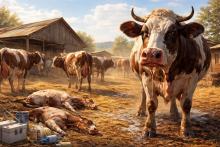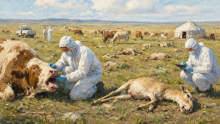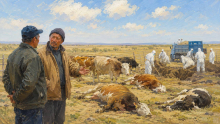
In two villages in the Narynkol district of the Raiymbek district of the Almaty region, the death of around 25 head of livestock is being reported. The cause is not yet known, but against the backdrop of previous cases of livestock deaths in Kazakhstan, this story again returns to an inconvenient question: how many more farms will face livestock deaths before clear answers about the causes emerge?
WHAT IS KNOWN
The footage shows dead animals, including cattle and horses. The author of the video on Facebook reports the death of around 25 head of livestock in two villages of the Narynkol district.
The resident also called on the authorities to look into the situation and recalled that for rural residents livestock are an important part of the household.
AGAINST THE BACKDROP OF WHAT EVENTS IS THE STORY UNFOLDING
Incidentally, the "unknown disease" in Kazakhstan has recently been affecting almost all domestic and wild animals: saiga antelopes, cattle in several regions at once, as well as small ruminants.
In spring this story became particularly acute against the backdrop of a mass outbreak of cattle disease in the West Kazakhstan region (WKR). The official diagnosis was pasteurellosis. However, Doctor of Veterinary Sciences Gaisa Absatirov cast doubt on it: in his opinion, the lesions of the oral cavity, lameness and death of young animals did not correspond to the clinical picture of this disease.
In May, Deputy Minister of Agriculture Amangali Berdalin stated that samples taken in 477 settlements returned negative results for foot-and-mouth disease. At the same time, two samples tested positive for rhinotracheitis — an infection whose symptoms, according to the official, can be confused with foot-and-mouth disease. According to the official version, foot-and-mouth disease has not been registered in Kazakhstan. But questions about the causes of the mass livestock deaths have not disappeared because of this.
The founder of FBRK, agro-expert Kirill Pavlov noted that having obtained the status of a country free of foot-and-mouth disease, Kazakhstan found itself in a rather strange position — it is no longer possible to talk about foot-and-mouth disease, since on paper it seemingly does not exist, but one can tirelessly churn out "unknown diseases"; the more favourable the epizootic statistics look on paper, the more reluctantly agencies rush to give diagnoses.
AND WHAT ABOUT ANTHRAX AND BRUCELLOSIS
In 2025, Kazakhstan again recorded outbreaks of anthrax — in the Akmola, Kostanay and Turkestan regions, as well as in Shymkent. In 2026, the latest reports concerned a different problem: in September it emerged that in Kosshy residential buildings had ended up within the sanitary zone of an anthrax burial site. According to the veterinary department of the Akmola region, the region has 250 foci on record, but the location is known for only 67.
Brucellosis, by contrast, continues to be confirmed in laboratories. In October, a court in the Kostanay region ordered a farm to send infected livestock for sanitary slaughter. At the same time, obtaining a full picture of the spread of the infection among animals from open data is difficult. The Committee for Veterinary Control and Supervision classified information about foci of livestock disease, vaccination and the counting methodology as information for official use.
The result is a familiar picture: animals are dying, owners are trying to understand the cause, and public discussion again begins before an official diagnosis appears. This does not prove that some specific infection lies behind the deaths in Narynkol. But without prompt investigation and a clear answer from the veterinary services, the story risks remaining yet another episode in which the cause is never named.