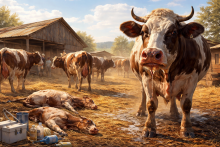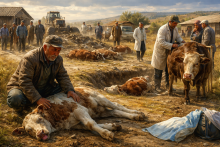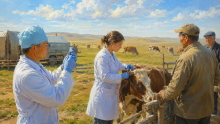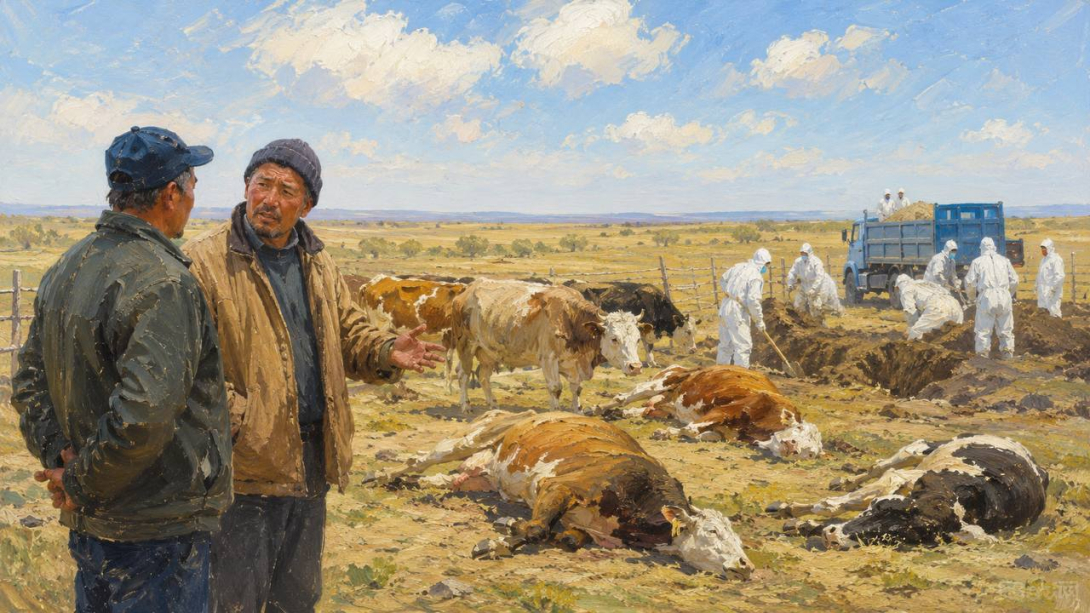
Cattle in the Atyrau region have been dying for the second year running for a reason that the official veterinary service has so far failed to name: the animals weaken and die within a matter of days, while specialists, after carrying out tests, can only throw their hands up in the air. In Kenzhebek, farmers have lost at least 13 head, and it is the recurring nature of the problem that appears to worry them as much as the losses themselves.
WHAT HAPPENED
According to Almaty.tv, locals say that only a few days pass between the first symptoms and the death of an animal. The carcasses were removed, burned and buried in a designated area. Neighbouring farms fear the deaths will spread to their own livestock.
Businesswoman Raya Mukhanbetova has lost 13 head and says a diagnosis was never established. Farmer Yerkin Sharipov adds that last year 20-30 head died with no explanation given.
WHAT OFFICIALS SAY
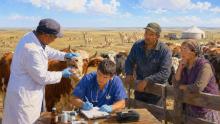
The official version mirrors the farmers' concerns almost exactly. The akim of the Kenzhebek rural district, Eduard Ospanov, said that tests on the animals, water and hay revealed no disease. Compensation will only be paid if the illness is confirmed, even though the livestock has already been burned, and vaccination has yet to be carried out - it is only planned.
WHAT THIS MEANS
The journalists at Almaty.tv titled their report "Under mysterious circumstances" - a phrase that seems to capture the entire logic of Kazakhstani veterinary science. In recent months, "unknown" has become almost the most common diagnosis in Kazakh livestock farming. It appears in the May outbreaks in the West Kazakhstan region, in the brucellosis episodes, and now again in the Atyrau region. The only difference is the geography and the number of dead animals.
It is telling that the people trying to call a spade a spade are not officials, but individual sector experts. Previously, FBRK reported in detail how Doctor of Veterinary Sciences Gaisa Absatirov directly diagnosed foot-and-mouth disease from the clinical picture in the West Kazakhstan region - elevated temperature, lesions of the mucous membranes, lameness, mass mortality - while the Ministry of Agriculture denied the outbreak, citing the absence of laboratory confirmation.
We have also written about livestock deaths from brucellosis in the same region, where farmers treated their cattle using advice from messaging apps because the veterinary service had effectively withdrawn from on-the-ground diagnostics. The current situation in Kenzhebek is not a new episode at all, but a continuation of the same story under a new geographical label.
And yet, literally in May of this year, Kazakhstan received international status as a country free from foot-and-mouth disease, and Minister Aidarbek Saparov was quick to present this achievement as the result of systematic work on biosecurity. The result is a strange picture. The country demonstrates epizootic wellbeing to the world while, inside its borders, farmers are burying livestock one after another without a diagnosis.
There is no technical contradiction here, because the status is awarded for specific zones and specific diseases, not for the entire veterinary system as a whole. But politically it looks exactly like a contradiction: the certificate is shown to external partners, while internal witnesses of livestock deaths are told to wait for test results that, year after year, lead to no diagnosis at all.
There is also another aspect of this matter that is probably worth paying attention to. An official diagnosis is not just a medical fact; it is an obligation: to pay compensation to farmers, to introduce quarantine, to report the outbreak to trading partners and to risk the export statuses that the government has spent years securing. An "unknown cause" obliges no one to do anything.
As long as the veterinary service can put mass livestock deaths down to water and hay tests that "showed nothing", the system frees itself from all the inconvenient consequences of official recognition, while farmers continue to count their losses alone and wait for the next season, in which - judging by years of statistics - history could very well repeat itself.