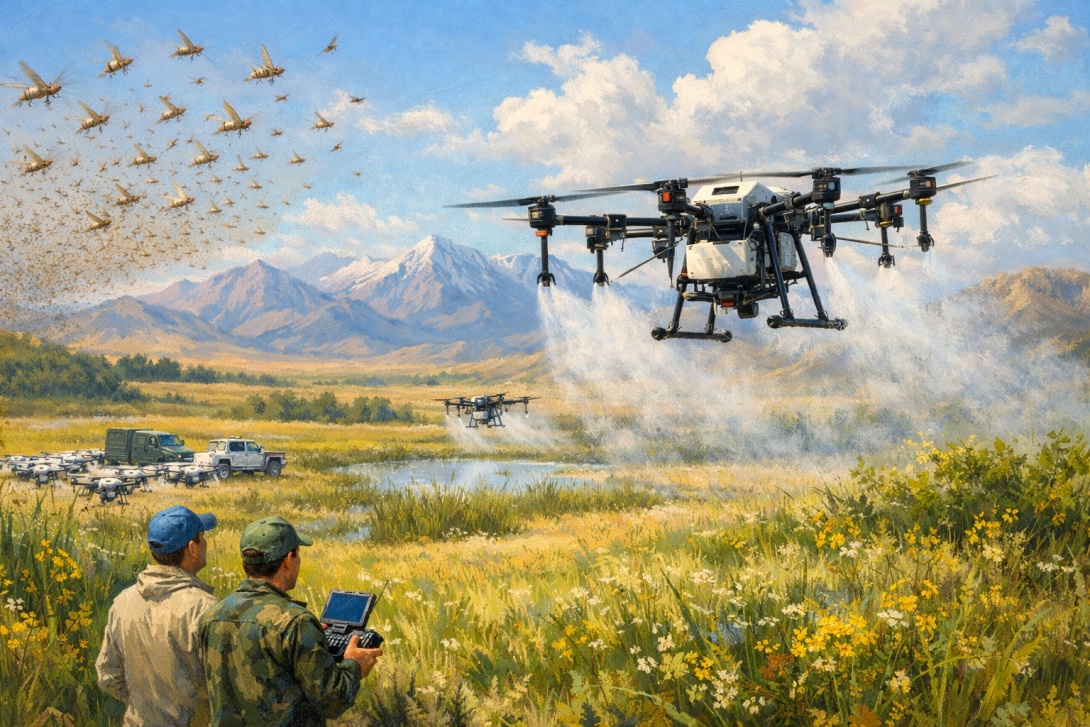
For the new locust control season, the Ministry of Agriculture (MoA) has entered with a significantly expanded fleet of drones. While a year ago the specialist centre had only 7 drones, it now has 57 — after an additional 50 units were purchased in December 2025. Alongside this, 46 agricultural drones have been prepared for the season for targeted chemical treatment. This brings the total to over 100 units of unmanned aerial equipment.
WHY DRONES ARE NEEDED IN THE FIGHT AGAINST LOCUSTS
Gregarious locust species spread across steppe, desert and mountainous zones, as well as river floodplains — areas where ground-based equipment simply cannot operate. Drones enable the rapid identification of pest infestation hotspots, speed up monitoring, and increase the coverage of surveyed areas.
As reported by the "Kazinform" International News Agency, specialists carried out a comprehensive check of the equipment ahead of the season, assessing flight safety, the effectiveness of spraying systems, and the stability of controls.
The drone fleet belongs to the State Institution "Methodological Centre for Phytosanitary Safety and Forecasts", which conducts monitoring of agricultural land. In 2025, the centre had 7 drones, purchased at the end of 2024. Now it has 57.
A STORY WE HAVE ALREADY TOLD
The expansion of the drone fleet comes against the backdrop of a prominent story that the FBRK editorial team has documented in detail over the past year.
For example, our editorial team established that the 46 agricultural drones for chemical treatment, which today’s announcement appears to refer to, were purchased at the end of 2024 for 368 million tenge — using leftover budget funds allocated for locust control, rather than as part of a planned equipment programme.
As was revealed in October 2025, 27 units of these 46 drones — that is, 58.7% of the fleet — fairly quickly ended up under warranty repair with the supplier. Data on flight hours were not provided. At the same time, the depreciation cost per hectare of treatment using state drones was twice as high as the market price for a similar service from private contractors.
Furthermore, the FBRK editorial team reported on an attempt to introduce a "single supplier" system, under which the contractor would be responsible for the entire locust control cycle. According to an industry source, this reform failed: contractors refused to take responsibility for results when using pesticides of questionable quality, while the responsible department chose not to comment on the project at all.
WHAT HAS CHANGED — AND WHAT REMAINS THE SAME
Against this backdrop, the official announcement of the successful preparation of 57 drones for the season sounds encouraging. The fleet has indeed grown. Technical maintenance has been carried out. The season will begin as normal.
But no one has received answers to the previous questions. Last year's experience shows that without concrete, verifiable data, official reports of successful season preparation remain merely a pretty picture. Whether this will change in 2026 — we will learn after the season ends.
We also note that the relationship between the two figures (57 and 46 drones) is not disclosed in the official materials: the ministry does not clarify whether the latter are included in the former, or whether these are separate fleets. The FBRK editorial team has sent a formal request to the MoA to ascertain the actual composition of the fleet, the fate of the equipment that underwent warranty repairs, and the sources of the new purchases.