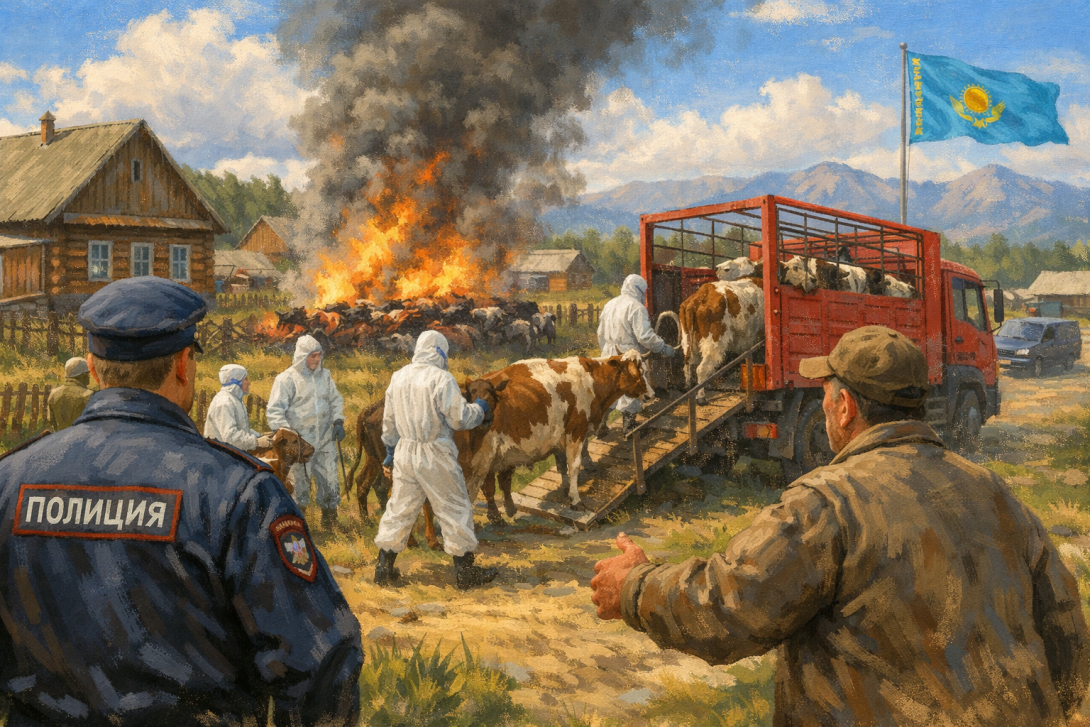
When the state begins to destroy livestock with a police escort and riot police (OMON), without naming the diagnosis or providing documents to the owners, this is clearly not a routine veterinary operation. Since February 2026, Russia has been experiencing a large-scale crisis in livestock farming: thousands of livestock have been destroyed in several regions of Siberia and the Volga region. The official version is mutated pasteurellosis and rabies. The unofficial version is foot-and-mouth disease, one of the most dangerous infectious diseases affecting cloven-hoofed animals.
The editorial board of FBRK decided to investigate what is happening across the border, and why it directly concerns Kazakhstan's livestock industry.
WHAT IS HAPPENING IN RUSSIA
Since the beginning of February 2026, in the Novosibirsk, Omsk, and Sverdlovsk Oblasts, the Altai Republic, and a number of regions in the Volga area and North Caucasus, the authorities have begun the mass seizure and destruction of farm animals. The official reason given is outbreaks of pasteurellosis (an acute bacterial infection) and rabies.
In the Novosibirsk region alone, 42 rabies hotspots and 5 pasteurellosis hotspots were recorded – in the Ordynsky, Karasuksky, Bagansky, Cherepanovsky and Kupinsky districts. In the Omsk region, at the SPK 'Rodnaya Dolina', 2,100 livestock had been destroyed by mid-February. In the Altai Republic, by mid-January there were around 2,000 sick animals, and the number of hotspots had risen to 70 by 10 February.
On 16 February, a state of emergency was declared in the Novosibirsk region, but this only became public knowledge a month later. Quarantine zones were cordoned off with checkpoints, and veterinary teams arrived accompanied by police officers. Farmers were not shown any documents justifying the seizure, and the results of laboratory tests were not provided. On 25 March 2026, the government of the Novosibirsk region announced that the culling of livestock in the region was complete. 200 million roubles (approximately 1.2 billion tenge) was allocated for compensation, whereas expert estimates put the actual damage at over 1.5 billion roubles (approximately 8.9 billion tenge).
PASTEURELLOSIS OR FOOT-AND-MOUTH DISEASE
It is the nature of the measures taken that has caused a wave of professional scepticism. According to Russian Government Decree No. 310, which regulates the procedure for the seizure of animals during the elimination of particularly dangerous diseases, pasteurellosis is not included in this list. This disease can be treated with antibiotics and does not require the total slaughter of the entire herd.
Meanwhile, the scheme used – destroying all susceptible animals within a radius of up to 5 km from the outbreak, incinerating carcasses – exactly matches the protocol for combating foot-and-mouth disease. This is a highly contagious viral disease affecting cattle, pigs, sheep, goats and camels. There is no cure for it.
Russian veterinary epidemiologist and forensic veterinary expert Svetlana Shchepetkina stated directly in a comment to Forbes that animal owners were refused permission for an independent veterinary examination and the provision of blood test results – despite the fact that such tests take only a few hours. According to her, this in itself suggests that the official version is 'far from the truth'.
Another factor is also telling. A source for one publication reported that shortly before the seizures began, livestock in a number of villages were vaccinated specifically against foot-and-mouth disease. A source from an agricultural holding operating in the Novosibirsk region stated outright that among large herd owners, the answer to the question 'what is happening' is known: a foot-and-mouth disease epidemic has begun.
Officials, notably the head of the Novosibirsk Centre for Veterinary and Sanitary Provision, Yuri Schmidt, denied the presence of foot-and-mouth disease. However, the head of the Novosibirsk Farmers' Association, Alexei Salnikov, while justifying the cull, described exactly the foot-and-mouth disease protocol – destroying all potential carriers within a five-kilometre zone, while not naming the disease.
The motive for possible concealment is obvious. In May 2025, Russia received from the World Organisation for Animal Health (WOAH) the status of a country free from foot-and-mouth disease. This status is critically important for the export of meat and dairy products. Losing it would mean the immediate closure of foreign markets.
KAZAKHSTAN IMPOSES A BAN – RUSSIA OBJECTS
Kazakhstan responded quickly to events. In February 2026, the Veterinary Control and Supervision Committee of the Ministry of Agriculture imposed a ban on the import and transit of live livestock and livestock products from a number of Russian regions – Altai, the North Caucasus republics (Dagestan, Ingushetia, Kabardino-Balkaria, Karachay-Cherkessia, North Ossetia, Chechnya, Stavropol Krai), Kalmykia, Buryatia, and the Astrakhan and Novosibirsk Oblasts.
Rosselkhoznadzor sent an official letter to the Kazakh veterinary control committee, calling the imposed restrictions 'unlawful' and inconsistent with the principles of the Eurasian Economic Union (EAEU), according to which veterinary and sanitary measures must have a scientific basis and be applied only to the extent necessary. In response, the Kazakh side explained that the measures would be lifted after the situation stabilises and product safety is confirmed.
It is noteworthy that Belarus also imposed its own restrictions on meat imports from Siberia, meaning Kazakhstan was not the only country to consider the situation serious enough for countermeasures.
RISK SEASON: WHAT HISTORY TELLS US
Given the current events, perhaps the most logical step is to look at history. This is what the FBRK editorial board did. According to data published in 2023 on foot-and-mouth disease outbreaks in Kazakhstan from 1955 to 2013, three strains historically circulated within the country: A and O – which were local – and A22 – an introduced strain. Outbreaks of the local strains traditionally occurred between February and April – the winter-spring period. Outbreaks of the introduced A22 strain, according to the study, were recorded mainly in May.
This means that Kazakhstan is entering the epidemiological most vulnerable period right now – in late March and April, when local strains historically become active. And considering the opaque epizootic situation in Russia's border regions, May carries the risk of introduction – the traditional season for the A22 strain.
The founder of FBRK, agricultural expert Kirill Pavlov, notes that the scale and nature of the measures being taken are not typical for pasteurellosis. In his opinion, the picture is much more consistent with foot-and-mouth disease.
However, the expert's main concern is not so much the Russian situation itself, but rather the state in which Kazakhstan's veterinary system finds itself to meet this threat. If you combine an external threat with the internal problems of the industry, you get a high-level threat, according to Kirill Pavlov.
This refers to systemic, not situational, problems: the low level of pay for veterinary specialists, constant scandals in the veterinary committee of the Ministry of Agriculture, and a shortage of personnel in remote areas. According to Pavlov's assessment, the state reacted to these problems year after year with the same approach – 'throwing money at it', without solving them structurally.
The expert's key point concerns vaccination. If it had been carried out in a timely and systematic manner, the current risks would have been minimal – it would have been enough just to strengthen border controls. But the current situation, according to Pavlov, is a direct consequence of how agriculture has been managed throughout all the years of independence.
The expert advises not to rely solely on the state's response. Livestock owners should independently take all possible protective measures now – without waiting for official notifications, which, as the Russian experience shows, can be delayed by weeks.
WHAT NEXT
Possible scenarios for the development of the situation can be outlined as follows.
The optimistic scenario: Russia really did manage to contain the outbreak within a few regions, Kazakhstan's import restrictions proved to be a sufficient measure, and the situation stabilises without cross-border transmission.
If we approach the problem with greater concern, and say the virus – regardless of the official diagnosis – did manage to migrate through border areas via 'grey' channels: illegal livestock drives, spontaneous trade at border markets, or the migration of wild animals. In that case, the first outbreaks on the Kazakh side can be expected in April–May, in the traditional risk zones – the North Kazakhstan, Pavlodar, and East Kazakhstan regions.
If the real causative agent is foot-and-mouth disease, and Kazakhstan's monitoring system, hampered by a shortage of personnel, misses the early outbreaks, an epidemic could affect several regions simultaneously. By way of comparison, in Primorsky Krai in 2018, a foot-and-mouth disease epidemic destroyed more than 100,000 pigs, the region's industrial pig farming was effectively wiped out, and the total losses for three large companies amounted to around 570 million roubles (about 3.4 billion tenge) – and this was with the timely recognition of the disease.
For all three scenarios, one factor is critically important: the speed and independence of the response – both from the state and from the livestock farmers themselves.
At present, the ban imposed by Kazakhstan on the import of livestock and meat products from a number of Russian regions is a proportionate measure in conditions of epidemiological uncertainty. The problem, however, runs deeper: the EAEU mechanism does not oblige member states to disclose complete veterinary information in real time – and this is a structural flaw which, in this situation, poses direct risks for Kazakhstan's livestock industry.
This leaves the question posed by Kirill Pavlov unanswered: if vaccination has not been carried out properly, and there is a shortage of veterinary specialists – what can be relied upon in the event of a real outbreak?