(4 February 2026 | Source: FBRC)
In 2012-2013, international experts warned the government of Kazakhstan about the catastrophic consequences of infrastructure projects for the saiga antelope population. Specific alternatives were proposed — cheaper and less destructive.
Today, when the Ministry of Ecology is permitting the culling of a species once on the brink of extinction and is hiding the biological justification for this decision from the public, it would be appropriate to return to what scientists warned about over a decade ago.
WHAT THE STUDY SAYS
In 2012-2013, Kirk A. Olson from the Smithsonian Conservation Biology Institute prepared a detailed study with recommendations for mitigating the impact of the border fence and railway corridors on saiga populations, commissioned by the Frankfurt Zoological Society, the Association for the Conservation of Biodiversity of Kazakhstan (ACBK), Fauna & Flora International, and the Convention on Migratory Species (CMS).
At the time of the study, the Ustyurt saiga population numbered only 6,500 individuals — a drop from 250,000 in 1998. A decline of 97.4% over 14 years. The Betpak-Dala population numbered 110,000 individuals, down from 300,000-500,000 in the 1990s.
The International Union for Conservation of Nature (IUCN) had already classified the saiga as a species on the brink of extinction. In 2006, Kazakhstan signed a Memorandum of Understanding under the Convention on Migratory Species (CMS MOU), which committed the country to "ensure effective protection of the saiga, restore its numbers to ecologically and biologically acceptable levels, and restore its habitats".
RAILWAYS
Olson's key recommendation concerned the routes of the planned railway corridors: Shalkar — Beineu (through the Ustyurt population) and Zhezkazgan — Saksaulsky (through Betpak-Dala).
Olson believed that "the proposed routes would pass through ecologically pristine and virtually uninhabited steppe habitat that is of immense importance for migrating saiga".
He proposed an alternative route: Zhezkazgan — Baikonur, south of the main saiga range. Economic calculations showed this option would be $67-201 million cheaper to build and would add only 3.9 hours to transit between China and Germany — less than 1% of the total travel time.
A similar recommendation concerned the Shalkar — Beineu corridor: it was suggested to shift the route northwards "to avoid the main saiga range, which was identified using GPS collar data".
BORDER FENCE AND NEW SETTLEMENTS
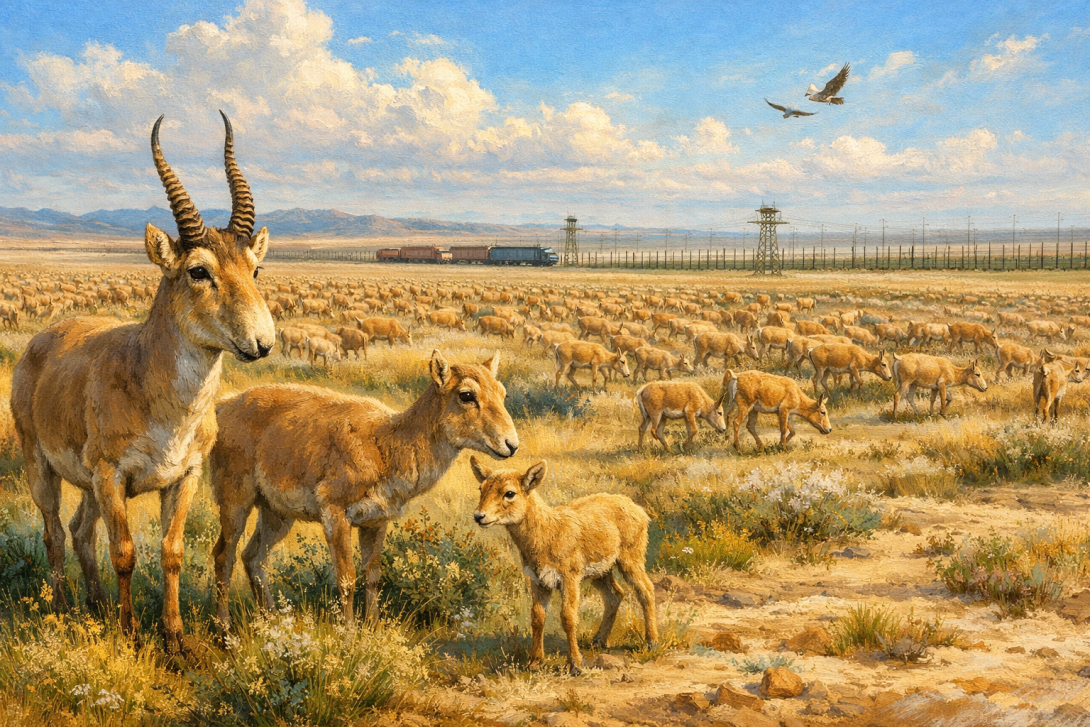
The second major threat Olson identified was the border fence between Kazakhstan and Uzbekistan, stretching approximately 615 km, built as part of the customs union with Russia and Belarus.
The fence cut off the Ustyurt saiga from critically important winter pastures in Uzbekistan. GPS tracks showed animals wandering along the fence looking for gaps, which "uses extra energy and may weaken the animal to a point where it cannot continue moving". Furthermore, when attempting to squeeze between the barbed wire, saiga left tufts of fur, exposing their skin to extreme cold.
Olson recommended removing the bottom two strands of the fence wire, creating a 60 cm gap between the ground and the first wire, which would be sufficient for free passage. He deemed the two 15 km gaps left by the authorities as insufficient "for a species that does not have predictable migration patterns".
The third threat was the construction of new settlements along the railways. In Kazakhstan, it was standard practice to build stations and housing for workers approximately every 75 km.
Olson warned that "with settlements come dogs and livestock. There will also be a temptation to hunt saiga". He insisted on limiting additional housing to existing settlements only.
Olson believed that if the planned measures were implemented, these additional threats could have devastating consequences; there was a high risk that the Ustyurt and Betpak-Dala populations would decline to ecologically insignificant sizes, increasing the risk of complete extinction.
WHAT HAPPENED
As is known, Kazakhstan ultimately built the railway corridors along the original routes, passing through critical habitat zones. And the border fence remained without significant modifications.
Today, the authorities of Kazakhstan claim that the total saiga population in the country has reached 3.9 million individuals. If this figure is taken at face value, it creates a fundamental contradiction with the logic of conservation science.
In 2012, the Ustyurt population numbered 6,500 individuals, and the Betpak-Dala population 110,000. The total number of the two populations was about 116,500 animals. According to official statistics, the population has since grown more than 33-fold.
Moreover, following official logic, this incredible growth occurred under conditions where the railway corridors were built directly through migration routes, contrary to expert recommendations, and the border fence cut off the Ustyurt saiga from critical winter pastures in Uzbekistan. Yet the authorities insist: the population not only survived but grew 33-fold.
Does it not seem strange that a species once classified by the IUCN as "on the brink of extinction" today shows unprecedented demographic explosion simultaneously with the implementation of all the factors that were supposed to lead to its extinction?
Biologically, such growth is only possible under ideal conditions: absence of predators, abundant food resources, minimal anthropogenic pressure, and free migration.
Well, either the scientific forecasts of Olson and international experts were fundamentally wrong, or the population counting methodology does not provide sufficient accuracy for such conclusions.
Without access to the biological justification, which should contain the counting methodology, the distribution ranges of populations, GPS monitoring data, and year-on-year dynamics, it is impossible to assess the reliability of the stated figures.
At the same time, the document on the basis of which the decision was made to destroy hundreds of thousands of animals has turned out to be closed to the public due to either "copyright issues" or a "for official use" classification — the ministry, it seems, has not yet decided.
But if the authorities are so confident in the saiga population increase to 3.9 million animals, why are they hiding the document that should be the triumphant proof of success of Kazakhstan's conservation policy?
Olson ended his report with a question: "Will Kazakhstan be able to develop its economy and preserve its wild natural heritage, or will their fate remain just a symbol engraved on its currency?"
It seems the answer to this question is becoming increasingly clear today.