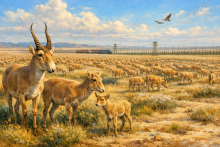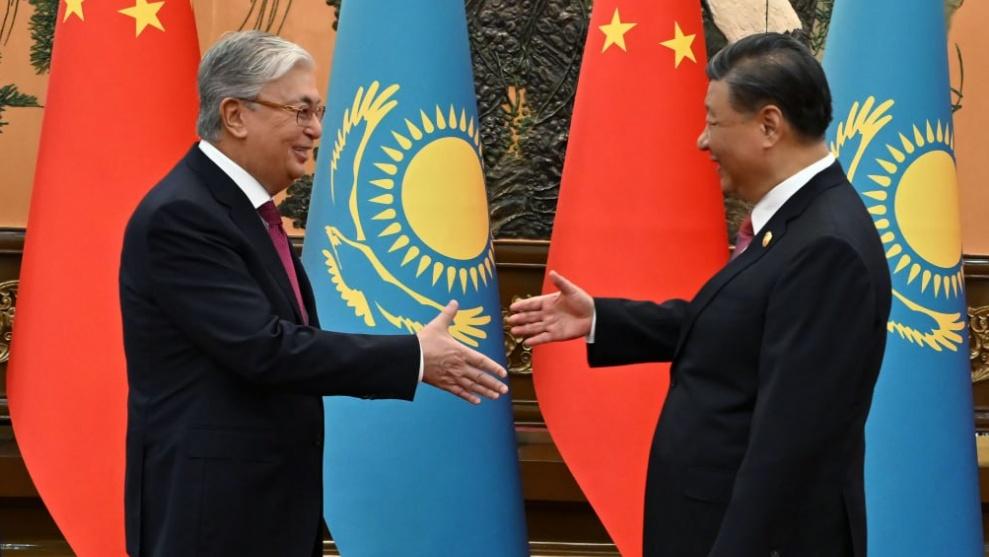
The President of Kazakhstan, Kassym-Jomart Tokayev, has decided to transfer 1,500 saiga antelopes to China for resettlement in the west of the country, with the aim of restoring the population. This was reported by the press service of Akorda.
The President of the People's Republic of China, Xi Jinping, expressed gratitude to the President of Kazakhstan for the initiative to preserve the rare species.
In recent years, Kazakh farmers have repeatedly stated the problem of crop destruction by saiga antelopes. In a number of regions, authorities have discussed the need to control the population size, as the herds allegedly cause serious damage to agricultural land.
According to the Ministry of Ecology, Kazakhstan is home to over 98% of the global saiga population. However, information on the exact number remains highly contradictory. Aerial surveys are conducted along predetermined routes in a narrow strip of the steppe, where saiga antelopes naturally concentrate into large herds during certain periods, such as calving season. These local data are then extrapolated across the entire habitat. The result is an impressive growth chart, which delights officials and alarms deputies.
As previously noted by FBRK founder Kirill Pavlov, the official statistics on saiga antelopes resemble arithmetic from a parallel universe. The figures released by the Ministry of Ecology look impressive but raise serious questions for anyone with even a basic understanding of population biology. According to official data, the saiga population grew from 1.3 million to 4.1 million individuals by the beginning of May 2025 — an increase of over 200%. Remarkable, isn’t it?
Incidentally, at the end of May this year, the Ministry of Ecology completed the development of a roadmap for regulating the saiga population and was preparing to submit proposals to the government on "transitioning to the sustainable use" of these animals.
Behind these vague formulations, it seems, lies yet another attempt by the agency to once again take up arms. And once again, under the guise of caring for nature, to orchestrate what, just a year ago, the FBRK editorial board rightly called barbaric, nearly uncontrolled slaughter of saiga antelopes.
Meanwhile, over the past few months, the agency has gone from making solemn declarations about abandoning inhumane methods to discussing the industrial processing of thousands of animals per day.
Not so long ago, in March 2025, the Minister of Ecology, Yerlan Nyssanbayev, spoke about possible methods of regulation, including corrals, nets and culling, adding the rhetorical question: what other way is there?
By May, Vice-Minister Nurken Sharbiyev was already discussing population regulation and the permissibility of culling up to 20% of the population. And in June, Minister Nyssanbayev discussed allowing hunting, recalling Soviet-era practices when the steppe was strewn with the bodies of saiga antelopes with their horns sawn off.
The mechanisms of implementation are also changing radically. In March, they promised humane management through corrals and corridors. But by June, the talk was of industrial processing: 13 meat processing plants were supposedly ready to receive 3,700 head per day, factories were to be located in seven regions, and the meat was promised for retail sale.
Will this recent international gesture influence a review of Kazakhstan's domestic policy on saiga population management?
It will be recalled that on 16 June 2025, the President of the PRC, Xi Jinping, arrived in Kazakhstan on an official visit. He was ceremonially welcomed at Astana airport by President Kassym-Jomart Tokayev. Following the talks, the two sides signed 24 intergovernmental and interdepartmental documents.