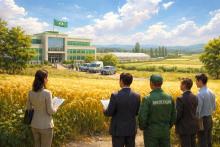
The FBRK editorial office has obtained a letter from the chief accountant of the A.I. Barayev Scientific Production Centre for Grain Farming (SPCGF), Gulnar Kabdina — a five-page document addressed to authorised state bodies. The author describes violations of financial discipline, pressure on staff, and what she herself calls a return to the "era of chaos" in one of the main agricultural scientific institutions of northern Kazakhstan.
WHAT HAPPENED
Gulnar Kabdina worked as chief accountant in the quasi-public sector for almost thirty years. She joined the SPCGF at the end of 2022 — at a time when, according to her, the accounting at the Centre was in a state of complete disarray following previous management. Together with her team, she painstakingly rebuilt the accounts: refining the 1C database, introducing separate accounting for programmes and funding sources. By 2025, according to her, the Centre had transparent financial reporting that any regulatory body could audit.
Everything changed with the arrival of a new director. Bauyrzhan Kalibayev took up the post of director of the SPCGF on 5 January 2026, following Timur Savin, appointed by NAO "National Agrarian Scientific and Educational Centre" (NASEC). From the very first days, writes Kabdina, he raised the issue of her dismissal. Unfounded reprimands, disciplinary committees, and pressure on accounting staff began — three of them have already submitted voluntary resignation letters.
On 29 April 2026, by order of Kalibayev, Gulnar Kabdina was transferred to the position of a rank-and-file accountant. However, she received the notification only after the decision was made, without prior consultation as required by the Labour Code. The vacated position was filled by an ordinary employee with no experience in senior financial work, who, according to available information, is a close relative of the Deputy Chairman of the Board for Science, Yuri Dolinny.
Furthermore, according to Kabdina, Kalibayev demanded that data on assets from the previous year's reports be included in the statistical returns, and proposed creating a fictitious electronic invoice (E-invoice) to do so. The accounting service refused. Additionally, Kalibayev has still not signed the asset handover certificate from the previous management, even though the Board of Directors instructed him to do so back in the minutes of 25 December 2025. However, he is already proceeding with the sale of the Centre's assets, and apparently with great enthusiasm.
A separate theme in the letter concerns the Kokshetau Experimental Production Farm (EPF), which the Centre took into trust management from NASEC in February 2026. According to Kabdina, the daughter of the head of LLP "Zerenda-Agro-2021" became the acting chairwoman of the EPF board. Meanwhile, the EPF has active joint activity agreements and a warehouse lease agreement with the same LLP. According to Kabdina, it was "Zerenda-Agro-2021" that sold the EPF's laboratory equipment and furniture, which de jure remained the property of the farm.
Kabdina also notes that the cost of producing one tonne of hay in the EPF's reports is recorded as 225 thousand tenge — a level comparable to the cost of grain crop seeds. These figures were approved by NASEC's economic service. Obviously, it is impossible to sell hay at that price: it will sit in stock, lose its marketable quality, and ultimately be written off as a loss.
WHAT CAME BEFORE
Let us recall that last year the FBRK editorial office already reported on the systemic crisis in Kazakh seed production. We reported that the Barayev Centre had lost more than half of its land designated for scientific purposes — the area had shrunk from 12,900 to 5,500 hectares. Even so, the Centre remained one of the few functioning pillars of the country's agricultural science.
To understand why, one only needs to look at what is happening to NASEC's lands overall. As FBRK founder and agricultural expert Kirill Pavlov wrote, the holding has about 140,000 hectares of arable land — the best plots, selected back in Soviet times for breeding and experiments. Over 30% of them are leased out under the guise of "joint activity".
For example, the Arkalyk Agricultural Experimental Station (AES) has thus given away all its 24,000 hectares; the legendary experimental station "Zarechnoye" itself cultivated fewer than 1,000 hectares of its 18,000; and the North Kazakhstan Scientific Research Institute (SevKazNII) leases out all its land at a fixed rate per hectare. In other words, the state demands applied results from science and allocates land specifically for that purpose, while science in turn leases this land and lives off the percentage.
President Kassym-Jomart Tokayev has repeatedly stated that agricultural science must work for the economy, not simply spend budgets for the sake of spending. And looking at the figures, it is hard to disagree. Institutes receive funding as research structures but function as management companies for other people's crop areas — a true structural absurdity.
No competitions are held for this "joint activity" — in other words, whoever they wanted, they brought in. And while most of NASEC's institutes have long become rentiers, the Barayev Centre remained one of the few that actually conducted scientific and production work on its own land. Now, however, judging by reports, one of the country's last operating agricultural institutes is rapidly heading the way of the others. But if this is how they treat what was working, what can be expected from what never worked at all?
From 2023 to the end of 2025, the Barayev Centre was headed by Timur Savin. Under him, scientific research funding increased by 2.1 times to reach 3 billion tenge, the material and technical base was modernised, and transparent accounting was established — as Gulnar Kabdina also attests. Crop yields over this period rose from 9 centners per hectare in 2023 to 21 centners in 2025.
Timur Savin left his position as Chairman of the Board at the end of 2025. According to unofficial information known to our editorial office, one possible reason for Savin's departure could be disagreements that arose with the deputy for production, who had previously worked at NASEC. Moreover, the professional experience of the NASEC appointee in production and scientific fields is reportedly viewed rather ambiguously. According to information from FBRK sources, the new deputy systematically sent complaints to various authorities, accusing the Centre of decline, although the figures pointed to exactly the opposite.
WHAT NEXT
The Barayev Centre is no ordinary institution. It is one of the key institutes for grain farming in Kazakhstan, which, it must be said, already suffers from an acute shortage of qualified personnel. But this story is not even about that; it shows how control over quasi-public institutions in Kazakhstan works and who really makes decisions within this vertical power structure.
Kirill Pavlov, analysing the presidential policy of pragmatism in science, wrote that the state no longer intends to fund a pretence of activity; budget injections must be converted into real results. The Barayev Centre was one of the few organisations where, judging by documents and the accounts of those involved, this was actually starting to happen. For a while. Now, everything that was built is being methodically dismantled.
Who benefits and why is a question that, presumably, should be directed to NAO "NASEC" and the Ministry of Agriculture. Or perhaps the answer is already obvious, because, as we know, science is easiest to manage when it is in debt and chaos.
Let us recall that recently the FBRK highlighted discrepancies in Kazakh seed production reports: according to data announced at the Ministry of Agriculture, NASEC reported the production of over 60,000 tonnes of top-category seeds in 2025, but this figure is based on the "gross harvest" indicator, whereas actual production is estimated at 37,500 tonnes, of which only 15,500 tonnes were in demand, calling into question the correctness of the accounting methodology and the transparency of the centre's data.