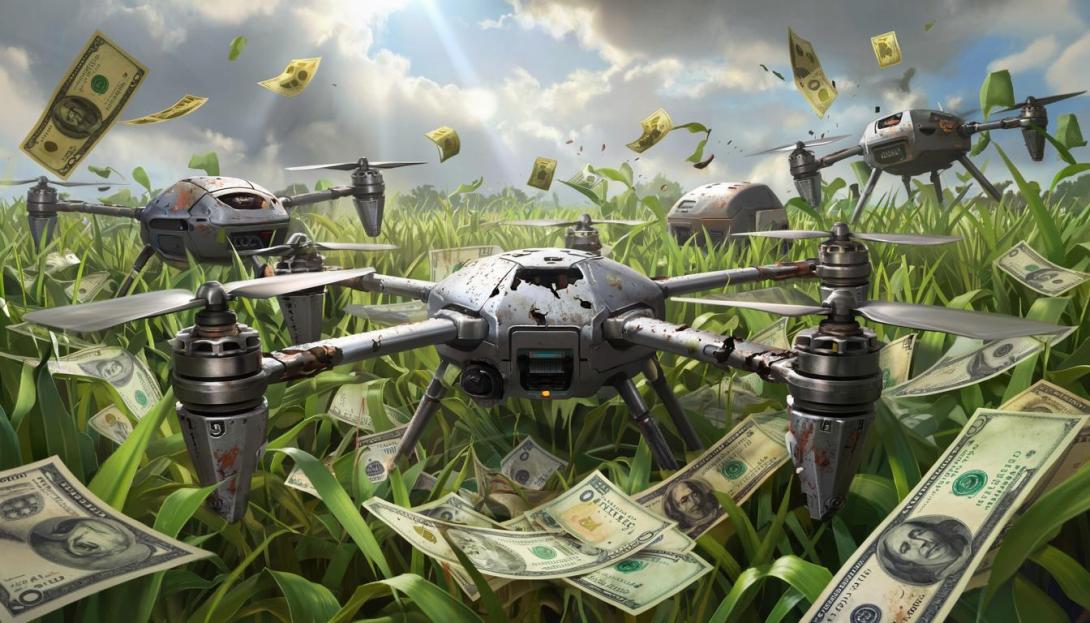
Of the 46 agricultural drones purchased by the Ministry of Agriculture (MoA) in 2024 for 8 million tenge each, 27 units are already "under warranty repair". At the same time, the department, apparently, cannot explain what exactly happened to them, how long they actually worked, and who will be held responsible. The editorial board of FBRK continues to investigate how the MoA's rhetoric can conflict with reality.
Not long ago, a video spread across the media showing people, presumably employees of the RSE "Phytosanitation", retrieving damaged unmanned aerial vehicles from shrubbery. The drones visually match those that the Ministry of Agriculture purchased in 2024 for 368 million tenge, at 8 million tenge per unit.
The editorial board of FBRK decided to find out the state of this expensive equipment: where the drones have gone and whether they are being used for their intended purpose. We sent an official request to the Ministry of Agriculture. However, the department's response raises far more questions than it provides answers.
The most notable part began with the question about breakdowns and damage to the equipment. The Ministry reports: "Currently, 27 drones have been transferred to the supplier for the purpose of carrying out maintenance and repairs under warranty obligations."
Of the 46 purchased drones, 27 are being repaired. This is 58.7% of the total. In other words, more than half of the equipment, purchased less than a year ago, is not working for some reason.
What happened to these drones? The Ministry uses the vague term "maintenance and repair". But let's be honest: maintenance is a scheduled procedure that does not require transferring more than half of the equipment fleet to the supplier at the same time. If it is a matter of "repair under warranty obligations", then, logically speaking, the drones either broke down or were damaged. There is simply no third option.
Moreover, the Ministry did not state exactly when the drones were sent for repair, nor what specific faults or damage were found, nor where these 27 units of equipment are physically located. There is no information about who was operating the drones when the problems occurred, whether an internal investigation was conducted, or whether reports on property damage were drawn up. A complete information vacuum, despite this being state property worth over 200 million tenge.
Things get more interesting. We requested data on the actual use of the drones — how many hours they flew and what area they treated. The Ministry replies: "As of 2025, the total treated area using these drones amounted to 52.483 thousand hectares."
As you can see, there is no information on the number of flight hours for the drones. Why? There are several possibilities: either the flight log, which according to point 22 of the order of the Ministry of Industry and Infrastructural Development (MIID) No. 706 all operators of unmanned systems must maintain, is simply not being kept, or the data is so unflattering that it is inconvenient to disclose. Or perhaps there is no data at all because systematic record-keeping simply does not exist.
And even those figures that should reflect the drones' efficiency raise serious doubts. So, 52.4 thousand hectares have been treated over the period "as of 2025". The phrasing itself raises questions: is this data for the entire period since receiving the drones, or only for 2025? The drones were purchased in 2024 — where is the statistics for last year? The Ministry does not clarify.
Let's generously assume this is data for the entire operational period, roughly one and a half years considering seasonality. Let's calculate. 52.4 thousand hectares divided by 46 drones — we get about 1,140 hectares per drone. For comparison, a modern agricultural drone can treat between 5,000 and 10,000 hectares per season, as per the technical specifications for locust control procurement. This suggests the Ministry of Agriculture's drones are being used at approximately 10-20% of their capacity.
But that's not all. If we consider that 27 drones are under repair, only 19 units are actually operational. Let's recalculate. 52.4 thousand hectares divided by 19 drones — about 2,758 hectares per drone. This is still 2-4 times less than normal productivity.
Now let's look at the economics. The cost of the equipment is 368 million tenge. 52.4 thousand hectares were treated. Dividing one by the other gives 7,021 tenge per hectare. And this is only the depreciation cost of the drones themselves, excluding costs for pesticides, operator salaries, and maintenance.
For comparison, according to official MoA data, the purchase price of chemical treatment services against locusts using unmanned systems in 2025 was 3,400 tenge per hectare: the contractor arrives with their own equipment, treats the field, and leaves. This means the Ministry spent on the depreciation of the purchased drones alone twice as much as the market price for the full cycle of the work.
Our editorial board also asked about pilot qualifications. According to MIID order No. 706, operating drones for aviation work requires a second level of clearance — a minimum of 100 hours of flight time and 50 hours of special training. We asked: how many pilots within the structures of the Ministry of Agriculture have such qualifications?
The Ministry replied that permits are issued to operating organisations, not individual pilots, and that RSE "Phytosanitation" holds a valid permit. However, this is not an answer to the question asked. An organisation holding a permit does not automatically mean that qualified specialists work there.
How many employees of RSE "Phytosanitation" have actually completed a training programme of at least 50 hours? How many of them have a flight time of at least 100 hours? Do they have practical piloting skills in various flight modes? The Ministry did not answer these questions.
When we asked for information on the identification features of the drones — colour, stickers, logos, inventory numbers that would distinguish them from commercial units, the Ministry directed us to the public procurement web portal, where we could "familiarise ourselves independently". The problem is that government procurement websites usually post the technical specifications from the contract, but not photographs of the actually delivered equipment with visible markings. It appears that establishing the ownership of a specific drone to a government purchase is practically impossible. Whether this is accidental or a deliberate hindrance to identification, let everyone decide for themselves.
So, let's try to summarise what we learned from the Ministry's response. Of the 46 drones worth 368 million tenge, 27 units are under repair — why, when, and where exactly is unknown. The actual utilisation of the equipment appears to be only a small percentage of its potential. Data on flight hours has not been provided — possibly because records are not being kept. Information on operator qualifications is absent. Economic efficiency is highly questionable. Personal responsibility has not been established.
One gets the strong impression that the Ministry's reasoning goes something like this: if awkward questions are answered with general phrases, references to open sources, and one set of figures is substituted for another, then journalists will eventually tire, the public will forget, and the problem will resolve itself.
This is called systemic irresponsibility. When huge budget funds are spent without proper control, without transparent reporting, without personal consequences for those making the decisions. When simple arithmetic calculations raise numerous legitimate questions, but no one sees the need to explain anything.
However, if you think the story about the drones is the Ministry of Agriculture's only problem, we must disappoint you. The editorial board of FBRK certainly has more to tell.
To be continued...