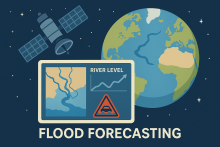
On 10 April at a press conference of the Central Communications Service (CCS), the moderator dismissed a question from the editorial team of FBRK regarding the effectiveness of the digital systems Tasqyn and Talsim-NG as "not relevant to the topic". Shortly after the conference, FBRK received a written response from the press service of the Ministry of Water Resources. We examine what it says — and what it does not.
WHAT HAPPENED ON 10 APRIL
At a press conference dedicated to the culture of water conservation, the speaker was the Vice-Minister of Water Resources and Irrigation, Talgat Momyshev. The FBRK editorial team asked about the concrete results of the Tasqyn and Talsim-NG systems: how much more accurate the forecasts had become, whether losses had been reduced, and whether an effectiveness assessment had been carried out.
However, the moderator stated that the question was not relevant to the topic of the press conference.
For context, our editorial team has previously explained in detail why this question is not only relevant to the event's theme but is also fundamental to understanding whether the state's digital water policy works in practice.
WHAT THE DEPARTMENT RESPONDED
The response received from the ministry's press service consists of two parts. The first concerns Tasqyn: the system was developed by JSC "NC "Kazakhstan Gharysh Sapary" for forecasting floods based on data from RSE "Kazhydromet".
The second concerns Talsim: a hydrological model that transmits river flow data to Tasqyn. The Talsim-NG software itself was transferred free of charge to NJSC "Information and Analytical Centre" with the support of the United Nations Development Programme (UNDP).
On the question of measurable results, the response proved extremely brief. The outcomes are intended to be summarised after the end of the flood season.
But here is the catch. These systems have been in use for more than a year (they were commissioned in February 2025). If no statistics on their accuracy have been accumulated during this period of operation — that in itself is a noteworthy fact. If the data exists, but there is no hurry to disclose it, a simple question arises: why?
The point about financing deserves particular attention. The response emphasises that the Tasqyn system was created "using its own funds" from JSC "NC "Kazakhstan Gharysh Sapary", without involving the budget. However, the company itself was established by a resolution of the Government of the Republic of Kazakhstan with 100% state participation in its authorised capital, and the sole shareholder is the Aerospace Committee of the Ministry of Digital Development, Innovation and Aerospace Industry of the Republic of Kazakhstan.
In other words, the company's "own funds" are the funds of an entity which is entirely state-owned. This leads to a logical question: at what point did taxpayers' money become considered corporate, "own" funds — and why should this exempt it from public accountability?
For context, last year the FBRK editorial team already wrote in detail about the Tasqyn system. As is the case today, in 2025, information about the project's budget, as well as data on the system's effectiveness, was not disclosed to us.
WHAT NEXT
Not a single official response received by the FBRK editorial team regarding these systems over two years has contained a single figure relating to practical effectiveness. The paradox is that projects like these should be maximally transparent: public money requires a public account. Instead, citizens are asked to wait until the end of the flood season — and, judging by last year's precedent, it is not certain that anything will change once it is over.
The FBRK editorial team has sent a follow-up request to the Ministry of Water Resources and Irrigation.