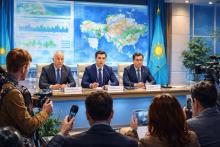
Commissioned by the President, the Tasqyn flood forecasting system, which was brought into operation a month ago, failed to live up to expectations in its very first flood season. Despite promises to provide all Kazakh citizens with access to the system and ensure early flood warnings, regions of Kazakhstan continue to suffer from flooding, and the cost of developing the system remains a secret.
According to statements from the Ministry of Water Resources and Irrigation, by early March the system was supposed to issue its first forecasts and become accessible to all Kazakh citizens. However, reality turned out to be different.
Instead of timely warnings about possible flooding, March brought a new wave of floods: flooding in Petropavl, the washing away of a temporary bridge in the Aktobe Region, and the flooding of a section of road in the Kostanay Region. It recently became known that in the Akmola Region, 17 sections of road have been flooded due to the high water, leading to the complete isolation of several villages from transport links.
The FBRK editorial team sent an official request to the Ministry of Digital Development, Innovation and Aerospace Industry (MDDIAI) to clarify the cost of the project and assess its effectiveness.
The ministry's response turned out to be evasive. The MDDIAI stated that the Tasqyn system was developed by JSC “NC “Kazakhstan Garysh Sapary” (KGS) “using its own funds” without involving contractors. However, the specific budget for the project was not disclosed.
The ministry only provided the technical specifications of the system: flood forecasting and modelling of potential flood zones with identification of settlements in the risk zone, integration with data from “Kazhydromet” and operation based on open-source software (React, NestJS, PostgreSQL and others).
Meanwhile, the wording about development “using its own funds” raises serious questions. Real project costs may be hidden behind this vague phrase. It is obvious that creating such a system requires significant human resources — salaries for programmers, analysts, testers and other specialists.
Given that KGS is a national company and is financed from the state budget, it can be assumed that the development was in fact carried out at the expense of taxpayers. According to the Ministry of Digitalisation, “further development” of the system is planned in 2025, but once again the budget is not being disclosed.
The lack of information on the effectiveness of Tasqyn's operation deserves particular attention. The department did not provide data on whether the system had worked even once, warning of a flood. When regions are going underwater, the silence surrounding the results of the system's work looks alarming.
Additional doubts are raised by the fact that the Tasqyn website has ceased to be publicly accessible and requires login credentials. As reported by “Kursiv”, the MDDIAI explained this as being due to security requirements and concerns from the Ministry of Emergency Situations. The system, promised to all citizens, is now only available for official use.
It is noteworthy that Tasqyn was created on the direct instruction of President Kassym-Jomart Tokayev. In April last year, 2024, he instructed the relevant departments to develop an information system for modelling emergency situations, including floods and fires, by the end of the year.
The lack of transparency regarding the funds spent on the project makes it impossible to assess the value for money. Furthermore, the MDDIAI's response also reveals a certain carelessness: outdated names of organisations are present, and specific information on a number of key issues is absent. This calls into question the competence of the department concerning the system under its supervision.
Thus, the national flood forecasting system has so far failed to meet expectations. Regions are suffering from the elements, transport routes are being disrupted, and the system, on which unknown sums of money have been spent, has become inaccessible to the citizens for whose safety it was created.