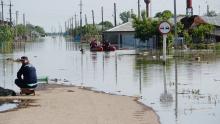
The Minister of Water Resources and Irrigation, Nurzhan Nurzhigitov, has declared the "effectiveness" of the Tasqyn flood forecasting system, yet the facts and statistics of the flooding contradict the official's bold claims. Despite supposedly significant state investments, hidden behind the phrase "own funds", the system only provides vague forecasts on the scale of entire regions, while residents of flooded areas continue to lose their property.
After many regions of Kazakhstan ended up under water, the Minister of Water Resources, Nurzhan Nurzhigitov, unexpectedly stated the "effectiveness" of the Tasqyn flood forecasting system. According to him, the system supposedly gave correct forecasts and warned of possible flooding, indicating risks in 1,200 populated localities.
"The Tasqyn system has shown its effectiveness. < ... > The forecasts that the Tasqyn system gave turned out to be correct", the minister self-assuredly declared, overlooking that declaring 1,200 populated localities as potentially flood-prone is tantamount to saying nothing specific at all.
Such a "forecast" can be compared to predicting that it will rain somewhere in the country. For a system, the development of which cost undisclosed sums from the state budget, this level of accuracy raises serious questions about the justification of the investment.
It is worth recalling that the Tasqyn system was launched in February 2025 with grand promises about its ability to provide accurate data on floods and model flood zones. The Ministry promised that the first forecasts would appear in early March, but, as practice has shown, even these vague predictions did not help prevent the numerous floodings that occurred in various regions of the country.
Reality contradicts the ministry's optimistic reports: in several regions at once (North Kazakhstan, Aktobe, Kostanay, Akmola regions), serious floodings continue, roads are washed away, populated localities are flooded, and transport links are disrupted. Entire villages have been cut off. And all this is happening against the backdrop of statements about the "effective" operation of the Tasqyn system, which supposedly gave accurate forecasts.
Meanwhile, Minister Nurzhigitov claims that thanks to the system's forecasts, "local executive bodies were able to carry out additional work, build embankment dams, and warn the population". However, the results of these "additional works" are hard to call impressive, given the scale of the floodings that occurred.
Of particular concern is also the fact that the Tasqyn system, initially promised as a publicly accessible resource for all citizens of Kazakhstan, now requires special login credentials for access. The question arises: how can the system effectively perform its main function — warning the population of danger — if ordinary citizens do not have access to it?
It is worth recalling that, according to official data, Tasqyn uses four sources of information, including satellite imagery and the global model GloFAS, but does not provide accurate forecasts.
Instead, the system limits itself to general warnings about threats by region, essentially repackaging free GloFAS data into a new interface. In other words, taxpayers have paid an unknown sum for the development of a "shell" for already existing free information.
The Minister mentioned that "the system has started working and will be improved", however, the question arises: is the price of this "improvement" not too high? When regions of the country are going under water and residents are losing their property, assurances that the forecasting system "has shown its effectiveness" sound like a mockery.
While officials report on successes, residents of flooded areas continue to suffer the consequences of the floods, and the system, created for their protection, proves no more accurate than folk superstitions. Kazakhstan needs transparent information about the real cost of the Tasqyn project and concrete results of its work, not vague reports about "effectiveness" and promises of future improvements.