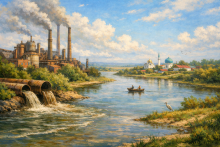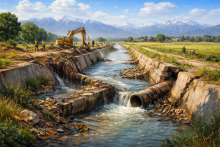
After completing our large-scale investigation into the state of the Astana (Vyacheslav) reservoir and the Ishim River — key water supply sources for the capital and surrounding regions — the FBRK editorial team continued monitoring the country's water resources. When we received signals from activists about a problematic situation on the Ural River, we decided to apply the same methodological approach that proved effective in previous investigations. Today, having completed months of work, we present a comprehensive analysis of what is happening to one of the most vital waterways of Western Kazakhstan.
Our investigation was built around four main areas: analysis of land use in the water protection zone, study of the activities of subsoil user companies, assessment of state control, and monitoring of the river's ecological state. Each area required different working methods — from analysing open databases to making official requests to government bodies.
The first phase of work revealed the scale of the river's commercialisation, which exceeded our initial expectations. Analysis of land use data showed that over 640,000 square metres of the Ural River's coastal territories have been leased long-term to private companies for sand and gravel extraction. These are not scattered plots, but an integrated system of industrial exploitation of the waterway, affecting both the riverbed and coastal zones.
Our editorial team studied the activities of the tenant companies in detail and discovered an interesting pattern: this is not simply about mining enterprises, but about complex business structures with extensive connections. For example, Estoral LLP turned out to be part of a family empire, including an international enterprise and covering the entire chain from extraction to export. Zhaiyk - Kurylys Kum LLP demonstrated close ties with government structures through its founders and managers, while Fleet LLP showed a typical picture of multiple debts despite continuing operations. Analysis of the companies' financial situation revealed a paradoxical situation: enterprises with serious tax arrears and enforcement proceedings continue to carry out large-scale extraction of natural resources. To give an idea of the scale of the problem, let us note that the total amount of various debts for just three main companies exceeds 30 million tenge.
The second phase, studying the system of state control, once again demonstrated a fundamental problem of Kazakhstan's environmental policy: fragmented responsibility. The Zhaiyk-Caspian Basin Inspectorate openly acknowledged the limitations of its powers, effectively stating it was unable to respond to public signals. The Ministry of Water Resources focused on the international agenda, emphasising the Russian origin of 70% of the river's flow. Meanwhile, the Ministry of Ecology provided detailed monitoring data. According to the agency, hydrochemical monitoring is carried out at 17 monitoring points in the West Kazakhstan and Atyrau regions using 43 parameters, including water temperature, suspended solids content, transparency, and concentrations of heavy metals and pesticides.
Analysis of the responses received revealed a key problem: each agency performs its own narrow functions, effectively bearing no responsibility for the comprehensive state of the water body. The Basin Inspectorate coordinates the plots, the Ministry of Ecology conducts monitoring, and the Ministry of Water Resources tracks hydrological indicators. But no one, it seems, is responsible for how these processes affect the river as a whole.
The third phase of the study focused on comparing state restoration programmes with actual economic activity. Here, the main contradiction of the entire situation emerged: the state simultaneously spends significant funds on restoring the river's ecosystem and issues long-term permits for its industrial exploitation. The Kazakhstan-Russia cooperation programme for 2021-2024 indeed showed impressive results: a fivefold increase in flow, elimination of over 2,000 illegal dumps, and restocking the water body with fish. However, these positive changes are occurring alongside the intensive extraction of sand and gravel directly from the riverbed. And although data from the Ministry of Ecology shows the river is classified as "moderately polluted" without acute toxicity, it is worth understanding that these indicators reflect the chemical state of the water, not the physical state of the riverbed and banks, which are precisely the ones subjected to direct mechanical impact.
Comparing all the obtained data led us to several fundamental conclusions. First, the situation with the Ural River demonstrates a systemic crisis of environmental governance in Kazakhstan. The absence of a single body responsible for the comprehensive state of water bodies creates a situation where the private interests of a small group of companies dominate over public ones. Second, the existing system of permits and controls does not account for the cumulative effect of industrial activity. The issuance of individual permits for the development of plots seemingly proceeds without an assessment of their combined impact on the river's ecosystem. Third, the international agenda is used as a means of avoiding responsibility for what is happening on the Kazakhstani part of the river. References to the Russian origin of most of the flow cannot justify inaction regarding industrial extraction on one's own territory. And finally, environmental restoration programmes simply lose their meaning without the simultaneous restriction of destructive economic activity. You cannot restore an ecosystem with one hand while issuing permits for its destruction with the other.
The most interesting thing is that the country officially spends millions on restoring the river and simultaneously sells it off piece by piece to private companies. This no longer looks like bureaucratic confusion, but rather a deliberate policy of double standards. When the Basin Inspectorate honestly admits its own powerlessness, and the Ministry of Ecology reports on successes in parallel with issuing permits for destruction — this is not just administrative inefficiency, but rather a capitulation of the state before private interests.
Currently, based on our request, the Department for Land Resource Management (DULR) is conducting an inspection of the identified violations. The FBRK editorial team will continue to monitor the fate of the Ural River, because this story is about what kind of country we are building for our children. About whether we are ready to sacrifice rivers for the profit of a few companies. About whether there is a force in Kazakhstan capable of telling business: some things are simply not for sale.
To be continued…