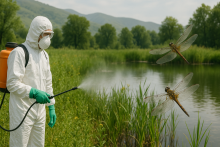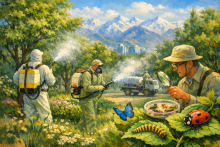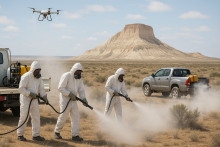
The FBK editorial team continues its series of articles on disinsection in the regions of Kazakhstan. This time, we analyse the situation in the Almaty Region, where the treatment of green spaces ranges from a complete refusal to a combined use of biological and chemical preparations.
According to the responses from akimats to the editorial team's inquiry, a significant number of districts do not carry out treatment of green spaces against insects due to a lack of funding. At the same time, disinsection is still carried out in some cities, but with varying levels of transparency.
IN MOST DISTRICTS, TREATMENT IS NOT CARRIED OUT
Several districts immediately reported the absence of disinsection. In the Balkhash District, work is "not carried out and not planned". The situation is similar in the Ili, Karassay, Kegen, Raimbek and Enbekshikazakh Districts, where the reason cited is a shortage of budgetary funds or a lack of funding.
In the Zhambyl District, it was specified that a funding request had been submitted, but no funds were allocated. As a result, neither the timeline for the work nor the list of preparations has been determined.
Some districts are essentially distancing themselves from responsibility. In the Talgar and Enbekshikazakh Districts, it was indicated that treatment falls under the competence of the RSE "Phytosanitary", while in the Uighur District, they stated that no requests for carrying out the work had been received.
CITIES ADOPT DIFFERENT APPROACHES
Against this backdrop, two cities stand out — Alatau and Konayev.
In Alatau, treatment is planned and will be carried out in stages from spring to autumn. However, the specific list of preparations has not been determined in advance; it is drawn up based on the results of procurement. It is only stated that products of hazard class III–IV will be used.
The authorities also declare safety measures and plan to involve the public in monitoring, but without specifying the actual preparations, it is impossible to assess the real risks.
In Konayev, the approach is more detailed. Here, the use of biological products has been announced — "Ak Kobelek" (based on Bacillus thuringiensis) and Green Gold (azadirachtin), and, if necessary, the chemical preparation "Diuron" (active ingredient — diflubenzuron) is applied.
BIOLOGY WITH AN ADDITION OF CHEMICALS
According to the provided materials, biological products are considered relatively safe. For example, azadirachtin primarily affects humans through direct skin contact, and products based on bacteria are used as a less toxic alternative to chemicals.
However, it has not been possible to completely abandon chemical substances. In Konayev, the use of diflubenzuron is permitted — a substance that, if regulations are violated, can cause headaches and difficulty breathing.
Furthermore, diflubenzuron poses an increased danger to freshwater invertebrates and can accumulate in the environment.
CONTEXT OF PREVIOUS YEARS
Previously, FBK had already noted that in the Almaty Region, a mixed approach was being used: while a priority for biological means was declared, the use of chemical insecticides, including diflubenzuron, continued.
Thus, the current situation demonstrates a continuation of the same trend, but with a new emphasis: whereas before the issue concerned the choice between biology and chemicals, now a significant part of the districts has completely abandoned treatment.
WHAT THIS MEANS
The situation in the Almaty Region in 2026 shows that a unified disinsection system at the regional level has effectively not been established.
In some districts, work is not carried out due to a lack of funding; in others, it depends on external structures or the receipt of requests, while actual treatment is concentrated in individual cities and implemented according to different models.
The key issue remains transparency: which preparations are used, by what criteria are they chosen, and how is their use controlled?
The region's experience shows that even with the availability of safer alternatives, unified approaches to disinsection and control mechanisms have still not been developed.
The FBK editorial team will continue to monitor the situation in other regions of Kazakhstan.