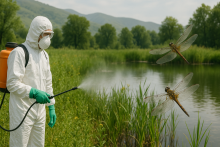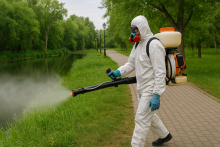
The FBRK editorial team continues its series of articles on disinsection in the regions of Kazakhstan. In Almaty, the season for treating green spaces has begun, using biological preparations against insects.
WHAT PREPARATIONS ARE USED
According to the Almaty Department of Ecology and Environment, from 7 April 2026 disinsection is being carried out in the city using the biological preparations "Bitoxybacillin" and "Actarofit". Their active basis consists of the bacteria Bacillus thuringiensis and avermectins of fungal origin.
"Bitoxybacillin" is a biological insecticide with intestinal action, used against caterpillar pests, the Colorado potato beetle and spider mites.
"Actarofit", in turn, is a bio-insectoacaricide with contact-intestinal action and is used against a wide range of pests, including aphids, mites, thrips and whitefly.
Such preparations affect insects biologically: the bacteria damage their intestines, leading to the death of the pests. According to specialists, such means are considered safe for humans, animals and the environment.
HOW THE TREATMENT IS CARRIED OUT
The treatment is carried out in four stages — from April to September — mainly at night. The department explains this is necessary to increase the effectiveness of the preparations and to take temperature restrictions into account.
At the same time, the department emphasises: the insects being combatted do not pose a direct threat to health, but create significant domestic discomfort.
WHY BIOLOGICAL PREPARATIONS ALONE MAY BE INSUFFICIENT
However, according to expert assessments, using exclusively biological means does not always allow the problem to be fully resolved.
For example, specialists note that preparations based on Bacillus thuringiensis are effective at the larval stage, affecting them in the aquatic environment. But they are significantly less effective against already developed, flying insects.
Furthermore, it is impossible to completely destroy the insect population:
- some larvae remain outside the treatment area;
- adult specimens can migrate from other territories;
- the ecosystem does not allow the complete disappearance of such species.
In connection with this, in practice, disinsectors often use a combined approach: biological preparations — for water bodies and larvae, and chemical means — as a so-called "barrier" against flying forms.
WHAT WAS REPORTED PREVIOUSLY
The FBRK editorial team has been monitoring the disinsection situation in Almaty for several years. In 2023 the ecology department stated that biological preparations were used and emphasised their relative safety for the population.
In 2024, the Almaty Disinfection Centre reported that preparations of hazard class 3–4 were used in the city to combat insects. It was separately clarified that biological preparations were not used due to their unavailability.
In 2025, a combined model was again stated: predominantly biological preparations with the possible use of chemical means of low hazard class.
CONTEXT AND SIGNIFICANCE
On the one hand, in 2026 the Almaty authorities state the use of biological preparations. On the other hand, expert practice shows that effective insect control, especially at the adult stage, typically requires the use of other methods, including chemical insecticides.
The ecology department does not clarify whether such methods are being used in Almaty this year, which may indicate incomplete disclosure of information. After all, city authorities have previously permitted the use of chemical means.
Let us also recall that in Shymkent in 2026, agricultural-grade chemical insecticides with neurotoxic effects are used. Biological methods are not provided for there at all.
The FBRK editorial team will continue its analysis of disinsection practices in other regions of Kazakhstan.