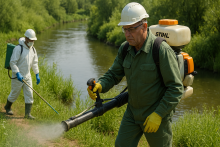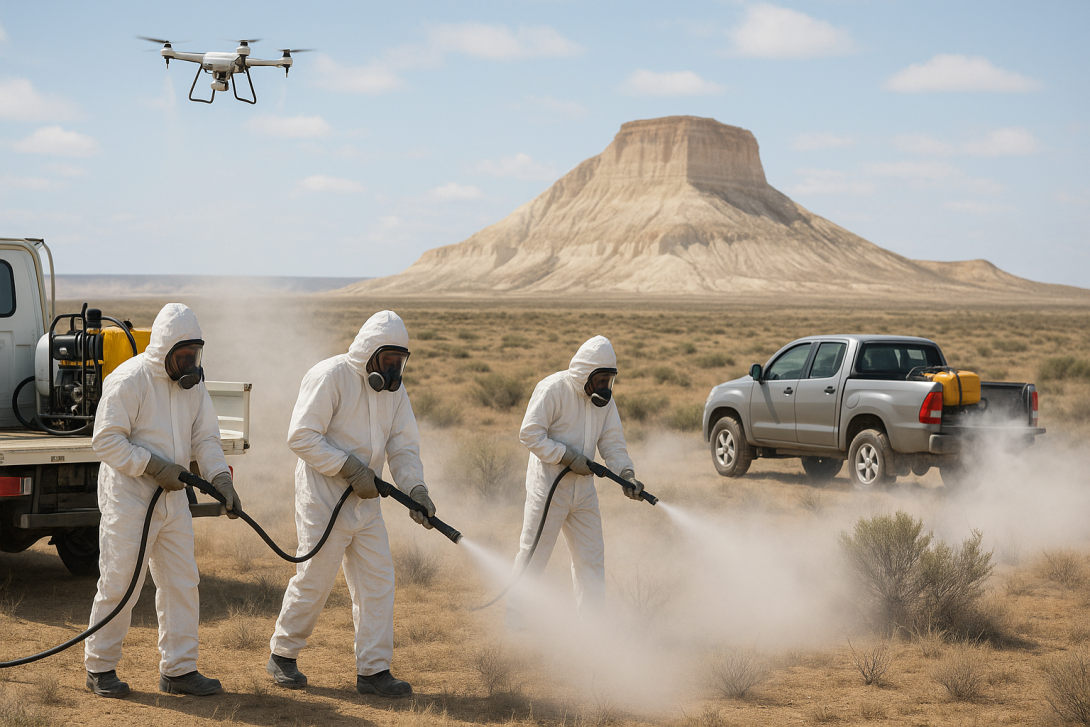
The editorial board of the FBRC continues its analysis of the preparations used for the disinsection of urban plantings in the regions of Kazakhstan in 2025. The study of the Mangystau region revealed radically different approaches by municipalities: from the use of highly toxic chemical compounds to a complete refusal to treat green spaces.
GEOGRAPHY OF USE: FROM CHEMICALS TO ABSTENTION
Analysis of official responses from eight local executive bodies of the Mangystau region revealed fundamentally different approaches to protecting green spaces from pests.
The active use of chemical preparations was recorded in the region's major cities:
- Aktau used ‘Decis Expert’ and ‘Karate Zeon’ from 15 April under a public-private partnership agreement with ‘Green City Aktau’ LLP
- Zhanaozen carried out night-time treatments from 7 May using the preparation ‘BI-58’ against ‘the quarantine object — seriphidium’
Complete abstention from chemical treatments in the current year was practised by four districts of the region:
- Mangystau, Tupkaragan, and Beyneu districts officially stated they had no plans for disinsection in 2025
- Munaily district plans to conclude contracts for disinfection in the future, but in 2025 limited itself to landscaping work
PREPARATIONS AND THEIR EFFECTS
The chemical compounds used in the region's major cities belong to different classes of insecticides and have various mechanisms of action.
- ‘Decis Expert’ and the problem of resistance
This preparation, based on deltamethrin from the group of pyrethroid insecticides, can, if safety precautions are not observed, cause allergic reactions and symptoms of acute poisoning: uncoordinated movements, shortness of breath, headache, and convulsions. The substance poses a particular danger to bees and fish.
A critical problem with deltamethrin is its loss of effectiveness: around 88% of bed bugs in the USA have genes that block its action, which calls into question the expediency of mass treatments.
- ‘Karate Zeon’ — a substance of hazard class two
This preparation contains lambda-cyhalothrin, which irritates mucous membranes, can negatively affect the cardiovascular system, and in critical cases leads to pulmonary oedema. The compound is lethal to pollinating insects and extremely dangerous for aquatic fauna.
- BI-58: an organophosphorus compound with multiple risks
This preparation, based on dimethoate, is classified as a possible human carcinogen. If application technology is violated, it can cause acute poisoning with loss of consciousness, convulsions, and paralysis. Repeated exposure can affect the nervous system and cause genetic mutations.
SYSTEMIC SHORTCOMINGS AND INFORMATION GAPS
Examination of the official responses reveals characteristic problems in the organisation of disinsection work in the region:
- Lack of uniform standards. Local executive bodies apply diametrically opposed approaches without coordination at the regional level. This creates unequal conditions for the protection of the population and green spaces.
- Ignoring biological methods. None of the akimats mention the use of or plans to introduce biological preparations safe for humans and beneficial insects. The choice is limited to the dilemma of ‘chemicals or nothing’.
- Limited public information. Notifications on social media three days before treatment contain no practical recommendations for protecting health, pets, or apiaries.
- Self-monitoring without independent expertise. Verification of compliance with technological processes is carried out by the contractors themselves, which does not guarantee objectivity of assessment.
- Incomplete technical documentation. Official responses lack data on solution concentrations, waiting periods, and specific precautionary measures for various categories of the population.
ECOLOGICAL CHARACTERISTICS OF THE REGION
The Mangystau region, with its arid climate and limited water resources, requires a special approach to chemical treatments. The use of substances toxic to aquatic fauna in conditions of fresh water scarcity could have long-term ecological consequences.
A significant proportion of the region's municipalities did not carry out disinsection treatments in 2025, citing the absence of ‘mass spread of harmful insects’. This could indicate either a favourable ecological situation in the steppe districts or a lack of funding for protective measures.
The contrast between the chemically active cities (Aktau, Zhanaozen) and the ‘zero’ districts creates a mosaic pattern of impact on the regional ecosystem, requiring comprehensive scientific analysis.
CONCLUSION
The situation with disinsection in the Mangystau region reflects the systemic problems of Kazakhstan's practice of protecting urban plantings: a lack of uniform standards, insufficient control over the use of chemical preparations, and incomplete public information.
When using potentially hazardous substances, strict compliance is critically important with all application regulations and the creation of a system of independent control. Until a full-fledged system of public monitoring of chemical treatments is established, residents of the region are advised to exercise increased caution during periods of disinsection work and to demand from local authorities the provision of complete information about the preparations being used.